








Most agencies compare three numbers: a freelancer’s hourly rate, a partner’s monthly quote, and a salary. Then they pick the smallest one.

That number is the cheapest part of the decision. The expensive part is the time your senior people spend finding, briefing, reviewing, covering, and replacing whoever does the work. None of it shows up on an invoice, but all of it comes out of your margin.
This guide prices all three routes the honest way, with current US data, a worked example, and a clear rule for when each one wins.
Key numbers at a glance
- US digital agencies averaged a 13% after-tax net margin in 2025 (Promethean Research).
- Upwork charges clients a 5% marketplace fee on its Basic plan, plus a per-contract initiation fee of $0.99 to $14.99 (Upwork pricing, 2026).
- Benefits make up 30% of private-industry compensation costs (BLS, June 2026).
- A nonexecutive hire costs about $1,200 to recruit and takes about 45 days to fill (SHRM, 2025).
- Replacing an employee can cost one-half to two times their annual salary (Gallup).
The Rate Is the Tip of the Iceberg: 6 Costs Hiding Underneath
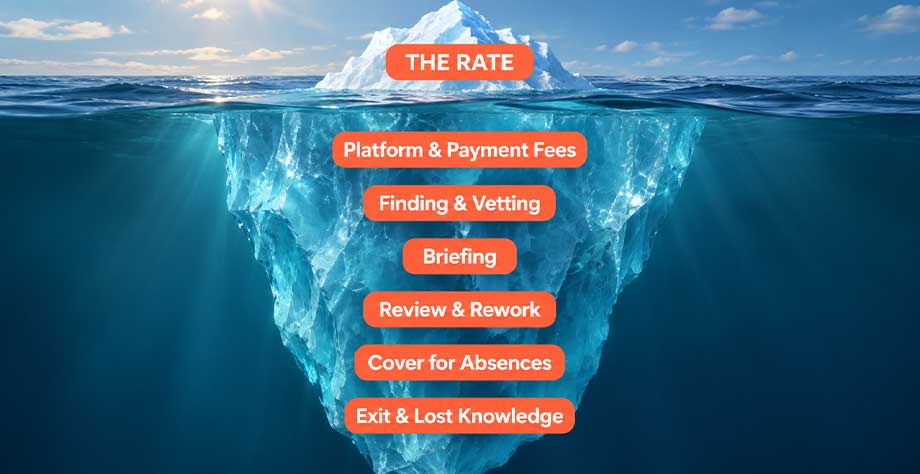
- Platform and payment fees. The visible layer, charged on top of every freelancer payment.
- Finding and vetting. Portfolio reviews, test tasks, and calls, repeated for every new person.
- Briefing. Every new face needs the client’s brand, tone, tools, and history.
- Review and rework. If nobody checks the work before it reaches you, your senior lead becomes the QA department.
- Cover. Sick days, vacations, and double-booked freelancers leave gaps someone must fill.
- Exit. When a person leaves, the account knowledge walks out with them.
Each of these lands on your most senior people, the same ones who sell, plan, and keep clients happy. An hour they spend chasing a file is an hour they are not billing or winning new work.
Side-by-Side: What Each Route Really Costs
| Cost line | Freelancer | Partner team | New hire |
| Rate | Hourly or fixed quote | Monthly or project quote | Salary plus ~30% benefits |
| Fees on top | Marketplace and payment fees | Usually none | Recruiting, job ads |
| Vetting | Your hours, per person | Your hours, once | Interviews, ~45 days to fill |
| Briefing | Per job | Per client, then retained | Heavy in the first months |
| Review | Your senior’s hours | Partner QA first, you approve | Your senior’s hours |
| Cover | Find someone new | Backup who knows the account | Team absorbs it |
| Exit | Knowledge leaves | Written handover, set notice | Turnover cost up to 2x salary |
A Worked Example: One 40-Hour Brief, Priced Honestly
Say a freelancer quotes $50 an hour for 40 hours of design work.
- Rate: $2,000
- Upwork Basic marketplace fee (5%): $100
- Your account lead spends 8 hours briefing, chasing, and reviewing, at an internal cost of $75 an hour: $600
True cost: $2,700, or $67.50 an hour. The real price runs 35% above the quote, before the initiation fee.
Now look at it from the margin side. If you bill that job at $4,000 and run the 35% average project margin Promethean reports, you expect $1,400 of profit. Those 8 untracked senior hours cut it by $600, or 43%. Run three freelancers on one account and the account lead becomes a full-time integrator.

What the Same Work Costs as a Salary
A $60,000 designer looks cheaper per hour on paper. But if benefits make up 30% of total compensation, the real annual cost is closer to $85,700, before recruiting, equipment, and software seats. Add about 45 days of vacancy and a ramp-up period where output trails pay. The math only works when that person stays busy on billable work all year.
Mini Template: Track the Hidden Hours
Copy this line into your project tracker for every brief:
Route | Quote | Fees | Vetting hrs | Briefing hrs | Review hrs | Rework hrs | Internal rate | True cost
Repeat the exercise for the second brief. Whichever route forces you to repeat the briefing and review hours is the one quietly draining your margin.
When Each Route Wins: A Simple Decision Framework

Choose a freelancer when:
- The task is small, one-off, and self-contained
- A trusted freelancer already knows your accounts
- The skill is rare and needed for two weeks, not two quarters
- You already review the work anyway, so the review cost barely moves
Choose a partner team when:
- Work arrives steadily but not enough to justify a full salary
- You need several skills (design, development, SEO) under one lead
- Clients expect coverage during holidays and sick days
- You want QA done before files reach your inbox
Choose a new hire when:
- A discipline has had more work than people for 12 months straight
- Your pipeline says that demand will continue
- The skill is the one you win pitches on, so it belongs in-house
A salaried person who stays costs less over time than renting the same capacity. Until a lane is full, a partner team bridges the gap without the 45-day hiring wait.
Your 90-Day Plan to Price It With Real Numbers
Days 1 to 30: Measure. Pick three recent briefs. Log every senior hour spent on vetting, briefing, review, and rework. Calculate your internal hourly cost for those people.
Days 31 to 60: Compare. Run one real brief through each route on paper using the table above. Add fees, senior hours, and cover risk to every quote.
Days 61 to 90: Commit. Move steady, multi-skill work to the route with the lowest true cost. Keep freelancers for small, rare-skill tasks. Open a job requisition only where demand has held for a year.
Frequently Asked Questions
Are freelancers cheaper than a white-label partner?
Often on the rate, not always on the total. Fees, briefing, review, and cover can add 30% or more to a freelancer’s quote.
What is the true cost of a freelancer for an agency?
The rate plus platform fees plus every senior hour spent finding, briefing, and reviewing. Price those hours at your internal cost.
How much does a new employee really cost beyond salary?
Benefits add about 30% of total compensation, plus recruiting, onboarding, equipment, and months of ramp-up time.
When should an agency hire instead of outsourcing?
When one discipline has been overbooked for about a year and the pipeline shows that demand will last.
What hidden costs come with Upwork freelancers?
A 5% client marketplace fee on Basic (10% on Business Plus), a contract initiation fee, plus your vetting and review time.
Can I start with one specialist instead of a full team?
Yes. One dedicated specialist at steady volume is a common first step. Add a lead and QA when several skills are needed.
How do I calculate my internal hourly cost?
Divide a person’s salary plus benefits by the hours they actually work in a year. Use that figure for every unbilled hour.
How do partner teams protect agency margins?
They bundle QA, project management, and backup cover into one price, so your seniors approve work instead of fixing it.
Price Your Next Brief With Xceed BD
Xceed BD builds white-label delivery teams for US agencies: dedicated specialists or full pods with QA, a delivery lead, and backup cover included in one monthly price. Bring one real brief, and we will help you compare all three routes with your own numbers.