








The math changed. The number of US high school graduates peaked in 2025 at roughly 3.9 million, then began a long slide that cuts the pool 13% by 2041, according to the Western Interstate Commission for Higher Education (WICHE). At least 16 nonprofit colleges closed their doors in 2025. If you run enrollment or marketing for a school, you already feel the squeeze.

Here is the part nobody puts on the doom slides: total US enrollment actually rose 1% in fall 2025, and community colleges grew 3%. This is not a collapse. It is a redistribution. Seats are moving away from schools that market like it is 2015 and toward schools that market to how students actually decide in 2026.
This guide is the playbook for landing on the winning side. Real numbers, real channels, and a 90-day plan you can start Monday.
The Cliff Is Real. It Is Also a Land Grab.
The demographic cliff traces back to the 2008 recession, when US birth rates dropped. Fewer babies then means fewer 18-year-olds now. WICHE projects about 576,000 fewer high school graduates per year by 2041, and the 18-year-old population is unlikely to top 4 million again this century.
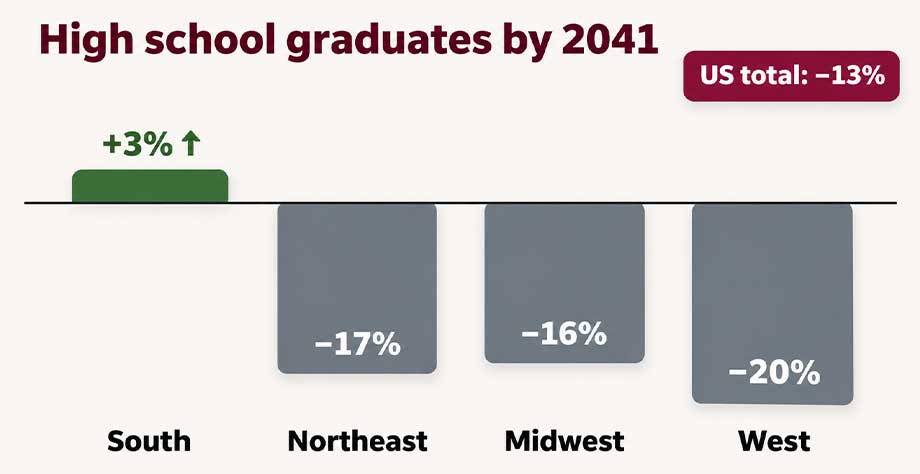
But the decline is lopsided, and that is your opening. The South is the only US region projected to grow (+3%). The West drops 20%, the Northeast 17%, and the Midwest 16%. Eight states lose more than a fifth of their graduates, led by Hawaii, Illinois, California, and New York.
Fall 2025 already showed the split. Undergraduate enrollment climbed 1.2% overall. Community colleges gained 3% and public four-year schools 1.4%, while private nonprofits slipped 1.6% and for-profits 2%. Same market, opposite outcomes. The difference was rarely program quality. It was which schools reached the right students, in the right place, before a competitor did.
The old escape hatch is closing too. Schools that leaned on international students to offset domestic decline hit a wall in fall 2025, when new international enrollments dropped 17%. NAFSA pegged the hit at roughly $1.1 billion in lost revenue. With the domestic pool and the international backstop both tightening at once, squeezing more enrollments out of the students you already reach matters more than it ever has.
Two audiences soften the blow if you court them. Adult learners already drive 42% of higher education revenue, and the addressable pool tops 242 million people. Gen Z is projected to make up 60% of adult learners by 2031. Ignore them and you fight over a shrinking teenage pool. Win them and you tap a market most of your rivals barely touch.
Market the Funnel, Not the Channel
Most enrollment “strategies” are a pile of tactics: post on TikTok, run some ads, send an email. That is how thin competitor content reads, and it is why it does not move the numbers. Buying more leads and pouring them into a leaky funnel is like carrying water in your bare hands.
Enrollment is a funnel with defined stages: awareness -> inquiry -> application -> admit -> deposit -> enrolled. Each stage has a conversion rate, and small gains compound. Here are the benchmarks enrollment teams measure against, drawn from NACAC, AACRAO, and enrollment-management research:
| Funnel stage | Typical conversion | What it reveals |
| Inquiry to application | 15% to 25% | Follow-up speed and application friction |
| Application to admission | 50% to 70% | Applicant quality and fit |
| Admission to enrollment (yield) | 20% to 40% | Competitiveness and affordability |
The national yield rate for four-year nonprofit colleges was about 30% in fall 2022, split 33% for private and 25% for public schools. It has fallen from 36% in 2016, which means admitted students are shopping harder than ever.
Now the math that should change where you spend. Say you generate 10,000 inquiries. At a 20% inquiry-to-application rate, a 60% admit rate, and 30% yield, you enroll 360 students. Lift only the inquiry-to-application step from 20% to 25%, and you enroll 450 students. That is 90 more from the same ad budget, purely by answering faster and simplifying a form. Buying 25% more leads would cost real money and deliver fewer net enrollments.
Find your weakest stage. Fix that first. This single discipline separates schools that grow from schools that just spend.
The Channel Mix That Actually Fills Seats
Channels are tools, and each one does a specific job in the funnel. Here is where the money goes in 2026 and what “good” looks like.
Paid Search: Catch Ready-to-Enroll Intent
When someone types “accelerated BSN near me” or “MBA no GMAT,” they are deep in the funnel. That is why education carries one of the highest costs per click of any industry, about $6.23 on Google Ads. Expensive, but it converts. Education’s paid-search conversion rate hit 11.38% in 2025, the largest year-over-year jump of any industry (+43.87%).
Two moves protect your budget. First, spend on non-brand program terms carefully, because those clicks rose about 31% year over year. Second, defend your brand terms, which got 3% cheaper and convert extremely well. Since more than 60% of education clicks come from phones, a slow or clunky mobile application form quietly wastes every dollar you spent upstream.
Skip the Display Network for lead generation. Education display ads limp along at roughly a 0.55% click rate and a $143 cost per acquisition, because Gen Z scrolled past banner ads their whole lives. This matters because budgets are tight: 80% of higher education marketing leaders name limited budget as their top constraint, and 69% saw flat or shrinking budgets this year. Every dollar has to work, which means putting it where intent already exists rather than where impressions are cheap.
Paid Social: Reach Students Before They Search
Meta still drives the most lead volume in higher education, converting around 10% on lead campaigns. Aim for a cost per lead under $28, then judge it on how many of those leads actually enroll, not on raw volume. Program-specific creative (“Finish your RN to BSN in 18 months”) beats generic “apply now” branding every time, because Meta rewards relevance.
Email: The Channel You Own
Every other channel rents you attention. Email is the one relationship you control, and education posts open rates around 35% to 38%, among the highest of any sector. Use it across the whole journey: an instant reply to a new inquiry, deadline nudges, admitted-student nurture, and melt prevention over the summer. One caution: more than half of students say they react negatively to messages that feel AI-generated. Personalize with real detail and skip the robotic tone. EAB found that hyper-personalized outreach lifted engagement by 29 points over generic sends.
Video and Social Discovery: Where the Search Actually Starts
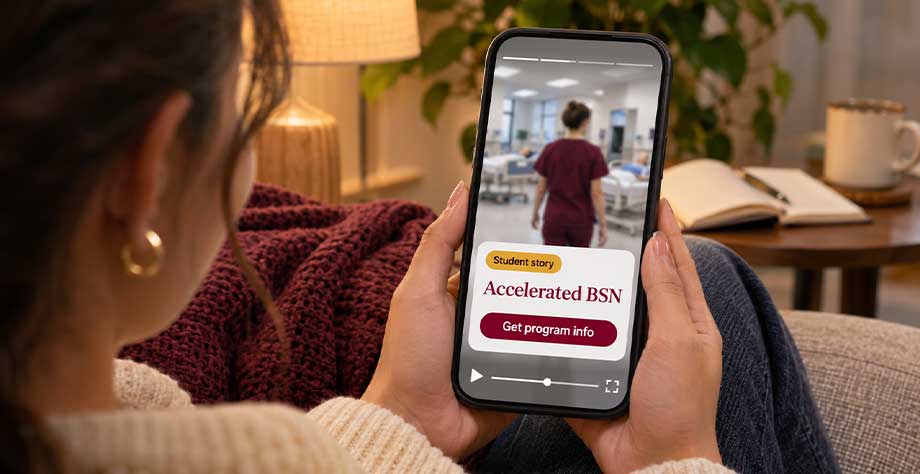
Prospective students search on TikTok, YouTube, and Reddit long before they visit your site. Google’s own data shows 40% of Gen Z uses TikTok or Instagram search instead of Google, college research included. They hunt for “day in the life at [school],” “is [major] worth it,” and “best college for [interest].” In social content, 65% want clear program summaries, 54% want career outcomes, and 50% want real student testimonials. Give them authentic student video, then optimize titles, captions, and descriptions like search assets, because that is exactly how they get used.
Your Website Is the Channel You Keep Underfunding
Here is a quiet mismatch that costs schools students every year. The institution’s own website is the number one information source for both undergraduate and graduate students during their search, yet it ranks only sixth among marketing leaders’ stated priorities. You are pouring money into ads that send traffic to a page that has not been touched in three years.
The payoff for fixing it is huge. The gap between median website conversion in higher education (about 3.8%) and top performers (about 11.5%) is enormous, which means most schools are leaving enrolled students on the table with slow pages and buried forms. Remember also that discovery and application often happen on different devices: students find you on a phone, then sit down at a laptop to apply. Both experiences have to be clean. A program page that loads fast, states outcomes in plain language, and puts a two-field inquiry form above the fold does more for enrollment than another ad campaign pointed at a broken page.
Get Cited in AI Answers (The 2026 Advantage)
This is the gap almost every competing article ignores, and it may matter more than anything else on this page. Students now shortlist schools inside AI tools before you even know they exist.
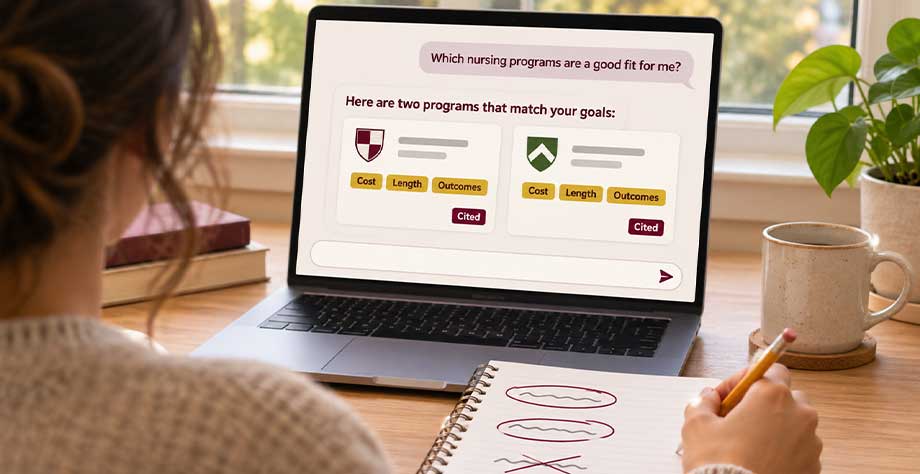
The shift happened fast. In spring 2025, 26% of high school students used AI in their college search. By late 2025 that reached 46%, per an EAB survey of more than 5,000 students. Among AI users, 62% use it to find good-fit schools and 48% use it to discover schools they had never heard of. The number that should worry you: 18% removed a college from their list based on what AI told them. Meanwhile, 79% read Google’s AI Overviews when they appear, and 56% trust an institution more when AI cites it.
Paid search cannot buy your way in here. The proof: Western Governors University holds an estimated 14% AI citation share for online-program prompts, while the University of Phoenix captures just 1.5% despite dominating paid search. Visibility in AI answers is earned through content, not bid.
How to earn it:
- Write clear, standalone program pages that state outcomes, cost, format, and length in plain sentences an AI can lift. Buried answers do not get cited.
- Keep public data accurate and consistent everywhere. AI amplifies outdated tuition or admissions details, and small errors become reputation problems.
- Lead with tangible outcomes: placement rates, salary data, time to completion. That is what students ask AI to compare.
- Audit your own visibility. Ask ChatGPT, Gemini, Perplexity, and Google AI Overviews the exact questions your prospects ask, then check whether you appear.
Do this and you enter the shortlist before the competition even shows up.
Speed Is the Cheapest Enrollment Lever You Have
You can fix this one this week, for free, and it moves yield more than most ad spend. Speed to first response.
Here is why it decides races: 72% of modern learners enroll at the first school that admits them. Not the best school. The first. On the front end, responding to an inquiry within 5 minutes dramatically raises the odds of conversion, yet the market median sits under 15 minutes, and only top performers actually hit that 5-minute mark. Students expect it, with 37% wanting an answer within a single day.
Families notice the difference. In Niche’s 2025 Parent Pulse survey, 66% of parents rated the speed of communication from the school they chose as high or very high, compared with just 37% for the schools they turned down. Speed is not a nicety; it is a signal of how the whole experience will feel.
The funnel is also getting harder to see. Nearly 10% of applicants now enter without ever submitting an inquiry first, a tenfold jump since 2020. These “stealth applicants” research you quietly through search, social, and AI, then show up ready to apply. You cannot nurture someone you never knew was interested, which is why being clear and findable everywhere upstream is now part of the speed equation.
Applications also leak for avoidable reasons. Brookings found that of 1.2 million college-ready students, roughly 300,000 never finished their applications, and more than half of students call the application the most stressful academic task of their lives. Cut the friction. One school that switched to auto-admitting on GPA and letting students “claim your place” with a short form lifted enrollment 176%.
Route hot inquiries to a human instantly, acknowledge every one automatically, and strip your application down to what you truly need. That is the whole trick.
Your First 90 Days
You cannot do everything at once, so sequence it. Here is a realistic rollout for a lean team.
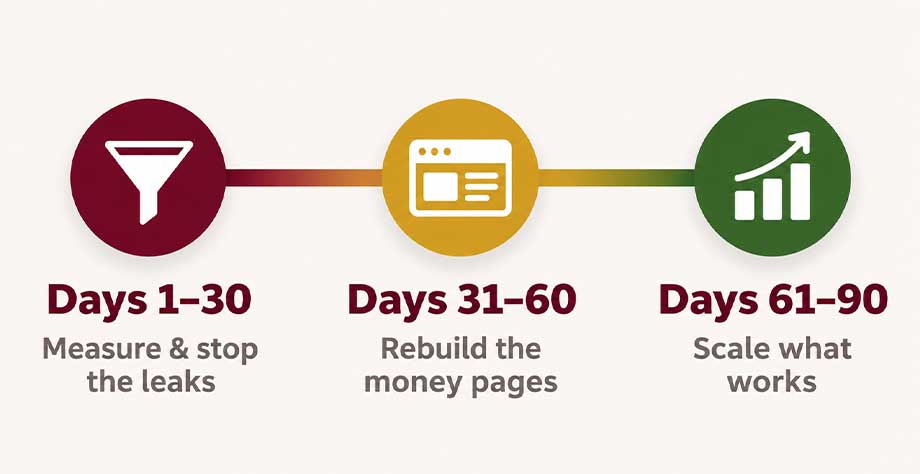
Days 1 to 30: Measure and stop the leaks.
- Map your funnel and find the weakest stage.
- Set a “respond within one hour” rule for inquiries, faster if you can.
- Audit your AI visibility across ChatGPT, Gemini, and Google AI Overviews.
- Fix broken or outdated information on your top program pages.
Days 31 to 60: Rebuild the money pages.
- Rewrite your top three program pages with clear outcomes, cost, and length.
- Launch or clean up brand-term Google Ads (cheap and high-converting).
- Simplify your application and inquiry forms, then test them on a phone.
- Start an email nurture sequence for new inquiries.
Days 61 to 90: Scale what works.
- Add non-brand paid search on your strongest programs.
- Launch program-specific Meta campaigns with a sub-$28 cost-per-lead target.
- Publish authentic student video for social discovery.
- Review cost per enrolled student by channel and shift budget to the winners.
Small, sequenced changes beat a giant relaunch. Ship one stage at a time so you can tell what actually worked.
Measure What Actually Matters
Most schools track the wrong things. Fewer than 60% of higher education marketers can even see how a lead performs after it leaves marketing, and 31% cannot tie their work to enrollment at all. That is a budgeting disaster.
Track two numbers religiously: cost per inquiry and cost per enrolled student. In online and continuing education, a qualified inquiry runs about $140 (roughly $128 for undergraduate and $157 for graduate programs), and enrolling one student costs around $2,849, closer to $3,800 for graduate programs. Once you know those figures by channel, budget decisions stop being guesses. You pour money into what enrolls students and cut what only generates clicks.
Keeping Students Is Cheaper Than Recruiting Them
The fastest way to grow net enrollment is to stop losing the students you already have. Every student who leaves is a seat you have to refill at that $2,849 acquisition cost, plus the tuition you forfeit for every remaining year they would have stayed. Retention is enrollment math wearing a different hat.
The leaks are real. First-year retention sits around 76.5% at public institutions and 82.1% at private ones, so one in five to one in four first-year students does not come back. The same digital tools that recruit students help keep them: onboarding email sequences, early-alert outreach when engagement drops, and content that answers the “am I in the right place” doubts that drive summer melt and first-year attrition. A school that lifts retention two points often gains more net students, at far lower cost, than a school that chases two points of new leads.
Fill Your Class Instead of Watching It Shrink
Winning enrollment in 2026 is not about shouting louder. It is about reaching the right students on the platforms and AI tools they actually use, then answering faster and with less friction than the school down the road.
That is exactly the kind of enrollment engine XCEEDBD builds for education clients: paid search, paid social, AI-search visibility, and the funnel plumbing that turns inquiries into enrolled students. Ready to grow your class? Talk with our team at xceedbd.com/contact.
Frequently Asked Questions
How does digital marketing increase student enrollment?
It reaches qualified students on the channels they already use (search, social, and AI tools), then converts them through a measured funnel. Instead of hoping flyers work, you track inquiry-to-application and yield rates, fix the weakest stage, and spend where students actually enroll. The result is more of the right students at a lower cost per enrollment.
Which digital marketing channel works best for student enrollment?
There is no single winner, because each channel does a different job. Paid search catches ready-to-enroll intent and converts at about 11%. Meta builds awareness and volume. Email nurtures the relationship you own. Social video and AI search shape the shortlist before a student ever visits your site. The right mix depends on your programs and audience.
How much does it cost to enroll one student through digital marketing?
In online and continuing education, enrolling a single student costs about $2,849 on average, and roughly $3,800 for graduate programs. A qualified inquiry runs around $140. Costs vary by program, competition, and how efficient your funnel is, which is why tracking cost per enrolled student by channel matters so much.
What is Answer Engine Optimization, and why does it matter for schools?
Answer Engine Optimization (AEO), also called Generative Engine Optimization, means making your content clear and accurate enough that AI tools cite you in their answers. It matters because 46% of high school students now use AI in their college search, and 18% have dropped a school based on AI results. If you are not in the answer, you are off the list before anyone applies.
How do I market to prospective students on a small budget?
Start with the free and cheap levers. Respond to inquiries within minutes, simplify your application, and fix your program pages so AI tools and search engines can read them. Then add brand-term Google Ads, which are inexpensive and convert well, plus email nurture, which costs almost nothing. These beat expensive broad campaigns for a lean team.
How fast should we respond to a student inquiry?
As fast as possible, ideally within 5 minutes. Research shows that speed dramatically raises conversion, and 72% of students enroll at the first school that admits them. At minimum, acknowledge every inquiry automatically and route hot leads to a person within the hour. Speed is the cheapest enrollment lever you have.
Does social media really drive enrollment, or just likes?
It drives enrollment when you treat it as a discovery engine, not a bulletin board. About 40% of Gen Z searches on TikTok or Instagram, including for colleges. Students want program summaries, career outcomes, and real testimonials. Authentic student video that answers “is this major worth it” moves prospects toward a branded search and an application.
How do we increase enrollment during the demographic cliff?
Court audiences your rivals ignore and market to the funnel. Adult learners already make up 42% of higher education revenue and are a growing pool of 242 million people. Improve conversion at your weakest funnel stage rather than just buying more leads, and get cited in AI answers. The schools growing through the cliff are taking share, not waiting for the pool to refill.