


In the current digital landscape, speed is currency. For businesses trying to scale, the strain of continuously managing internal frontend development can become a bottleneck that lowers efficiency and impedes expansion. It is challenging enough to stay current with emerging web technologies, let alone build distinctively beautiful, high-performance websites from scratch.
This leads many CTOs and founders to a critical question: Should you outsource frontend development?
The short answer is often yes—but only if executed with the right strategy. Outsourcing allows you to focus on your core business while external experts handle the complexities of the user interface. It is a lever for cost savings, scalability, and accessing global talent.
In this guide, we break down the market data, benefits, drawbacks, and engagement models to help you decide if outsourcing is the right move for your organization.
The State of IT Outsourcing: What the Data Says
Before diving into the “how,” it is vital to look at the “why” through the lens of market data. The shift toward outsourcing isn’t just a trend; it is a fundamental change in how global business operates.
According to data from Statista, the trajectory of the market is clear:
- Massive Revenue Growth: The IT outsourcing market is anticipated to generate $512.50 billion in revenue by 2024.
- Continued Expansion: Revenue is projected to expand at a 10.99% annual rate (CAGR 2024-2028), reaching a market volume of $777.70 billion by 2028.
- Investment per Employee: In the IT outsourcing sector, the average spend per employee is expected to reach $146.10 in 2024.
- US Market Dominance: When compared globally, the United States will produce the most revenue, estimated at $185.50 billion in 2024.
These numbers indicate that your competitors are likely already leveraging external talent to optimize their budgets and output.
What Exactly is Frontend Development?
If backend development is the engine under the hood, frontend development is the body, the dashboard, and the steering wheel. It is the main emphasis of the user experience (UX).
Frontend development concentrates on the “client-side” of applications—everything the user sees and interacts with. This includes:
- Visual Elements: Text colors, styles, graphics, graphs, tables, and general color schemes.
- Interactive Components: Custom interactive maps, pop-up forms, sliders, and buttons.
- Navigation: Menus and structures that facilitate user interaction and help users navigate the website or application.
These components are essential to improving the application’s aesthetic appeal and usability. Without a robust frontend, even the most powerful backend logic will fail to engage users.
8 Key Benefits of Outsourcing Frontend Development
Businesses looking to maximize resources and improve their online presence increasingly choose to outsource. Here is a closer look at the strategic advantages.
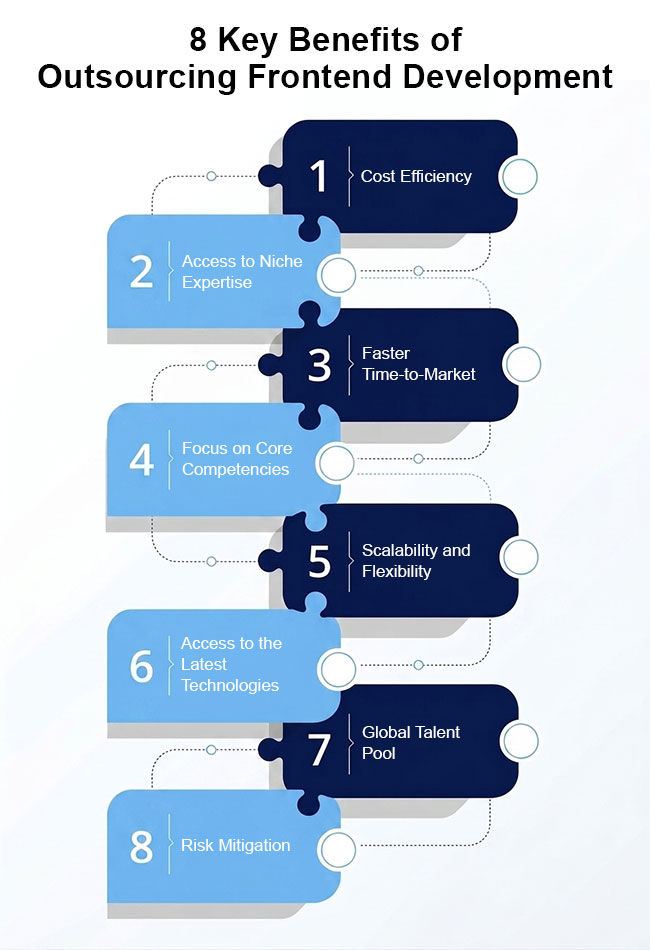
1. Cost Efficiency
Cost-effectiveness is the most immediate benefit. By tapping into a global talent pool, employers can hire talented developers from regions with relatively lower labor costs without sacrificing quality.
- Operational Savings: You save significantly on salaries, benefits, and office space.
- Infrastructure: Outsourcing saves money on hardware and technology purchases, as the external team typically supplies their own resources.
2. Access to Niche Expertise
Outsourcing frontend app development gives you immediate access to experts with specialized skills. External agencies and freelancers are often up to date on the newest technologies, trends, and best practices.
- This allows you to implement creative, high-caliber solutions that might be difficult to produce with a generalist internal team.
- You gain access to professionals who have accomplished comparable tasks for other clients, guaranteeing a degree of expertise that enhances your project’s success.
3. Faster Time-to-Market
Speed is critical. Outsourcing frontend development greatly shortens the time-to-market for companies looking to launch websites or applications quickly.
- Immediate Start: Expert firms have teams ready to deploy, eliminating the months-long process of recruiting and onboarding.
- Parallel Workflows: Outsourcing allows for parallel workflows. While your internal team handles core business logic, the external team can simultaneously handle UI/UX design and coding.
4. Focus on Core Competencies
Managing a development team is time-consuming. By connecting with an outsourcing partner, businesses free themselves from the complexities of overseeing daily coding tasks.
- Internal resources can be redirected toward high-value projects like marketing, CRM strategies, and new product development.
- This streamlining ensures that your in-house leadership focuses on business growth rather than technical debugging.
5. Scalability and Flexibility
Outsourcing offers unparalleled scalability.
- Scale Up: Need to push a major update? Add three developers for three months.
- Scale Down: Project finished? Reduce the team size instantly without the legal and emotional complexities of layoffs.
- This is especially helpful when dealing with projects that vary in complexity or when workloads fluctuate seasonally.
6. Access to the Latest Technologies
Maintaining a modern tech stack is essential for competitiveness. Outsourcing partners are incentivized to master the latest tools. By working with them, you gain access to:
- JavaScript Frameworks: Dynamic interfaces using React, Angular, or Vue.js.
- Responsive Tools: Tailwind CSS or Bootstrap for mobile-friendly designs.
- Progressive Web Apps (PWAs): Technologies that boost offline functionality and performance.
- Cross-Browser Testing: Tools like BrowserStack to ensure consistency across Chrome, Safari, and Firefox.
- Single-Page Architectures (SPAs): Creating fluid experiences without page reloads.
- GraphQL Integration: Increasing the flexibility and efficiency of data queries.
7. Global Talent Pool
You are no longer limited to the developers living within 20 miles of your office. Outsourcing opens the door to a vast global workforce.
- This range of viewpoints and skill sets supports original thinking and imaginative problem-solving.
- You can acquire specialized or rare expertise that may not exist in your local region.
8. Risk Mitigation
Working with a reliable outsourcing partner allows you to distribute effort and responsibility.
- Decentralization: Risks brought on by resource shortages or sudden staff turnover are lessened because the agency manages personnel stability.
- Accountability: Contracts with clear deliverables and deadlines provide a level of legal predictability and accountability.
Drawbacks of Outsourcing (and How to Solve Them)
While the benefits are compelling, outsourcing is not without challenges. However, most of these can be mitigated with the right approach.
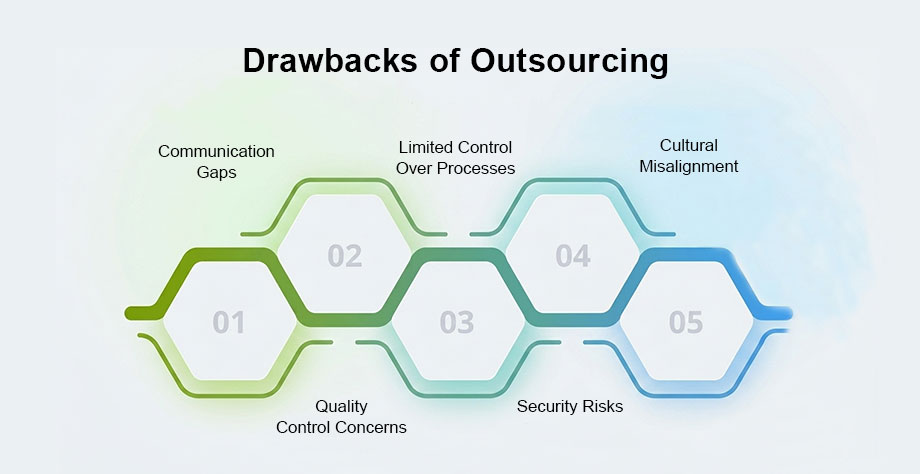
Challenge 1: Communication Gaps
Communication problems can arise due to cultural, regional, and time zone differences. Language limitations may also result in misunderstandings regarding requirements.
- The Solution: Conduct frequent video meetings and use collaboration technologies (like Slack, Jira, or Zoom) to guarantee real-time alignment. Establish clear communication standards and overlap hours where both teams are online simultaneously.
Challenge 2: Quality Control Concerns
Maintaining uniform quality standards across geographically distributed teams can be difficult. Variations in coding standards and a lack of direct supervision can lead to inconsistent results.
- The Solution: Implement a thorough testing and review procedure with frequent checkpoints. Set up explicit quality assurance (QA) procedures and insist on regular code reviews. Define your coding standards in the contract.
Challenge 3: Limited Control Over Processes
Clients may feel they have less control over daily operations due to the external team’s independence. Inaction or lack of visibility can lead to anxiety and mismatched expectations.
- The Solution: Define project milestones and goals clearly from Day 1. Encourage open communication and frequent updates. Balancing control and delegation is essential—trust your partner, but verify through reporting.
Challenge 4: Security Risks
Exchanging confidential and sensitive data with third parties carries inherent risks, including data breaches or unauthorized access.
- The Solution: Choose a partner with strong security protocols who conforms to industry norms (like GDPR or ISO standards). Sign strict Non-Disclosure Agreements (NDAs) and use secure communication channels for data transfer.
Challenge 5: Cultural Misalignment
Differences in business culture can lead to misunderstandings regarding brand voice or target audience nuances.
- The Solution: Align project goals early. Promote cultural awareness and provide thorough project briefs that explain not just what you are building, but who you are building it for.
Top Corporation Models for Frontend Outsourcing
Not all outsourcing relationships look the same. Depending on your needs, you can choose from three prominent engagement models.
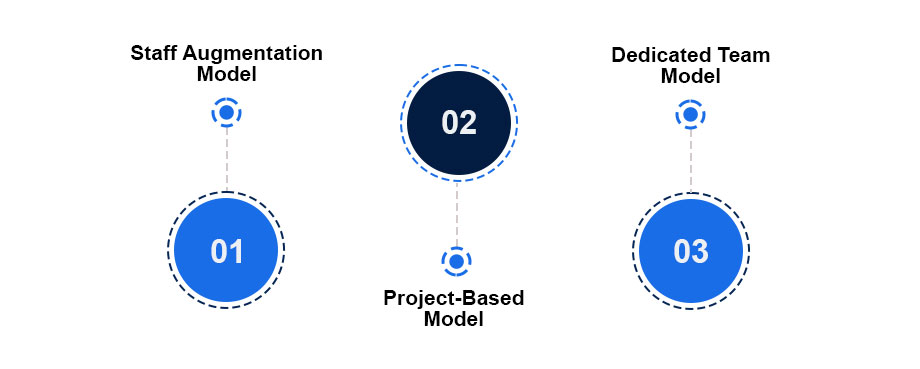
1. Staff Augmentation Model
Best for: Filling specific skill gaps in an existing team.
- This involves seamlessly integrating external professionals into your in-house team.
- You maintain full management control.
- The external specialists work alongside your internal team, often provided by specialized agencies.
- It is flexible and cost-effective for short-term needs.
2. Project-Based Model
Best for: One-time projects with clear requirements.
- Characterized by its flexibility and clear scope definition.
- You hire a team to complete a specific project with defined deliverables, deadlines, and objectives.
- Businesses can manage finances effectively as the cost is usually fixed based on the scope.
- Great for companies that want to access expertise without a long-term commitment.
3. Dedicated Team Model
Best for: Long-term development and evolving projects.
- The outsourcing partner provides a group of skilled developers, designers, and QA experts who work only for you.
- This team functions as an extension of your internal resources.
- You retain control over project management and task prioritization, fostering a sense of ownership and alignment with your long-term business objectives.
How XCEEDBD Helps You Outsource Successfully
If you are ready to take the next step, XCEEDBD is your trusted partner for frontend development outsourcing.
We understand that every business is unique. That is why we offer comprehensive solutions tailored to your specific requirements.
- Skilled Talent: Our team consists of experienced developers proficient in the latest frontend technologies (React, Angular, Vue, and more).
- Quality Commitment: We are known for our adherence to timelines, strict quality control, and transparent communication.
- Collaborative Approach: We don’t just write code; we work with you to ensure the final product aligns with your business vision.
Connect with us to tap into a premier talent pool and achieve a seamless, successful development experience.
The Bottom Line
The decision to outsource frontend development largely depends on your specific business needs, goals, resources, and the complexity of your project.
Outsourcing provides undeniable advantages in cost-effectiveness, expertise, speed, and technology access. However, success requires a careful choice of partner to mitigate risks like communication barriers and quality control.
By balancing these factors and choosing a trusted frontend development company like XCEEDBD, you can turn development from a bottleneck into a competitive advantage.
Frequently Asked Questions (FAQ)
Q1: How much does outsourcing frontend development cost? The cost varies based on the region of the developers, the complexity of the project, and the engagement model (hourly vs. fixed price). However, outsourcing generally reduces costs by 30-50% compared to hiring in-house US-based staff.
Q2: Will I lose control over my project if I outsource? No. With models like Staff Augmentation or Dedicated Teams, you retain full control over project management. Even in Project-Based models, clear milestones and regular reporting ensure you remain in the driver’s seat.
Q3: How do you handle time zone differences? We establish overlapping working hours for real-time collaboration (meetings, stand-ups) and use the time difference to your advantage—creating a “follow-the-sun” model where development continues even while your local team sleeps.
Q4: What frontend technologies should I look for? Look for expertise in modern JavaScript frameworks like React, Angular, and Vue.js, as well as proficiency in responsive design tools like Bootstrap or Tailwind CSS.
Q5: How do I ensure my intellectual property (IP) is safe? Always sign a Non-Disclosure Agreement (NDA) before sharing sensitive information. Ensure your outsourcing partner has strict data security protocols and that the contract explicitly states that all code written belongs to your company.
Ready to scale your development team?
[Contact XCEEDBD Today for a Free Consultation] Stop searching for talent and start building your product.