
Imagine for a moment that you have built an absolutely incredible website. You have poured your heart, soul, and significant financial resources into developing a product or service that you know the market needs. You launch the site, expecting a flood of eager customers, but when you look at your analytics dashboard, the reality sets in: the traffic simply isn’t there. You are invisible.
This is a recurring nightmare for countless small and medium-sized business owners across the globe. The statistics paint a harsh reality of the current digital landscape. Did you know that 91% of Google searchers never click past the first page of search results?. That means if you are ranking on page two, you are essentially non-existent to the vast majority of your potential audience. Even more alarming is the user behavior on that first page: more than 50% of users don’t even scroll past the top three results.
Why is this happening?. It is not necessarily because your product is inferior. It is because online presence has become the single most critical parameter for success, and the competition is fiercer than ever before. You are competing against millions of other businesses, all fighting for those same precious pixels at the top of the screen. If potential clients cannot locate your website, your investment is wasted.
The traditional solution to this problem has always been “content marketing.” You hire a writer, they research a topic, and they write a blog post. Then they write another. And another. But what if your customers are searching for thousands of different variations of a term? What if you run a travel site and users are searching for “Flights to Paris,” “Flights to London,” “Flights to Tokyo,” and 500 other cities? You cannot manually write 5,000 individual articles. It is impossible to scale that workflow efficiently.
This is where Programmatic SEO comes in.
Programmatic SEO is the methodology that automates and optimizes the search engine exposure of your website on a massive scale. It allows you to stand out in a crowded online marketplace not by working harder, but by working smarter. In this comprehensive guide, we are going to discuss the concept of Programmatic SEO in immense detail. We will explore its importance for driving business growth, how it differs from traditional methods, and exactly how you can implement it to revolutionize your digital marketing efforts.
What Is Programmatic SEO?
In the fast-paced online business world, getting noticed can be tough. That’s where Programmatic SEO comes in. But what exactly is it?.
Think about having a smart helper that does all the heavy lifting to improve your website’s visibility on search engines. That is effectively what Programmatic SEO does.
The Core Definition
Programmatic SEO is a method that employs automated tools, code, and algorithms to analyze data and determine how to optimize your website for search engines at scale. It is like having a digital assistant who understands your website’s requirements to rank higher in search results and executes the strategy across thousands of pages simultaneously.
Unlike traditional SEO, where a human writer crafts a narrative for a single URL, Programmatic SEO (pSEO) involves creating a database of information and using a “template” to generate thousands of unique landing pages programmatically.
Programmatic SEO eliminates the guesswork in search engine optimization. Instead of depending on manual processes and intuition, your SEO campaign is guided by strict, data-driven insights. By using smart technology and analytics, firms can remain ahead of the competition and reach more prospective clients online than ever before.
Why Is It Vital Now?
Why is programmatic SEO vital for your business right now?. The market is exploding. According to Research And Markets, the global SEO market is expected to reach a staggering $129.6 billion by 2030. That means the stakes are higher than ever. If your website isn’t ranking well, you could miss out on potential customers and valuable traffic that your competitors are happily absorbing.
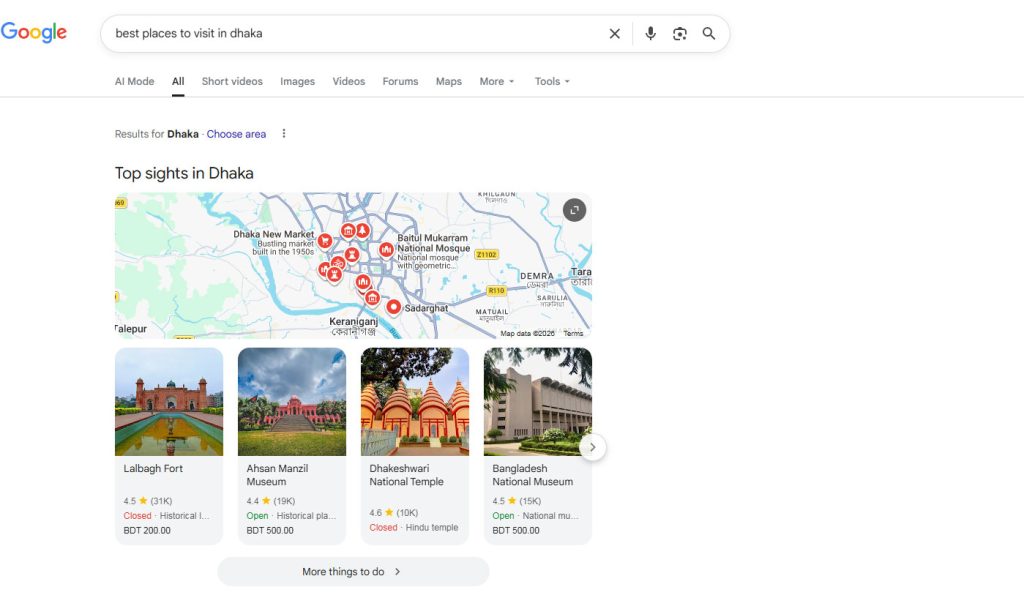
Consider a real-world example: if someone searches “best places to visit in (City),” you will almost always see Tripadvisor appearing in the top results. They didn’t write a unique article for every city by hand. They used Programmatic SEO to ensure their website is optimized to appear higher in search results for every city in the world, increasing their chances of attracting more visitors and generating more leads.
Now that we have a basic understanding of what Programmatic SEO is, let’s explore its importance for businesses in more detail.
The Strategic Importance of Programmatic SEO for Businesses
Did you know that 68% of online experiences begin with a search engine?. With the vast majority of consumer journeys starting online, programmatic SEO is crucial in ensuring businesses are visible and accessible to their potential customers at the exact moment intent is formed.
By using programmatic SEO strategies, companies can reap the following transformative benefits:
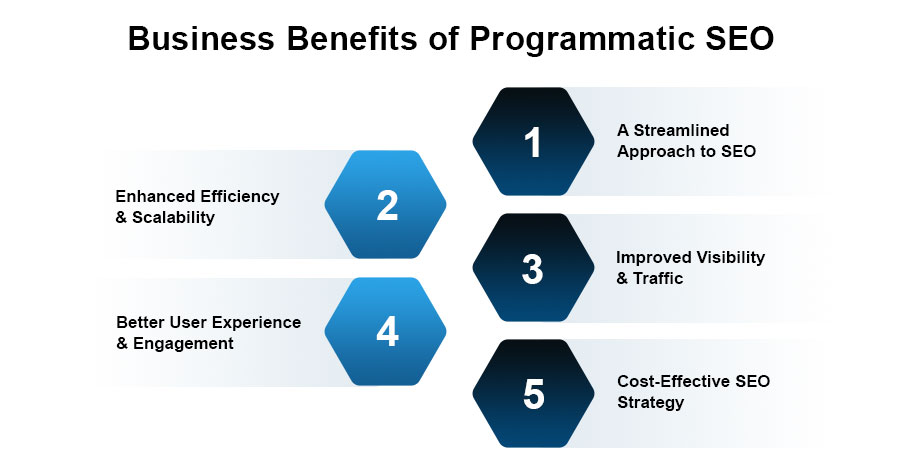
1. A Streamlined Approach to SEO
Are you finding it challenging to manage your SEO efforts effectively?. Managing a website with 50 pages is easy; managing one with 50,000 pages is impossible without automation. With programmatic SEO, you can automate various tasks, saving time and resources while ensuring accuracy and consistency in your optimization efforts.
- It automates keyword research, competitor analysis, and content optimization, removing human error from the equation.
- It ensures consistent implementation of SEO best practices across your entire website. You never have to worry if one page forgot a meta tag—the code handles it all.
2. Enhanced Efficiency & Scalability
Struggling to scale your SEO efforts as your business grows?. This is the classic “growth ceiling” many companies hit. Programmatic SEO allows you to scale your optimization efforts efficiently, regardless of the size of your business or the number of web pages you need to optimize.
- It streamlines creating and optimizing landing pages at scale, allowing you to launch into new markets (e.g., new cities or product categories) instantly.
- It simplifies link-building efforts by creating a massive footprint of indexable content that naturally attracts links.
3. Improved Visibility & Traffic
Does your website not attract enough organic traffic?. The math is simple: more high-quality pages indexed for relevant terms equals more traffic. With programmatic SEO, you can improve your website’s visibility in search engine results pages (SERPs) for thousands of long-tail queries.
- It leads to increased organic traffic and better exposure for your business.
- It optimizes your website for relevant keywords that manual strategies often miss because they are too specific or lower volume.
- It enhances your website’s overall search engine ranking and visibility by signaling to Google that you are an authority on the topic.
4. Better User Experience & Engagement
Struggling to provide a seamless user experience on your website?. Critics often argue that automated content is “spammy,” but good pSEO is actually highly user-centric. Programmatic SEO optimizes your website’s various aspects to enhance user experience and engagement.
- It eventually leads to higher conversion rates and customer satisfaction because the user lands on a page exactly matching their search intent.
- The programmatic framework helps optimize website speed, mobile responsiveness, and overall usability because the underlying code is clean and templated.
- It allows you to create engaging and relevant content tailored to your target audience’s needs dynamically.
- Also, implementing programmatic SEO strategies on WordPress can significantly enhance your website’s visibility and organic traffic, proving you don’t need enterprise-level custom software to start.
5. Cost-Effective SEO Strategy
Are you seeking an affordable solution to boost your website’s search engine ranking?. Programmatic SEO is a cost-effective solution that automates numerous SEO tasks while reducing the need for manual intervention.
- It reduces the need to employ more employees or outsource SEO work to expensive agencies for content writing.
- It maximizes the ROI of your SEO efforts. Once the system is built, the cost to create the 10,001st page is virtually zero.
Regular SEO vs. Programmatic SEO: The Showdown
Programmatic SEO and regular SEO both aim to generate more organic traffic. However, the way each aims to boost your site’s visibility in search engines is different.
Regular SEO is like painting a portrait: it takes time, requires immense detail on a specific subject, and yields one masterpiece. Programmatic SEO is like printing currency: it requires a complex setup, but once the plates are made, you can print value at scale.
Let’s compare them to see how they differ:
| Feature | Regular SEO | Programmatic SEO |
| Strategy Approach | Manual optimization and targeting of specific keywords. | Automated and data-driven optimization at scale. |
| Keyword Targeting | Focuses on individual keywords and phrases (e.g., “Best Shoes”). | Targets broad categories and utilizes modifiers (e.g., “Best [Color] Shoes for [Activity]”). |
| Scalability | Limited scalability due to manual processes. | Highly scalable through automation and data aggregation. |
| Flexibility | Limited flexibility in adapting to changing trends. | Adaptable to dynamic market conditions and trends instantly. |
| Efficiency | Time-consuming process requiring ongoing monitoring. | Streamlined process with continuous optimization. |
| Cost | Lower initial costs, but ongoing manual effort required. | Higher initial investment, but long-term cost efficiency. |
| Results | Results may vary based on manual efforts. | Consistent and predictable results with a data-driven approach. |
How to Do Programmatic SEO? The Master Class
Struggling to keep up with SEO demands?. Programmatic SEO streamlines the process. Businesses can improve online visibility by systematically finding keywords, analyzing competitors, and scaling landing page creation and link building.
Let’s discuss each step in detail.
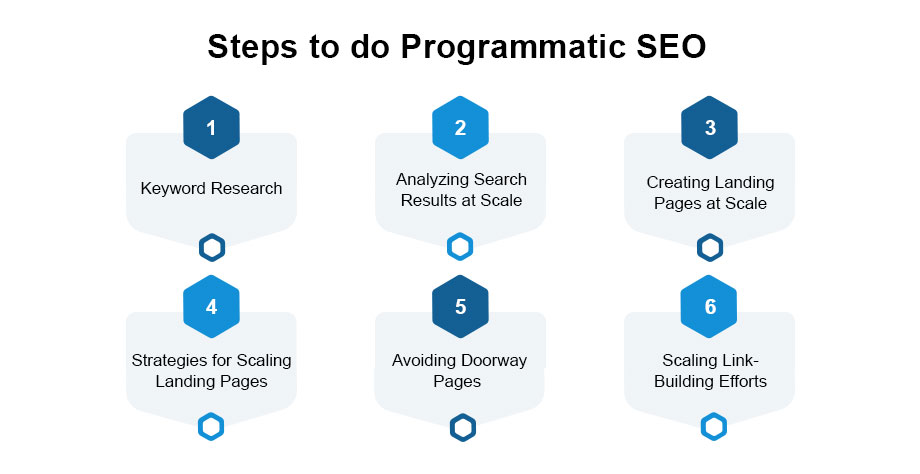
Step 1: Keyword Research
Keywords are the guiding stars for programmatic search engine optimization (SEO) strategies. However, the research process for SEO is fundamentally different from traditional research. You aren’t looking for a single keyword; you are looking for a pattern. Let’s explore how to find many keywords to fuel your programmatic SEO efforts.
A. Find Your Head Terms Head terms are the broad, overarching categories encapsulating your business offerings. Let’s see how we can identify them:
- Think about your business’s primary products or services. For example, if you’re a travel agency, your head terms could include “vacation packages” or “flight bookings”.
- Consider the main topics or themes relevant to your industry.
- Are there specific terms or phrases commonly associated with your niche? These could serve as your head terms.
- Pro Tip: Utilize keyword research tools like SEMrush or Google Keyword Planner to explore potential head terms and assess their search volume.
B. Find Your Modifiers Modifiers are the specific keywords or phrases that add context or specificity to your head terms. This is where the long-tail magic happens. Here’s how to uncover them:
- Brainstorm: Look for different variations or descriptors related to your head terms. For instance, if your head term is “vacation packages,” modifiers could include “all-inclusive,” “budget-friendly,” or “luxury”.
- Autocomplete Analysis: Analyze search engine autocomplete suggestions and related search queries to identify potential modifiers. When you type “Best coffee in…” into Google, the list of cities that drops down? Those are your modifiers.
- Validation: Use keyword research tools to assess your modifiers’ search volume and competitiveness.
C. Put Them All Together Once you have a list of head terms and modifiers, it’s time to create a comprehensive keyword list.
- Combine head terms with relevant modifiers to create long-tail keyword variations.
- Formula: [Head Term] + [Modifier 1] + [Modifier 2] (e.g., “Luxury” + “Hotels” + “in Florida”).
- Organize your keywords into categories or themes for easy management.
- Use spreadsheets or SEO software to track keyword performance and identify optimization opportunities.
Step 2: Analyzing Search Results at Scale
Understanding your competitors’ strategies can provide valuable insights into the competitive landscape. You cannot just launch 1,000 pages blindly; you must know what Google currently rewards for those queries.
Conducting a comprehensive competitive analysis includes the following steps:
- Identify Leaders: Find your main competitors in the online space. Who are the top-ranking websites for your target keywords?.
- Analyze Structure: Analyze their content, backlink profiles, and on-page optimization techniques. What strategies are they employing to rank prominently in search results?. Are they using tables? Maps? Reviews?
- Leverage Tools: Use programmatic SEO tools like Ahrefs, SEMrush, or Moz to collect data on your competitors’ keyword rankings, domain authority, and backlink sources.
- Gap Analysis: Look for gaps or opportunities where your business can differentiate itself or capitalize on underserved areas within your industry.
Example: Suppose you’re a local bakery looking to improve your online presence. You analyze the top-ranking bakery websites in your area and study their keyword usage, content quality, and backlink profiles. You might realize that while they list “Wedding Cakes,” none of them have pages for “Wedding Cakes in [Specific Neighborhood].” That is your programmatic opportunity.
Step 3: Creating Landing Pages at Scale
Landing pages are crucial to converting website visitors into leads or customers. This is the deployment phase.
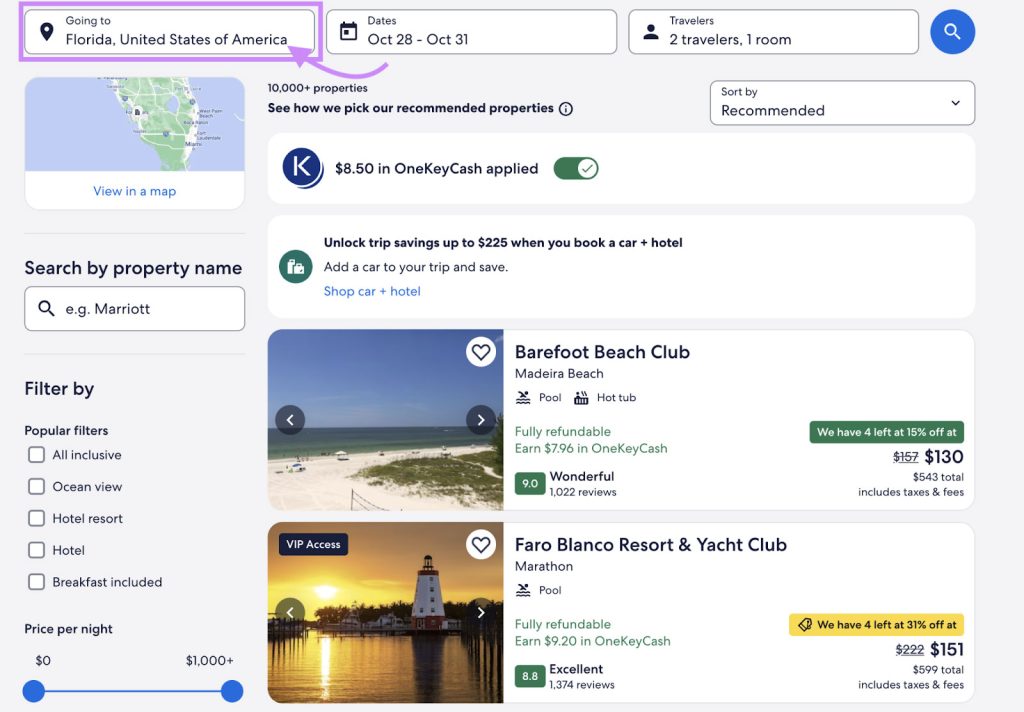
Let’s check out the result for “top hotels in Florida”. Then, look at “top hotels in California”. Notice how the landing page layout remains consistent even as the location and content vary. Expedia does not build these pages from scratch for each city, state, and country. It is done by programmatic SEO.
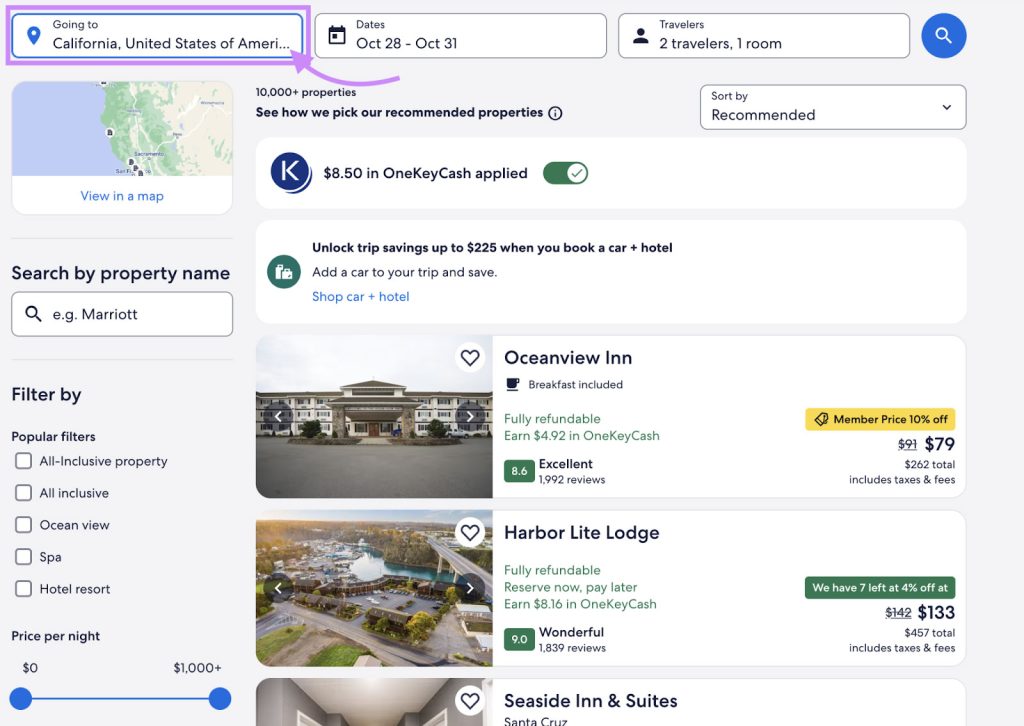
Here’s how to create landing pages at scale:
- Template Design: Develop a template or framework for your landing pages that maintains consistency in design and messaging while allowing for customization. The template should have “slots” for your data.
- Dynamic Injection: Utilize dynamic content or personalization functions to customize landing pages for specific audience segments or user preferences. When the user requests the “California” page, your database injects the California text, California images, and California hotel list into the template.
- Tooling: Use automation tools or Content Management Systems (CMS) services to simplify creating and deploying landing pages on your website. Tools like WP All Import for WordPress or Webflow’s CMS collections are perfect for this.
- Optimization: Continuously optimize and monitor your landing pages using performance measures such as conversion rate, bounce rate, and time on page.
Step 4: Strategies for Scaling Landing Pages
Scaling up your landing page efforts requires strategic planning and execution. It is not enough to just publish the pages; they must be valuable.
The key strategies to consider:
- Content Syndication: Implement a content syndication strategy to distribute landing pages across multiple channels and platforms.
- Social Proof: Leverage user-generated content or customer testimonials to enrich your landing pages with authentic social proof.
- Engagement: Incorporate interactive elements like quizzes, calculators, or surveys to engage visitors and drive conversions.
Example:
Airbnb creates destination landing pages featuring unique listings, photos, and reviews. By catering to different travel preferences and locations, Airbnb attracts a diverse audience. They don’t write the descriptions; the hosts do. Airbnb simply provides the programmatic architecture to display it.
Step 5: Avoiding Doorway Pages (Crucial!)
Doorway pages, also known as bridge pages or gateway pages, are designed to manipulate search engine rankings by redirecting users to unrelated or low-quality content. This is the dark side of programmatic SEO, and you must avoid it at all costs.
Let’s see why you should avoid them:
- Google Penalties: Doorway pages violate search engine guidelines and can result in penalties or deindexing your website. If Google thinks you are spamming, they will ban you.
- Bad UX: They create a poor user experience by deceiving visitors with irrelevant or misleading content.
- The Ethical Approach: Instead of resorting to manipulative tactics, create high-quality, valuable content that serves your audience’s needs.
Example: Imagine a business creating multiple doorway pages with slight variations of the same content to manipulate search results.
- Bad: A page for “Plumber in Austin” that is identical to “Plumber in Dallas” except for the city name.
- Good: A page for “Plumber in Austin” that lists specific Austin service areas, Austin-specific reviews, and a map of the Austin office. Instead of providing value to users, the “Bad” pages aim to deceive search engines and boost rankings artificially. Don’t be that business.
Step 6: Scaling Link-Building Efforts
Link building, one of the crucial components of SEO, involves acquiring backlinks from other websites to improve your site’s authority and visibility. With pSEO, you have more targets for links.
Key strategies to build links at scale include:
- Comprehensive Planning: Create a complete link-building plan that includes outreach, content production, and relationship-building with relevant websites.
- Targeted Outreach: Identify respected websites in your sector or business, then approach them with intriguing content or partnership options.
- Digital PR: Use guest blogging, press releases, and influencer collaborations to gain backlinks from credible sources.
- Maintenance: To keep your backlink profile healthy, monitor it regularly and remove any spammy or unnecessary links.
Example: A software company collaborates with industry influencers to create informative blog posts and resources, earning high-quality backlinks from authoritative websites and increasing its visibility in search results.
To Conclude
Programmatic SEO enables firms to increase their online visibility and attract more clients. It is a powerful shift from manual craftsmanship to industrial-scale digital dominance. Businesses can attain consistent and predictable search engine rankings by automating optimization operations and focusing on large categories.
However, the technical complexity means it is easy to get wrong.
Choosing XCEEDBD for Google SEO Services can enhance these benefits by providing expert advice and personalized ways to help businesses thrive digitally. XCEEDBD provides businesses with complete SEO solutions personalized to their specific needs, assuring long-term success and growth in the competitive online marketplace.
Ready to Scale Your Traffic?
Partner with XCEEDBD
Ready to dominate your niche? Let our experts build the infrastructure you need to target thousands of keywords and drive exponential growth.
Frequently Asked Questions (FAQ)
1. Is Programmatic SEO considered “Black Hat” or spam?
No, not inherently. It becomes spam (specifically “Doorway Pages”) if you produce low-quality, duplicate content. If you use data to create unique, valuable pages for users (like Yelp, TripAdvisor, or Zillow), it is a highly effective, legitimate “White Hat” strategy.
2. What are the best tools for Programmatic SEO?
The stack usually involves a keyword tool (Semrush/Ahrefs), a database (Airtable/Google Sheets), and a CMS that handles bulk imports (WordPress with WP All Import, Webflow, or specialized tools like PageFactory).
3. Can I use AI to write the content for Programmatic SEO?
Yes, AI is a perfect companion for pSEO. You can use AI to generate unique introductions, descriptions, or summaries for each of your thousands of pages, ensuring they don’t look like duplicate content to Google.
4. How long does it take to index thousands of pages?
This is the “Crawl Budget” challenge. If you publish 5,000 pages at once, Google won’t index them instantly. It requires a strong internal linking strategy and a clean sitemap. Typically, you should drip-feed pages or focus on high-authority backlinks to speed up indexing.
5. How much does Programmatic SEO cost compared to regular SEO?
The upfront cost is higher because it requires data engineering and development. However, the Cost Per Page is drastically lower. Regular SEO might cost $150 per page. Programmatic SEO might cost $5,000 to set up, but then generates 5,000 pages, bringing the cost down to $1 per page.
6. Do I need a developer to do this?
It helps, but it is not strictly necessary. With the rise of “No-Code” tools, savvy marketers can build programmatic sites using Zapier, Airtable, and Webflow without writing a single line of code.