


Artificial intelligence is no longer a futuristic concept reserved for science fiction novels or elite tech conglomerates. In 2026, artificial intelligence is the fundamental engine driving the modern business landscape. From generative machine learning models that draft complex software code in seconds, to sophisticated multimodal systems that can simultaneously process text, audio, and high-resolution visual data, the future of AI is aggressively reshaping how we live, work, and interact with the digital world.
But as the pace of technological innovation accelerates at breakneck speed, a highly critical question emerges for corporate leaders, IT executives, and business owners: Is your organization truly prepared to navigate the next massive wave of AI technology? Or will you inevitably be left behind by agile competitors who have already embraced intelligent automation, predictive analytics, and data-driven decision-making?
For modern enterprises, thinking beyond basic task automation is no longer an optional luxury—it is a strict survival imperative. The organizations that will dominate their respective industries over the next decade are those preparing right now for a customer-centric, highly personalized, and ethically responsible AI-driven future.
In this incredibly comprehensive guide, we will thoroughly explore the top AI statistics currently shaping the global economy, dissect the most transformative trends redefining workplace productivity, outline the ethical and technical challenges you must navigate, and provide a step-by-step roadmap to successfully prepare your business for the artificial intelligence revolution. Let’s dive deeply into the future.
The Current State of Artificial Intelligence: Eye-Opening Statistics
To truly grasp the future of AI in business, we must first analyze its current growth trajectory. Artificial intelligence has rapidly transitioned from an experimental novelty to a core operational necessity. According to recent industry analyses, approximately 78% of enterprise respondents are currently utilizing artificial intelligence in at least one primary business function, such as digital marketing, proactive customer service, or IT operations.
Here are the most critical, data-backed AI statistics you need to understand:
- Massive Enterprise Adoption: An estimated 40% of multinational corporations (MNCs) have deeply integrated advanced AI technologies into their core operational workflows, officially moving past the sandbox phase into full-scale, enterprise-wide deployment.
- The Rise of Automation Services: A staggering 82% of these multinational companies currently leverage specialized AI automation services to continuously streamline repetitive tasks, drastically reduce human error rates, and significantly accelerate their time-to-market for new products.
- Global Implementation Leaders: Businesses in rapidly developing technological hubs, notably India, are showcasing incredible adoption rates, with over 59% of enterprises regularly relying on AI-driven solutions to scale their operations.
- The Enterprise Advantage: Data consistently shows that large-scale, enterprise-level companies are twice as likely to implement the newest developments in artificial intelligence compared to small or medium-sized businesses (SMBs). However, the rapid democratization of accessible SaaS AI tools is quickly closing this operational gap.
These numbers paint an undeniably clear picture: AI is successfully automating incredibly complex business processes and enabling hyper-customized customer experiences at a massive scale that was considered technologically impossible just a few short years ago.
6 Transformative AI Trends Changing the Future of Technology
As we look toward the immediate horizon, several highly specific technological trends are actively dictating the future of AI. These are not passing fads or industry buzzwords; they are foundational shifts in how software infrastructure, hardware capabilities, and human intelligence seamlessly interact.
1. Generative AI: Moving Far Beyond Basic Content Creation
Generative AI remains one of the most explosive, controversial, and universally recognized developments in the artificial intelligence sector today. While earlier iterations of artificial intelligence were primarily analytical—designed solely to process historical data and output statistical predictions—generative AI actually creates completely net-new content from scratch.
This rapidly expanding category includes everything from drafting high-converting marketing copy and producing stunningly photorealistic images, to composing original, royalty-free music and writing highly functional, complex software code. Advanced models like OpenAI’s latest GPT architectures, DALL-E, and Midjourney have fundamentally transformed creative and technical workflows forever.
According to robust research from McKinsey, generative AI has the tangible potential to boost the global economy by a staggering $4.4 trillion annually. This massive, unprecedented financial impact spans multiple core sectors, including software engineering, B2B sales, consumer marketing, and customer support operations.
Real-World Business Applications:
- E-commerce & Retail: Automatically generating tens of thousands of unique, highly SEO-optimized product descriptions tailored to specific buyer personas in a matter of seconds.
- Digital Marketing: Dynamically creating hundreds of A/B testing variations for banner designs, compelling ad copy, and engaging social media campaigns without requiring a massive, expensive in-house design team.
- Customer Service Excellence: Deploying highly sophisticated, contextually aware chatbots that can converse with the deep nuance, empathy, and historical understanding of a human support agent.
- Software Development: Actively assisting software engineers by instantly generating boilerplate code, identifying critical security bugs, and suggesting complex architectural optimizations on the fly.
2. AI for Unprecedented Workplace Productivity
The outdated narrative that “AI will completely steal your job” is rapidly being replaced by a much more accurate, pressing reality: “A professional using AI will quickly replace a professional who refuses to adapt.” AI has become a highly practical, everyday productivity multiplier for the modern workforce.
Tools like Microsoft Copilot, Notion AI, and sophisticated grammar engines have made daily corporate operations significantly faster, substantially smarter, and far less stressful. By seamlessly automating tedious administrative tasks, summarizing lengthy hour-long meeting transcripts into bullet points, and organizing complex project management workflows, AI frees human workers to focus exclusively on high-level strategy and creative problem-solving. A highly notable study conducted by GitHub revealed that software developers utilizing GitHub Copilot completed their assigned technical tasks up to 55% faster than their peers who chose to code entirely manually.
How Productivity AI is Deployed Today:
- Human Resources & Talent Acquisition: Instantly screening thousands of incoming resumes in minutes to identify the absolute most qualified candidates based on objective, data-driven parameters.
- Sales & Revenue Teams: Automatically recording, transcribing, and intelligently summarizing lengthy client discovery calls to extract vital pain points, objections, and actionable next steps.
- Knowledge Workers: Effortlessly drafting complex vendor proposals, nuanced email responses, and comprehensive quarterly performance reports with minimal necessary human input.
3. The Explosive Rise of Multimodal AI Systems
If generative text was the defining breakthrough of the past few years, Multimodal AI is undeniably the defining trend of the immediate future. Multimodal artificial intelligence systems possess the incredibly advanced ability to seamlessly process, intuitively understand, and logically synthesize multiple distinct types of data inputs simultaneously—such as raw text, high-resolution images, complex audio streams, and dynamic video files.
Imagine an incredibly intelligent AI system where an executive can upload a highly complex financial spreadsheet (data), provide a spoken voice command asking for a high-level summary (audio), and immediately receive a beautifully formatted, highly detailed written executive report (text). Cutting-edge tools like Google Gemini and Meta’s ImageBind are aggressively pioneering this deeply interconnected, holistic approach to machine learning.
Why Multimodal AI Matters to Your Bottom Line:
- Hyper-Intelligent Customer Support: Advanced systems can actively analyze a frustrated customer’s tone of voice on a call, read their angry text complaint, and visually inspect an uploaded smartphone photo of a broken product all at the exact same time to provide a perfectly tailored, highly empathetic resolution.
- Contextual Content Creation: Generating engaging marketing videos where the visual elements, the spoken voiceover, and the on-screen text are all intrinsically, contextually aware of one another.
- Enhanced Digital Accessibility: Providing real-time, highly descriptive, and incredibly accurate audio translations of dynamic visual environments for visually impaired users.
4. Revolutionizing Science, Medicine, and Global Healthcare
The future of AI in the medical and healthcare sector is, quite literally, a high-stakes matter of life and death. Artificial intelligence is fundamentally changing how medical professionals interact directly with patients, how hospitals conduct clinical workflows, how specialists diagnose incredibly rare diseases, and how scientists discover life-saving new pharmaceuticals.
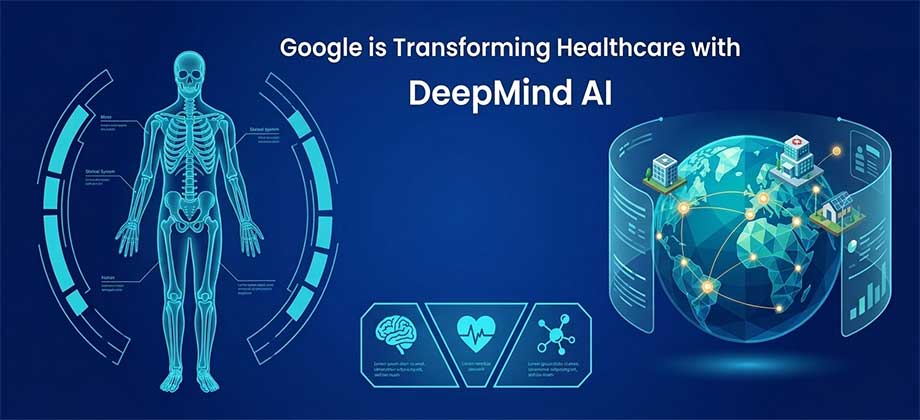
Advanced AI-based medical imaging platforms, such as Google’s DeepMind, are currently assisting physicians in detecting microscopic cellular abnormalities with incredible precision. This allows for the vital early detection of aggressive cancers and other severe diseases long before they become unmanageable or life-threatening to the patient.
Groundbreaking Healthcare AI Innovations:
- Predictive Outbreak Analytics: Utilizing massive arrays of real-time global health data to accurately predict, track, and strategically contain viral outbreaks long before they escalate into devastating global pandemics.
- Accelerated Drug Discovery: Intelligently simulating millions of complex molecular combinations in mere days—a painstaking process that traditionally took pharmaceutical companies decades of trial and error—to find viable, safe cures faster.
- Post-Treatment Patient Care: Utilizing intelligent, highly empathetic medical chatbots to actively monitor patient recovery progress, remind them of strict medication schedules, and instantly flag physiological warning signs to human doctors.
5. AI Ethics, Regulations, and Corporate Responsibility
With immense, world-changing technological power comes an equally immense, undeniable need for strict regulation and ethical boundaries. As AI integrates deeper into our sensitive daily lives, ensuring that these autonomous systems are safe, completely unbiased, and radically transparent is arguably the single greatest corporate challenge of the current decade.
If your enterprise is actively deploying AI for consumer-facing operations, you must be intimately, thoroughly familiar with AI ethics and stringent compliance frameworks. The primary, overriding goal of AI ethics is to absolutely guarantee that algorithmic systems deeply respect fundamental human rights, adhere strictly to moral standards, and do not inadvertently cause financial, social, or physical harm to users.
Core Pillars of Enterprise AI Ethics:
- Uncompromising Algorithmic Fairness: Ensuring that AI systems do not accidentally or intentionally discriminate against specific demographics, genders, or minority groups in critical, high-stakes areas like financial loan approvals or corporate hiring.
- Radical System Transparency: Aggressively moving away from opaque “black box” models so that software developers, corporate users, and everyday consumers can understand exactly how an AI reached a specific, critical conclusion.
- Strict Corporate Accountability: Establishing highly clear legal and ethical corporate guidelines determining exactly who is legally responsible when an autonomous system inevitably makes a costly, damaging, or harmful mistake.
6. AI-Augmented Software Engineering
The fundamental way digital products are conceptualized, built, and deployed is undergoing a massive, irreversible paradigm shift. AI is no longer merely an interesting feature built within software; it is actively, intelligently helping human engineers build the software itself. Rather than painstakingly writing every single line of code completely manually, modern developers are partnering directly with sophisticated AI agents to drastically accelerate the entire development lifecycle.
Incredible Benefits for Development Teams:
- Automating Monotonous Work: AI effortlessly and accurately handles the tedious creation of boilerplate code, complex database structuring, and routine, time-consuming bug debugging.
- Elevating Overall Code Quality: Intelligent systems can instantly scan hundreds of thousands of lines of code to intelligently identify hidden security vulnerabilities, memory leaks, and architectural inefficiencies before deployment.
- Rapid Agile Prototyping: AI can take a simple, conversational text prompt or a basic wireframe sketch and instantly generate a fully functional, highly interactive minimum viable product (MVP), drastically speeding up the time to market for startups and enterprises alike.
The Biggest Challenges and Roadblocks to AI Adoption
While the transformative potential of artificial intelligence is virtually limitless, the actual path to successful corporate integration is fraught with highly significant, costly hurdles. Businesses that attempt to recklessly rush AI adoption without a carefully structured, strategic roadmap almost always encounter severe roadblocks.
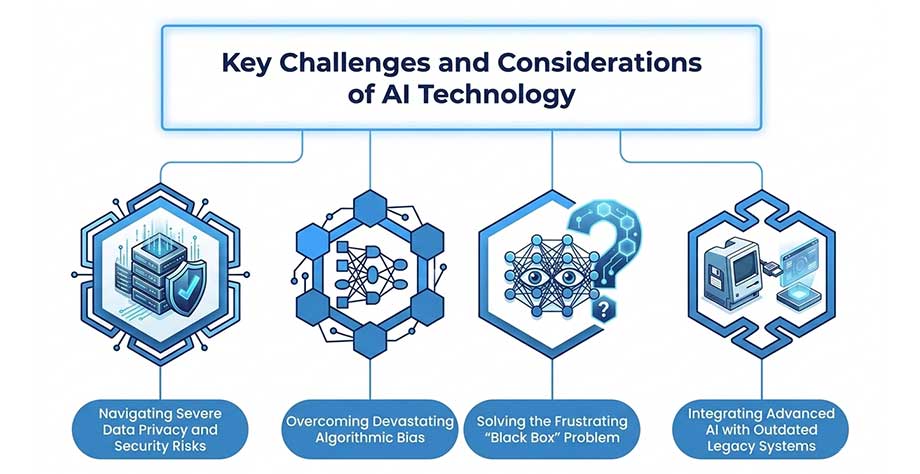
Navigating Severe Data Privacy and Security Risks
The Challenge: AI machine learning models are inherently, fundamentally data-hungry. They require absolutely massive datasets to learn effectively, adapt over time, and make highly accurate predictions. However, carelessly feeding highly sensitive customer or internal corporate data into unsecure cloud-based AI models can rapidly expose businesses to severe, legally devastating privacy breaches. The Solution: Organizations must ruthlessly prioritize stringent, uncompromising data governance. This means strictly, legally adhering to complex global data protection regulations like GDPR in Europe, CCPA in California, and HIPAA in the healthcare sector. Long before feeding any data into an AI system, businesses must intelligently implement robust encryption protocols, advanced data anonymization techniques, and crystal-clear user consent frameworks. Remember: consumer trust is incredibly hard to build, wildly expensive to maintain, and remarkably easy to lose forever.
Overcoming Devastating Algorithmic Bias
The Challenge: An AI system is mathematically only as objective, fair, and unbiased as the historical data it is trained upon. If historical corporate data contains implicit or explicit human biases, the AI will inevitably learn, rapidly replicate, and even massively amplify those biases at scale. This can quickly lead to disastrous, brand-destroying PR crises and massive legal liabilities, particularly in highly sensitive, high-stakes areas like corporate recruitment, law enforcement, and financial lending algorithms. The Solution: Forward-thinking companies must proactively prioritize diversity, equity, and broad representation in their fundamental training datasets. Furthermore, it is absolutely essential to conduct regular, rigorous, third-party algorithmic audits to continuously test for fairness and hidden bias. Establishing a mandatory “human-in-the-loop” operational protocol ensures that critical, life-altering AI decisions are always manually reviewed by a trained human professional before being officially finalized.
Solving the Frustrating “Black Box” Problem
The Challenge: Many highly advanced, incredibly complex deep learning neural networks function entirely as a “black box.” You input a set of data, and the system quickly provides a highly accurate, statistically probable answer—but absolutely neither the end-user nor the original developer can accurately explain exactly how the AI logically arrived at that specific, final conclusion. The Solution: Explainable AI (XAI) is rapidly becoming a mandatory legal and operational requirement, especially in heavily regulated, scrutinized industries like global banking, insurance, and healthcare. Businesses must deliberately choose interpretable algorithmic models or actively deploy supplementary analytical tools that effectively translate incredibly complex, mathematical algorithmic decisions into clear, understandable, human-readable logic.
Integrating Advanced AI with Outdated Legacy Systems
The Challenge: The harsh reality is that most established, highly profitable businesses do not actually operate on cutting-edge, modern IT infrastructure. Trying to forcefully plug a state-of-the-art, lightning-fast machine learning model into a clunky, twenty-year-old legacy database is a guaranteed recipe for catastrophic system failure, massive data latency, and severe data corruption. The Solution: Highly successful enterprise AI adoption requires deliberate, strategic architectural modernization. Businesses should heavily utilize flexible, API-driven middleware solutions to safely and effectively bridge the massive technical gap between aging legacy servers and modern, cloud-based AI tools. A carefully phased, step-by-step integration approach is infinitely more effective, manageable, and significantly less disruptive than a sudden, chaotic “rip-and-replace” IT strategy.
How to Prepare Your Business for the AI-Driven Future
Thoroughly understanding the incredible future of AI is only half the battle; the true, measurable corporate value lies entirely in precise execution. Before recklessly launching a massive, multi-million dollar enterprise-wide AI initiative, it is absolutely crucial to lay a rock-solid, incredibly stable foundation. Follow these six highly strategic, actionable steps to ensure your business is fully, comprehensively ready for the artificial intelligence revolution.
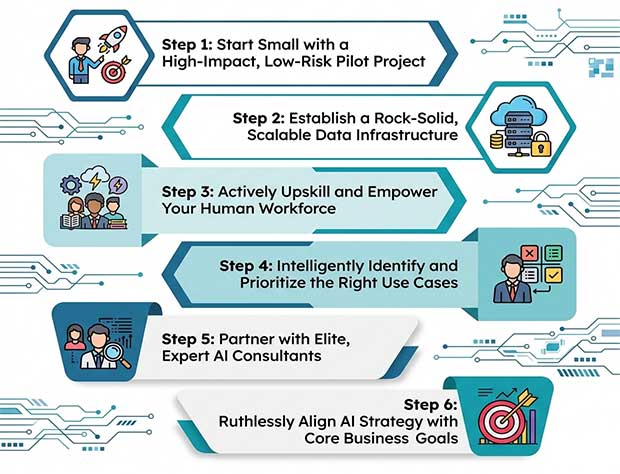
Step 1: Start Small with a High-Impact, Low-Risk Pilot Project
Do not foolishly attempt to completely automate your entire business operation overnight. The absolute most successful corporate AI transformations always begin with a tightly focused, highly specific, low-risk pilot project. Identify a highly specific, highly repetitive, incredibly tedious operational task—such as routing low-level customer service tickets, extracting data from invoices, or generating monthly financial summaries—and deliberately apply AI to solve it. Use the early, measurable victories from this contained pilot to actively build internal team confidence, secure crucial executive buy-in, and gather vital real-world data on actual system performance.
Step 2: Establish a Rock-Solid, Scalable Data Infrastructure
Artificial intelligence is entirely, completely dependent on the quality of its data. If your corporate data is currently highly fragmented across multiple departments, wildly outdated, or poorly labeled, your expensive AI initiatives will absolutely fail. “Garbage in, garbage out” is the absolute, unbreakable golden rule of all machine learning. You must invest heavily, and early, in proper data architecture. Actively centralize your various departmental data silos into a highly secure data lake or modern data warehouse, intelligently implement strict data hygiene protocols, and ensure all incoming data is accurately, systematically tagged and categorized.
Step 3: Actively Upskill and Empower Your Human Workforce
The best technology in the world alone cannot drive true corporate transformation; you urgently need a highly trained workforce capable of intelligently wielding that technology. Invest heavily in comprehensive, ongoing educational training programs to drastically improve the data literacy of your entire employee base. Teach your team exactly how to write highly effective text prompts for generative AI models, how to correctly interpret AI-driven predictive analytics, and crucially, how to easily spot algorithmic hallucinations or errors. Actively cultivate a modern corporate culture that heavily rewards experimentation and fundamentally views AI as a collaborative, highly useful partner rather than an existential threat.
Step 4: Intelligently Identify and Prioritize the Right Use Cases
Not every single business problem actually requires a highly complex AI solution. Conduct a incredibly thorough, highly detailed operational audit to accurately identify critical bottlenecks where AI can deliver the absolute highest measurable financial impact. Aggressively prioritize your potential use cases based on actual technical feasibility, estimated time-to-value, and projected Return on Investment (ROI). Focus intensely on operational areas that directly, measurably enhance the end customer experience, dramatically reduce bloated operational costs, or rapidly unlock entirely new, highly profitable revenue streams.
Step 5: Partner with Elite, Expert AI Consultants
The global AI technology landscape realistically evolves on a weekly, sometimes daily, basis. Attempting to navigate this incredibly complex, highly volatile ecosystem without deeply specialized, technical expertise is highly risky and incredibly expensive. You must actively collaborate with highly experienced, top-tier AI development agencies, like XCEEDBD.COM, that offer comprehensive, end-to-end technical support. A truly strong technology partner will expertly guide you from the initial strategic discovery phase, all the way through custom development, strict security auditing, and long-term, highly scalable system deployment.
Step 6: Ruthlessly Align AI Strategy with Core Business Goals
Enterprise AI integration should absolutely never be treated as a detached, rogue IT experiment. Every single artificial intelligence initiative must directly, clearly align with your broader, high-level corporate objectives. Whether your overriding goal is aggressive top-line revenue growth, efficiently expanding into new geographical global markets, or achieving industry-leading customer satisfaction scores, you must ensure your AI strategy directly, tangibly supports those exact targets. Establish crystal clear Key Performance Indicators (KPIs) and ruthlessly, consistently measure your progress against them.
Why XCEEDBD.COM is Your Ideal AI Transformation Partner
The global statistics and technological trends are completely undeniable: the incredibly lucrative future of modern business absolutely belongs to those who successfully, intelligently integrate artificial intelligence into their core DNA. But you absolutely do not have to navigate this incredibly complex, rapidly shifting technological landscape entirely alone.
At XCEEDBD.COM, we highly specialize in seamlessly transforming traditional, established businesses into wildly agile, deeply AI-driven operational powerhouses. Whether you are actively looking to intelligently automate mundane, highly repetitive back-office workflows, proactively deliver hyper-personalized digital experiences to your customers, or expertly deploy advanced predictive analytics to stay miles ahead of rapid market trends, our dedicated team of seasoned, highly technical experts has you completely covered. We architect and build custom, endlessly scalable, and highly secure AI infrastructures tailored precisely to your unique, ambitious business goals and specific industry compliance requirements.
Ready to Build Your Unfair AI Advantage?
Are you absolutely ready to significantly, permanently reduce operational overhead and massively scale your growth with highly custom artificial intelligence solutions? Book Your Free, No-Obligation AI Strategy Consultation with XCEEDBD.COM Today and let our elite team of experts actively build a beautifully tailored, highly secure implementation roadmap for your enterprise.
Frequently Asked Questions (FAQs)
1. How exactly will Artificial Intelligence comprehensively change the future of day-to-day business operations? AI will fundamentally, permanently shift businesses from highly reactive operational models to deeply predictive models. By intelligently automating repetitive, incredibly tedious administrative tasks, dynamically optimizing global supply chains in real-time based on weather and economic data, and actively personalizing customer interactions at an unprecedented scale, AI empowers companies to operate with incredible efficiency, dramatically lowered costs, and unmatched agility.
2. What are the absolute biggest, most critical AI trends that enterprise leaders need to watch in 2026? The most highly critical trends currently dominating the landscape include the massive, widespread adoption of Multimodal AI (which processes text, complex audio, and high-res visual data entirely simultaneously), the deep integration of Generative AI directly into everyday enterprise software development lifecycles, and the rapidly increasing focus on Explainable AI (XAI) algorithms to strictly meet complex regulatory and legal compliance demands.
3. Is artificial intelligence actually secure and legally safe for small and medium-sized businesses to adopt? Yes, AI is highly safe and incredibly accessible for SMBs today. Modern, highly secure cloud-based AI platforms and robust Software-as-a-Service (SaaS) tools easily allow smaller, growing companies to leverage incredibly powerful machine learning capabilities without ever needing massive, multi-million dollar upfront hardware infrastructure investments. This is entirely safe provided they strictly adhere to standard, rigorous data privacy and cybersecurity practices.
4. How can my specific company implement AI safely without risking devastating corporate data breaches? Safe, highly secure implementation requires incredibly strict, uncompromising data governance policies. You must proactively utilize advanced end-to-end encryption protocols, comprehensively anonymize all sensitive customer data long before feeding it into third-party models, strictly comply with legal frameworks like GDPR or CCPA, and explicitly partner with reputable, highly vetted AI development vendors that prioritize true enterprise-grade security at every layer.
5. Will Artificial Intelligence completely replace human workers in the immediate near future? AI is specifically, deliberately designed to powerfully augment human intelligence, not entirely, functionally replace it. While AI will absolutely automate highly repetitive, manual, and tedious tasks, it will simultaneously, inevitably create a massive, highly lucrative demand for completely new professional roles focused intensely on AI management, complex data analysis, high-level corporate strategy, and creative human oversight. Humans will successfully transition to much higher-value work.
6. What is the fundamental, technical difference between Generative AI and Multimodal AI? Generative AI focuses almost exclusively on intelligently creating brand new content (like writing a complex blog post or dynamically generating a 3D image) based entirely on user prompts. Multimodal AI, conversely, refers to a highly advanced system’s core ability to natively process, understand, and synthesize multiple entirely different formats of complex data—such as text, video, and audio—at the exact same time to provide incredibly comprehensive, deeply holistic insights.
7. Why is AI “explainability” considered so critically important for modern enterprises? Explainability directly prevents the terrifying “black box” scenario where an advanced AI rapidly makes a critical decision but simply cannot explain its logical reasoning to humans. In heavily regulated, highly scrutinized industries like corporate finance or healthcare, business leaders must be legally able to prove exactly why an AI algorithm approved a specific loan or recommended a specific medical treatment to guarantee complete fairness, prevent bias, and ensure absolute legal compliance.
8. How do I effectively evaluate and choose the right AI development partner for my business? You should actively look for a dedicated technology partner with a highly proven, thoroughly documented track record of successful, large-scale deployments within your specific industry vertical. They should confidently offer highly comprehensive, end-to-end technical services—ranging from initial corporate strategy and complex data structuring to final deployment and long-term system scaling—while consistently, aggressively prioritizing data security and ethical AI practices above all else.