
In today’s competitive business landscape, operational efficiency is more crucial than ever. Unexpected equipment breakdowns and unplanned downtime can severely disrupt productivity and profitability. Enter the power of Internet of Things (IoT) technology—offering businesses a proactive approach to maintenance that can optimize equipment performance, reduce downtime, and enhance overall operational efficiency.
In this article, we will explore how IoT-enabled predictive maintenance is revolutionizing business operations, ensuring minimal downtime, and helping organizations maximize productivity.
What Is Predictive Maintenance?
Predictive maintenance is a technique that helps businesses assess the condition of their equipment in real-time and predict when maintenance is required. Unlike traditional time-based or routine-based maintenance approaches, predictive maintenance provides a data-driven, cost-effective solution to prevent equipment failures before they occur.
By utilizing real-time analytics, sensors, and data from machinery, predictive maintenance empowers businesses to make smarter, data-backed decisions. The technology uses sophisticated algorithms and data analysis to identify potential issues, enabling timely intervention to prevent breakdowns.
How IoT Enhances Predictive Maintenance
While Supervisory Control and Data Acquisition (SCADA) systems have been used for years to manage maintenance tasks, the Industrial Internet of Things (IIoT) takes predictive maintenance to the next level. IoT devices and sensors collect large volumes of data in real time, providing a much more comprehensive and detailed picture of machine health compared to traditional systems.
For instance, IoT-enabled predictive maintenance leverages cloud computing to store vast amounts of sensor data and apply machine learning algorithms that predict failures before they happen. These predictive models process the data to detect subtle changes, such as fluctuations in temperature, pressure, or vibration, which might indicate an impending issue. This helps businesses respond swiftly to emerging problems, reducing the risk of unexpected downtime.
IoT-based systems are not only scalable but also adaptable, allowing for easy integration of additional equipment or sensors. This makes the system continuously effective, with seamless data flow and timely updates for maintenance teams.
Key Benefits of IoT-Enabled Predictive Maintenance for Business Operations
The integration of IoT into predictive maintenance offers numerous advantages, helping organizations streamline their operations and enhance their bottom line:

1. Improved Operational Efficiency
With IoT, businesses can continuously monitor equipment performance and predict when maintenance is required. By identifying issues early, companies can avoid production interruptions, optimize maintenance schedules, and reduce operational disruptions. This proactive approach improves overall workflow and productivity, driving operational efficiency.
2. Minimized Downtime
Unscheduled downtime is one of the most costly aspects of equipment failure. With IoT-driven predictive maintenance, businesses can pinpoint potential issues before they escalate into significant problems. By catching early signs of degradation, companies can schedule repairs and maintenance without disrupting operations, ensuring that equipment runs smoothly and efficiently.
3. Enhanced Quality Control
Predictive maintenance doesn’t just prevent breakdowns; it also helps maintain high standards of quality control. Continuous monitoring of equipment performance ensures that machines are operating at peak efficiency, which ultimately results in higher product quality. With fewer failures and better equipment performance, businesses can enhance customer satisfaction and protect their brand reputation.
4. Improved Safety and Compliance
Safety is always a top priority in industrial environments. IoT-based predictive maintenance systems allow businesses to identify potential safety hazards early, such as equipment malfunctions or safety violations. By monitoring critical systems, organizations can act quickly to address any emerging issues, ensuring a safer work environment. Moreover, predictive maintenance helps businesses stay compliant with safety regulations, reducing the risk of costly fines and legal consequences.
5. Lower Maintenance Costs
Traditional maintenance approaches often lead to unnecessary repairs and increased labor costs. IoT-enabled predictive maintenance optimizes maintenance planning by anticipating when equipment will need attention. By addressing problems before they lead to expensive repairs or replacements, businesses can save significantly on maintenance costs.
6. Better Asset Utilization
IoT-driven predictive maintenance allows businesses to maximize the lifespan and performance of their assets. With predictive maintenance, companies can identify bottlenecks or delays and take proactive measures to resolve them. This enhances the utilization of machinery and equipment, leading to improved productivity and reduced operational costs.
Common Use Cases of IoT-Based Predictive Maintenance
IoT-based predictive maintenance is already being widely adopted across various industries, each leveraging its benefits to solve unique challenges. Here are some common use cases:
- Manufacturing: In industries like discrete manufacturing, IoT systems monitor equipment such as milling machines to detect signs of wear and tear, ensuring optimal performance.
- Energy: The power sector uses IoT to predict failures in turbines and power plants, preventing downtime and optimizing energy production.
- Oil & Gas: IoT-based maintenance helps prevent costly issues such as pipeline corrosion and deterioration in offshore platforms, where conditions are too dangerous for human intervention.
- Transportation: Railways and logistics companies use IoT sensors to monitor the health of their equipment, including rails, wheels, and bearings, ensuring smooth operations and timely repairs.
Notable Businesses Implementing IoT-Based Predictive Maintenance
Several leading companies have already adopted IoT-enabled predictive maintenance with impressive results:
- Sandvik: This Swedish engineering firm collaborated with Microsoft to develop sensorized cutting tools, which predict tool maintenance needs using machine learning algorithms. This allows engineers to perform repairs before tool failures occur.
- ABB: Known for its expertise in robotics, ABB has created a predictive maintenance solution to monitor the performance of high-voltage motors, ensuring seamless production for industries like steel manufacturing.
- Coca-Cola: The beverage giant uses IoT sensors on its production lines to monitor equipment performance and product quality in real time, reducing defects and improving customer satisfaction.
- General Electric: GE’s use of IoT sensors on wind turbines helps predict failures before they occur, improving uptime and productivity in the renewable energy sector.
The Future of IoT-Enabled Predictive Maintenance
The future of IoT-enabled predictive maintenance looks incredibly promising. According to the Predictive Maintenance Market Report 2021-2026, the market for predictive maintenance is expected to reach $28.2 billion by 2026. This significant growth indicates the increasing importance of IoT technology in driving operational efficiencies across industries.
Several key trends are expected to shape the future of predictive maintenance, including:
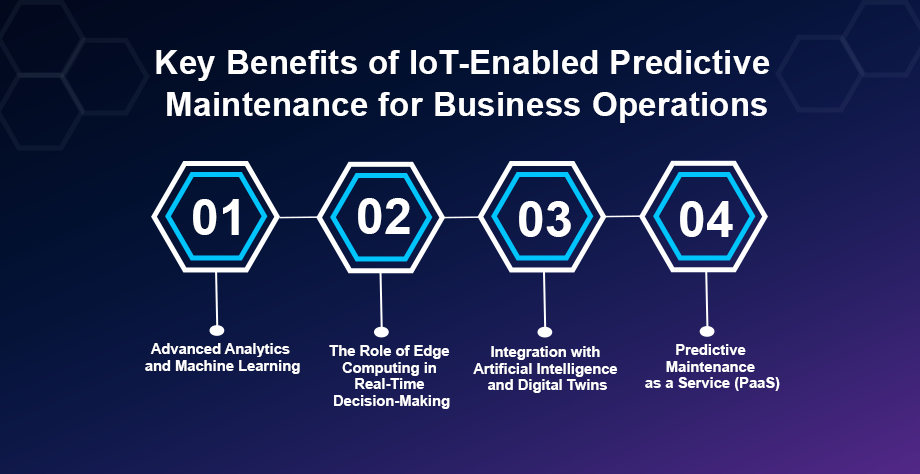
1. Advanced Analytics and Machine Learning
As IoT technology continues to evolve, advanced analytics and machine learning will become even more integral to predictive maintenance systems. By analyzing large volumes of real-time and historical data, machine learning algorithms can identify patterns and trends that were previously undetectable. This will enable businesses to predict equipment failures with even greater accuracy, optimizing maintenance schedules and minimizing downtime.
Organizations will increasingly rely on predictive models and real-time data analytics to pinpoint anomalies early on, allowing for timely interventions. The combination of big data analytics and IoT sensors will make predictive maintenance more precise, cost-effective, and accessible for businesses of all sizes.
2. The Role of Edge Computing in Real-Time Decision-Making
Edge computing is becoming an essential component of IoT systems. By processing data locally on IoT devices or nearby gateways, edge computing reduces the need to send all data to a cloud server for processing. This results in faster decision-making with lower latency, which is crucial for time-sensitive applications such as predictive maintenance.
As edge computing becomes more prevalent, businesses will be able to perform real-time analysis of equipment conditions without relying solely on cloud-based systems. This will allow for quicker responses to maintenance needs, ensuring that equipment remains in optimal working condition and reducing the risk of unexpected downtime.
3. Integration with Artificial Intelligence and Digital Twins
The integration of artificial intelligence (AI) and digital twin technology with IoT-based predictive maintenance is another trend that will shape the future of this field. A digital twin is a virtual representation of a physical asset, such as machinery or equipment. When combined with IoT sensors, a digital twin can simulate the performance of real assets, enabling businesses to predict maintenance needs and performance issues with remarkable accuracy.
By leveraging AI-powered predictive models and digital twins, businesses can perform advanced simulations and predictive modeling to optimize asset performance, improve decision-making, and minimize downtime. These technologies will also help companies anticipate future equipment needs and proactively address potential issues.
4. Predictive Maintenance as a Service (PaaS)
Another emerging trend is the adoption of Predictive Maintenance as a Service (PaaS). In this model, businesses can partner with third-party providers who offer predictive maintenance solutions through cloud platforms. This allows organizations to access advanced analytics, machine learning algorithms, and real-time data insights without the need to invest heavily in infrastructure or in-house expertise.
PaaS lowers the barriers to entry for small and medium-sized businesses, enabling them to implement predictive maintenance solutions without the high upfront costs typically associated with IoT-based systems. By subscribing to these services, businesses can stay competitive by leveraging cutting-edge technology without the need for significant capital investment.
How XCEEDBD Can Assist You with IoT-Based Predictive Maintenance
If your business is looking to implement IoT-based predictive maintenance, XCEEDBD can help. With our extensive expertise in IoT development and implementation, we assist businesses in designing and deploying IoT-enabled solutions that include sensors, connectivity, and advanced data analytics capabilities.
We specialize in guiding companies through the entire process of integrating predictive maintenance systems, ensuring seamless deployment and maximum return on investment. Our team works with you to build scalable, adaptive solutions that provide real-time data insights, improve operational efficiency, and reduce costs. Whether you’re in manufacturing, energy, transportation, or any other sector, we can help you leverage IoT to drive business success.
Conclusion: The Path Forward with IoT-Based Predictive Maintenance
Incorporating IoT-enabled predictive maintenance into your business operations is no longer just an option—it’s a necessity for staying competitive in today’s fast-paced market. By using IoT technology to predict and prevent equipment failures, businesses can significantly reduce downtime, lower maintenance costs, and optimize asset utilization.
With advancements in machine learning, edge computing, AI, and digital twins, the future of predictive maintenance looks brighter than ever. The next step for businesses is to embrace this technology, unlock its full potential, and watch as it transforms operational efficiency, safety, and cost-effectiveness.
Are you ready to enhance your operational efficiency with IoT-based predictive maintenance? Contact XCEEDBD today to explore how our expertise can help you implement the right IoT solutions tailored to your business needs.
Frequently Asked Questions (FAQs)
1. What is IoT predictive maintenance?
IoT predictive maintenance refers to using IoT technology to monitor and analyze equipment performance in real-time. By analyzing sensor data, machine learning models predict when maintenance is needed, reducing downtime and preventing costly failures.
2. How does IIoT contribute to predictive maintenance?
Industrial IoT (IIoT) plays a pivotal role in predictive maintenance by collecting real-time data from machines, sensors, and equipment. This data is then processed using advanced analytics to detect anomalies and predict potential failures, ensuring timely interventions and optimized maintenance schedules.
3. What is preventive maintenance of IoT sensors?
Preventive maintenance of IoT sensors involves regularly servicing and calibrating sensors to maintain their accuracy and performance. This ensures the reliability of data collected from IoT devices, which is crucial for effective predictive maintenance.
4. How does IoT help in predictive maintenance?
IoT helps predictive maintenance by providing real-time data from sensors installed in machinery. This data is analyzed to detect early signs of wear or malfunction, allowing businesses to plan maintenance proactively, minimizing downtime, and extending the life of equipment.
5. What is predictive maintenance for industrial IoT?
Predictive maintenance for industrial IoT involves using IoT devices, such as sensors and actuators, to continuously monitor equipment performance. The collected data is analyzed using machine learning to predict failures, optimize maintenance schedules, and improve overall operational efficiency in industrial settings.