


Selecting the right technology for enterprise software development is crucial for building robust, scalable, and efficient solutions. With an overwhelming array of programming languages and frameworks available in the modern digital landscape, choosing between Python and .NET can be incredibly challenging. However, making an informed decision is vital, as this choice will significantly impact your project’s long-term success, maintenance costs, and scalability.
According to a ResearchGate Survey, Python consistently ranks among the top programming languages, especially within the specialized fields of data science and artificial intelligence. Meanwhile, .NET remains a heavily preferred choice for comprehensive enterprise solutions, with many Fortune 500 companies actively utilizing it for their mission-critical applications.
Let’s delve into Python and .NET’s distinct strengths, technical characteristics, and real-world applications to help you make the best decision for your organization.
An In-Depth Overview of Python for Enterprises
Python is a high-level interpreted programming language that is universally known for its simplicity and readability. Created by Guido van Rossum and first released to the public in 1991, Python places a massive emphasis on clear and concise syntax. It uniquely uses significant indentation to enhance code structure and readability, making it accessible to developers of varying experience levels.
Key Characteristics of Python
Understanding the core traits of Python helps explain why it is so widely adopted:
- Multi-Paradigm Support: Python is highly adaptable because it supports object-oriented, procedural, and functional programming styles.
- Extensive Libraries and Frameworks: The language offers a vast, rich ecosystem of tools. This includes highly utilized frameworks like Django, Flask, Pandas, NumPy, and TensorFlow.
- Versatility: Python is successfully used across various domains, including web development, data science, machine learning, and task automation.
- Active Community: Developers benefit from a large, highly supportive community that continuously contributes to language improvement and provides abundant learning resources.
Pros of Python
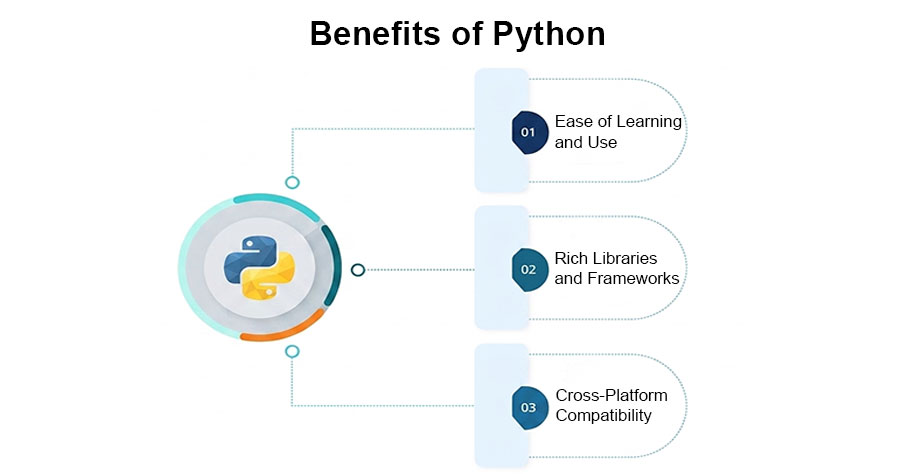
Python in enterprise applications is a highly popular programming language. Consider the following advantages to determine if it fits your organizational requirements:
- Ease of Learning and Use: Python is well-known for its easy-to-read syntax. This specific trait makes it highly efficient and approachable for both novice programmers and expert developers alike. Its purposefully simple design makes it drastically easier to understand complex programming concepts quickly. Furthermore, this simplicity directly reduces the time needed to build, test, and debug code.
- Rich Libraries and Frameworks: Python boasts an extensive ecosystem of libraries and frameworks that make various programming tasks considerably easier. From data analysis tools like Pandas and NumPy to website and app development frameworks like Django and Flask, the options are vast. Utilizing the best Python libraries for various use cases helps to effectively expedite development. These tools facilitate the quick creation of prototypes and the seamless deployment of intricate, complex features.
- Cross-Platform Compatibility: Python operates as a highly multipurpose language that functions reliably on Windows, macOS, and Linux, among other modern operating systems. This inherent cross-platform nature fundamentally allows developers to write code a single time and confidently deploy it across different environments with only minimal necessary adjustments.
Cons of Python
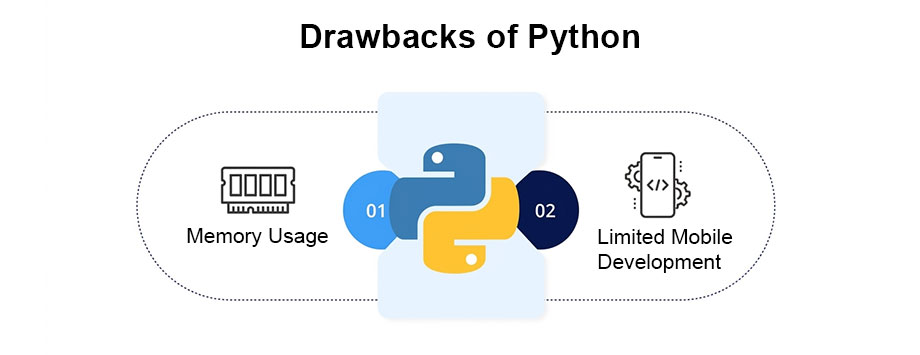
While powerful, Python does present certain structural challenges:
- Memory Usage: Python programming services may use memory more intensively than certain other compiled languages. This is largely because of its high-level data structures and its inherently dynamic nature. Consequently, this intensive usage can cause massive, large-scale enterprise programs to run more slowly and require significantly more hardware memory.
- Limited Mobile Development: The reality is that most native mobile app development does not predominantly use Python. Although there are alternative frameworks available, such as Kivy and BeeWare, native mobile development tools designed specifically for platforms like iOS and Android are vastly more developed and benefit from much wider industry support.
An In-Depth Overview of .NET for Enterprises
.NET is a highly versatile, open-source development platform created and maintained by Microsoft. It is renowned globally for supporting multiple programming languages, exhaustive libraries, and advanced tools specifically designed for building a remarkably wide range of software applications.
Launched initially in 2002, .NET places a strong emphasis on cross-platform capabilities, actively enabling enterprise developers to create highly functional web, mobile, desktop, and other specialized apps.
Key Characteristics of .NET
The .NET ecosystem is defined by several core features:
- Multi-Language Support: The platform supports multiple languages natively, such as C#, F#, and Visual Basic. This variety allows technical teams immense flexibility in their development approach.
- Robust Frameworks: .NET includes powerful frameworks designed for specific tasks, like ASP.NET for dynamic web apps and Xamarin for comprehensive mobile development.
- Cross-Platform Compatibility: Modern .NET architecture allows developers to build applications that run natively on Windows, Linux, and macOS environments.
- Strong Ecosystem: Dedicated .NET development services offer an incredibly rich set of libraries and tools. Additionally, the strong user community provides extensive resources and continuous, reliable support.
Pros of .NET
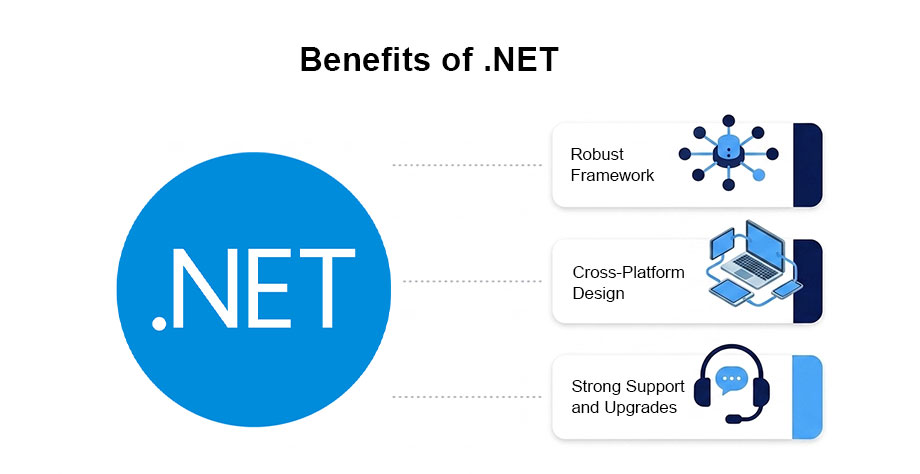
When selecting a primary framework for creating enterprise software, it is absolutely crucial to deeply consider the distinct pros and cons of .NET.
- Robust Framework: .NET consistently provides a robust, heavily structured, and all-inclusive framework for creating diverse enterprise apps. It comes fully equipped with an extensive, tested library of pre-built components. This vast library fundamentally simplifies the otherwise complex processes of efficient development, rigorous testing, and secure deployment of enterprise software.
- Cross-Platform Design: .NET Core is specifically intended to be a truly cross-platform tool, effectively making it a vital and flexible part of the broader .NET ecosystem. Practically, this implies that development teams won’t need to make significant, costly changes to the source code to reliably create and run programs on Windows, macOS, and Linux platforms.
- Strong Support and Upgrades: Microsoft, as the parent organization, consistently offers a highly reliable, wide range of support options and frequent, secure upgrades for the .NET platform. The platform inherently benefits from access to incredibly extensive documentation, a vibrant and active development community, and many mature third-party tools and resources.
Cons of .NET
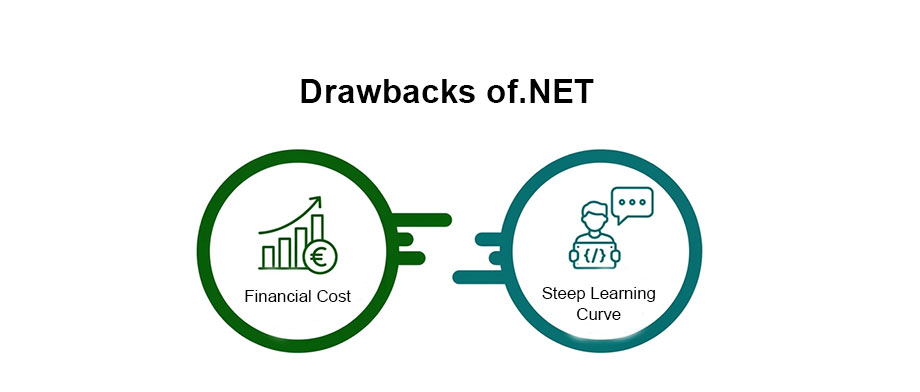
Despite its dominance in the corporate sphere, .NET is not without its drawbacks:
- Financial Cost: Traditional .NET app development costs can sometimes be expensive specifically due to corporate licensing fees, especially when building massive enterprise-level solutions. While the modern .NET Core framework itself is completely free and proudly open-source, there may be unexpected additional fees required for some proprietary features, specialized tools, and sophisticated managed services located within the larger .NET ecosystem.
- Steep Learning Curve: .NET often presents a considerably challenging learning curve for beginners. This difficulty arises primarily because of its incredibly extensive and structurally intricate framework architecture. Developers can expect to take significant time and sustained effort to become genuinely comfortable utilizing the numerous platform components, its primary languages (like C#), and its suite of development tools.
Head-to-Head: Python vs .NET Performance and Features
Comparing Python vs. .NET enterprise solutions is often one of the most confusing processes when technical leaders are choosing a primary programming framework. Having thoroughly reviewed the fundamental pros and cons of Python programming alongside .NET, it is clear that they are strategically suitable for entirely different organizational needs.
Here is a critical breakdown detailing the core differences between Python vs .NET performance and capabilities.
1. Primary Operating System Portability
- Python: Python is incredibly flexible from an infrastructure standpoint and can be successfully used with nearly every modern operating system, including Windows, macOS, and many different Linux versions. Thanks to its seamless cross-platform interoperability, enterprise developers can predictably create and deliver complex programs in several disparate settings with very little code modification. This reliability is precisely what makes it a highly popular option for modern enterprise software development.
- .NET: Originally intended exclusively for the Windows ecosystem, .NET has drastically broadened its market appeal with the highly anticipated release of .NET Core. This modern iteration operates as a dedicated cross-platform programming tool that is strikingly similar in architectural flexibility to Python. Today, .NET apps can operate flawlessly on Windows, macOS, and Linux servers.
2. Performance and Execution Speed
- Python: Because Python is fundamentally an interpreted language rather than a traditionally compiled language like .NET, it might occasionally execute operations more slowly. Technically speaking, Python does not perform as well as .NET when handling heavy, CPU-intensive activities. However, it remains absolutely excellent for highly rapid development cycles and fast prototyping.
- .NET: This specific programming ecosystem is globally renowned for its predictably outstanding performance, especially when scaled to handle massive enterprise-level applications. Because .NET functions as a compiled language, its deployed programs usually operate considerably faster and utilize less system memory during execution. Businesses that critically need high-performance applications—such as instantaneous real-time systems or complex services dealing with a massive lot of data—strongly prefer to use .NET.
3. Enterprise-Grade Security
- Python: Python provides developers with several reliable libraries and robust security capabilities; however, achieving true enterprise-level security strictly requires highly careful management and meticulous implementation. Due to the collaborative open-source nature of Python, teams can use various proven techniques to effectively secure their programs. Despite this, developers absolutely need to update their utilized libraries very frequently and remain constantly aware of deep code dependencies to successfully reduce potential vulnerabilities.
- .NET: Within the industry, .NET is frequently and rightfully thought to be significantly more secure right out of the box, especially for highly regulated businesses. Microsoft consistently offers strong, deeply integrated security features. These include advanced integrated data protection mechanisms, as well as strict authentication and complex authorization systems. The framework inherently serves as a great option for major businesses with stringent security compliance requirements because vital security patches are released very regularly. Furthermore, it seamlessly integrates with other established Microsoft security solutions.
4. Database Support and Integration
- Python: Python enjoys extensive, deep support for many different databases. This is largely thanks to highly developed modules and advanced frameworks like PyMongo, Django ORM, and SQLAlchemy, all of which specifically allow for highly easy, intuitive database interaction. Professional Python development services offer extremely strong support for traditional relational databases like MySQL, PostgreSQL, and SQLite. Concurrently, they also support agile NoSQL databases like MongoDB and Cassandra. This immense variety directly facilitates the complex management and vital scalability required for modern enterprise applications.
- .NET: The primary data access technology actively used by .NET is ADO.NET, which strongly and reliably supports a vast array of enterprise databases. Additionally, the platform heavily supports the Entity Framework. This is a powerful ORM that fundamentally streamlines highly complex database interactions located natively in business applications. Organizations frequently hire .NET developers specifically to get the immense scalability and deep flexibility required for large-scale applications. This is made possible by its exceptionally easy integration capabilities with major systems like MySQL, Oracle, SQL Server, and other massive corporate databases.
5. Core Frameworks
- Python: Python is incredibly well known worldwide for its extensive, highly varied framework ecosystem. This is especially true for the Django and Flask frameworks. Django functions as a highly structured, high-level web framework that is perfect for heavy enterprise-level projects. It earns this reputation because it actively promotes highly quick development and features a remarkably simple, straightforward architectural design. Conversely, the Flask framework is known to be much more versatile and highly lightweight. This structure makes Flask truly ideal for creating smaller applications, or for highly technical developers who strictly need much more granular control over individual system components.
- .NET: The .NET platform includes strong, battle-tested frameworks like ASP.NET and .NET Core. These specific tools are widely considered among the many notable features of the .NET platform and are especially well-suited for effectively developing secure, enterprise-level online applications and web services. Complex enterprise applications may be created seamlessly utilizing ASP.NET’s truly extensive toolkit and sprawling libraries. These tools are used to create highly dynamic webpages and incredibly intricate web apps. Simultaneously, .NET Core’s modern cross-platform functionality reliably lets these complex programs run identically on Windows, macOS, and Linux infrastructure.
6. Ideal Application Use Cases
- Python: Fields that are rapidly becoming increasingly important for advanced enterprise custom software development services—namely Data science, machine learning, and artificial intelligence—all extensively and heavily use Python. Because it is so fundamentally adaptable, Python is a highly flexible option for addressing various, constantly shifting organizational requirements. Today, it stands as the strongly preferred language for creating complex automation tools, deeply robust backend systems, and responsive web applications.
- .NET: In contrast, .NET remains the highly recommended and traditional option for creating massive enterprise-level software. This includes highly demanding massively multiplayer online apps, expansive cloud-based corporate services, and complex desktop programs. It is especially and historically well-liked in strict, regulated sectors that critically need highly reliable, definitively safe, and completely scalable solutions that rely fundamentally on established Microsoft technologies.
Real-World Enterprise Case Studies
Understanding theory is excellent, but examining practical applications brings clarity. Both Python and .NET have successfully emerged as immensely powerful frameworks that capably cater to incredibly diverse, massive project requirements. Here are some notable, real-world case studies clearly showcasing the effective use of Python and .NET in various high-demand applications and global industries:
Spotify’s Data Ecosystem (Python)
Spotify is globally known as the highly popular, industry-leading music streaming service. To maintain its massive infrastructure, the company uses Python extensively for its critical back-end services as well as its deep data analysis operations. Python possesses an unparalleled ability to successfully handle highly complex, large-scale data processing tasks. This specific capability effectively enables Spotify to securely and reliably manage user recommendations, custom radio stations, and complex music discovery features highly efficiently.
Stack Overflow’s Scalable Web App (.NET)
Stack Overflow operates as the globally renowned, definitive question-and-answer platform utilized heavily by programmers everywhere. To manage its staggering daily traffic, the company heavily leverages the .NET platform for its incredibly robust, highly active web applications. The .NET framework’s inherent high-level scalability and its deeply integrated security features actively allow Stack Overflow to reliably handle millions of simultaneous users. Furthermore, it helps safely facilitate completely seamless real-time interactions, ultimately making the site a highly reliable, go-to resource for millions of professional developers worldwide.
Making the Choice: Which One Is Better?
Ultimately, successfully choosing exactly between Python and .NET firmly depends on evaluating your highly specific project requirements, your current team’s technical expertise, and your organization’s overarching long-term business goals.
When to Consider Python
You should strongly consider utilizing Python if:
- Your Project Involves: Deep data science requirements, complex machine learning algorithms, or advanced AI integrations. It is also highly suitable when you require rapid development cycles and fast prototyping.
- You Need: Guaranteed cross-platform compatibility right from the start. Additionally, it is ideal if you need a language featuring a very simple, highly readable syntax specifically for ease of learning and onboarding.
- Your Team: Already strongly prefers, or currently possesses deep technical expertise in, writing and deploying Python code.
When to Consider .NET
You should actively consider adopting .NET if:
- Your Project Requires: Highly demanding, high-performance, and deeply secure enterprise-grade applications. It is also the correct choice if your compliance standards require incredibly robust built-in security features.
- You Benefit From: Deep, seamless integration with existing Microsoft products and enterprise services. Furthermore, it is beneficial if your developers require highly powerful development tools and deeply integrated IDEs.
- Your Team: Already has substantial prior experience working closely with C# and the broader Microsoft technological ecosystem.
The Microservices Approach: Using Both Technologies
In many modern enterprise architectures, you do not actually have to choose just one. Many organizations are successfully Using Both Technologies.
- Microservices Architecture: Enterprises can effectively implement varied microservices in the specific languages that are best suited for their exact tasks, housing them securely within a single cohesive system.
- Interoperability: For example, a company might intelligently use Python specifically for its heavy data processing and highly complex machine learning components. Concurrently, that same company could use .NET to build its highly responsive user interfaces or to power its highly secure core web services.
Conclusion
The ongoing industry debate between utilizing Python and .NET specifically for enterprise software development clearly highlights the absolute importance of carefully selecting the exact right technology stack required to meet your specific business needs. Thoughtfully choosing the right framework can dramatically and significantly impact both your immediate project’s overall success and your long-term organization’s ultimate growth trajectory.
Frequently Asked Questions (FAQ)
Is Python fast enough for massive enterprise applications? While Python is an interpreted language and therefore might occasionally execute more slowly than compiled languages, it is highly excellent for rapid prototyping and deployment. For CPU-intensive activities, .NET is generally faster; however, Python remains the industry standard for enterprise data science and AI applications.
Does .NET only work on Windows servers? No, that is a historical limitation. While originally intended exclusively for Windows, .NET has significantly broadened its capabilities with the release of .NET Core. Today, .NET functions as a true cross-platform tool, and .NET apps can successfully operate on Windows, macOS, and Linux environments.
Which framework is fundamentally more secure for corporate data? .NET is frequently thought by enterprise architects to be more secure right out of the box. Microsoft consistently offers strong built-in security features, including robust data protection, authentication, and authorization systems. Python can also be highly secure, but it requires much more careful, manual management of dependencies and library updates to reduce vulnerabilities.
Can Python be effectively used for mobile app development? Most native mobile app development does not actively use Python. While some alternative frameworks like Kivy and BeeWare exist, the native mobile development tools explicitly built for iOS and Android are significantly more developed and boast vastly wider industry support than Python’s mobile offerings.
Are there hidden costs when choosing .NET over Python? Developing enterprise applications with .NET can sometimes be expensive specifically due to corporate licensing fees associated with massive enterprise-level solutions. Although the modern .NET Core framework is completely free and open-source, there may still be mandatory additional fees required to utilize specific sophisticated services and advanced tools located within the larger .NET ecosystem.
Ready to Build Your Next Enterprise Solution?
At XCEEDBD, we clearly recognize that making the correct choice precisely between Python and .NET is absolutely crucial for the long-term success of your enterprise’s overarching digital str ategy. Our dedicated team of software experts is highly committed to reliably providing perfectly tailored software development solutions that align directly with your unique corporate goals.
- Option 1 (Soft CTA): Whether you specifically need expert assistance with new application development, complex legacy system integration, or high-level technology consulting, you can easily hire our .NET or Python developers to provide expert guidance safely through every critical step of your journey.
- Option 2 (Direct CTA): Don’t leave your enterprise architecture to chance. Contact us today to quickly learn exactly how XCEEDBD can successfully help you intelligently leverage the absolute best technology available for your demanding enterprise software development needs.