


In a digital landscape where attention spans are fiercely contested and algorithms dictate organic reach, owning your audience has never been more critical. Social media platforms can change their rules overnight, but your email list remains a proprietary asset.
When executed correctly, an optimized email marketing strategy is arguably the most powerful tool in your digital marketing arsenal. The numbers speak for themselves: email marketing consistently delivers an average return on investment (ROI) of $42 for every single dollar spent. That is not a vanity metric; it is a direct driver of sustainable revenue growth.
However, the days of batch-and-blast newsletters are long gone. Today’s consumers demand relevance, value, and personalization. If you simply send promotional emails without context, you will quickly find your messages ignored, unsubscribed from, or worse—banished to the spam folder.
To achieve outsized returns, your email marketing must be rooted in strategic list growth, meticulous segmentation, automated behavioral workflows, and high-converting copywriting. Whether you are scaling an e-commerce brand or nurturing B2B leads, this comprehensive guide will equip you with the exact strategies needed to transform your email channel into a predictable revenue engine.
1. The Anatomy of a High-Converting Email Campaign
Before automating complex sequences, you must master the fundamentals of a single, highly effective email. Every campaign you send must excel in three core areas: the subject line, the body copy, and the call to action (CTA).
Mastering the Subject Line
Your subject line is the gatekeeper of your content. If it fails to capture attention, the brilliantly crafted copy inside will never be read. To optimize open rates, you must balance curiosity with clarity.
- Keep it Concise: Mobile devices truncate subject lines after roughly 40-50 characters. Front-load the most critical information or the primary hook.
- Leverage Personalization: Beyond just using a first name, tailor the subject line to their recent behavior. For example, instead of a generic “Check out our new shoes,” use “A new running shoe for your upcoming marathon, John.”
- Create Authentic Urgency: Avoid fake scarcity. If a sale is ending in 24 hours, state it clearly: “Final 24 Hours: Your 20% Discount Expires Tonight.”
Structuring the Body Copy for Clarity and Impact
Once the email is opened, your body copy must immediately validate the promise made in the subject line. A highly effective methodology for structuring email copy relies on the “4Cs” framework:
- Clear: Eliminate jargon and complex sentence structures. The reader should understand your core message within three seconds of scanning.
- Concise: Respect the reader’s time. Cut the fluff. If a sentence does not advance the narrative or push the reader toward the CTA, delete it.
- Credible: Build trust quickly. Incorporate social proof, customer reviews, or data-backed claims to validate your offer.
- Compelling: Focus on the transformation, not just the features. How does clicking your link improve the reader’s life or solve their specific pain point?
Designing the Call to Action (CTA)
A high-converting email has one primary objective. Asking the reader to read a blog post, follow you on social media, and buy a product in the same email dilutes focus and crushes conversion rates.
- Isolation: Give your CTA breathing room. Use contrasting brand colors to make the button visually distinct.
- Action-Oriented Language: Avoid passive phrases like “Click Here.” Use strong, value-driven verbs such as “Claim Your Custom Strategy,” “Shop the Fall Collection,” or “Download the Free Framework.”
2. Architecting a High-Quality, Scalable Email List
A massive email list is useless if the subscribers are unengaged or unqualified. Organic list growth focuses on attracting high-intent users who genuinely want to hear from your brand.
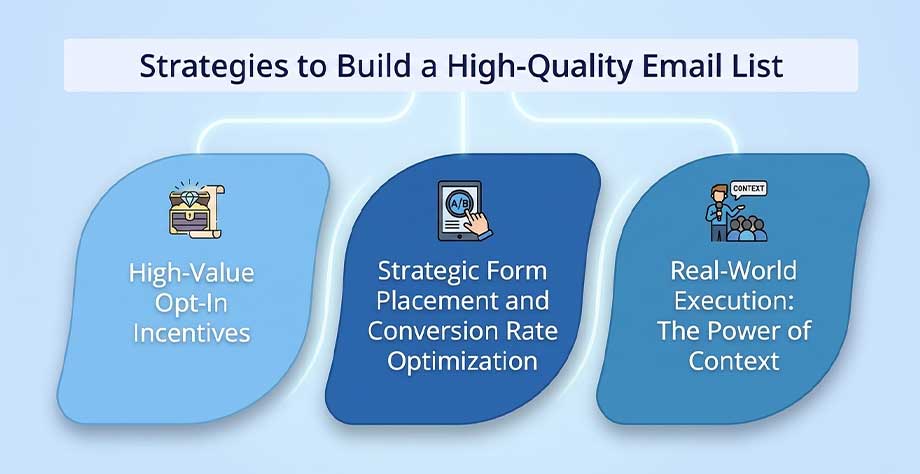
High-Value Opt-In Incentives
Consumers are fiercely protective of their inbox. To earn their email address, you must offer an immediate, tangible exchange of value—often referred to as a lead magnet.
For e-commerce, this is traditionally a first-purchase discount (e.g., 10% off). However, relying solely on discounts eats into margins. Consider alternative high-value incentives:
- Exclusive Content: A downloadable styling guide, an industry report, or a comprehensive checklist.
- Early Access: VIP access to new product drops or seasonal sales before the general public.
- Interactive Quizzes: A “Find Your Perfect Fit” or “Assess Your Digital Marketing Health” quiz that requires an email to view the customized results.
Strategic Form Placement and Conversion Rate Optimization
Where you ask for the email is just as important as what you offer. Relying on a static form buried in your website footer is insufficient.
- Behavioral Pop-ups: Instead of assaulting visitors the second they land on your site, use time-delayed or scroll-percentage triggers (e.g., appearing after the user scrolls 50% of a blog post).
- Exit-Intent Technology: Trigger a final, compelling offer precisely when the user’s cursor moves to close the browser tab.
- Inline Contextual Forms: Embed visually distinct opt-in boxes directly within high-traffic blog content, offering a downloadable resource specifically related to the article they are reading.
Real-World Execution: The Power of Context
Consider this scenario: A digital marketing agency was struggling with a 0.8% conversion rate on their generic “Subscribe to our Newsletter” homepage pop-up. The Task: Increase high-quality lead capture without resorting to gimmicks. The Action: They replaced the generic pop-up with a targeted exit-intent offer reading: “Don’t leave without our 2024 Technical SEO Audit Template (Used to rank 50+ clients).” The Result: The opt-in rate surged to 4.2%, adding a steady stream of highly qualified, intent-driven leads to their sales pipeline.
3. Advanced Segmentation Strategies
Sending the same email to your entire database—known as “batch and blast”—is a guaranteed way to increase unsubscribe rates. Segmentation is the process of dividing your audience into distinct groups so you can deliver hyper-relevant messaging.
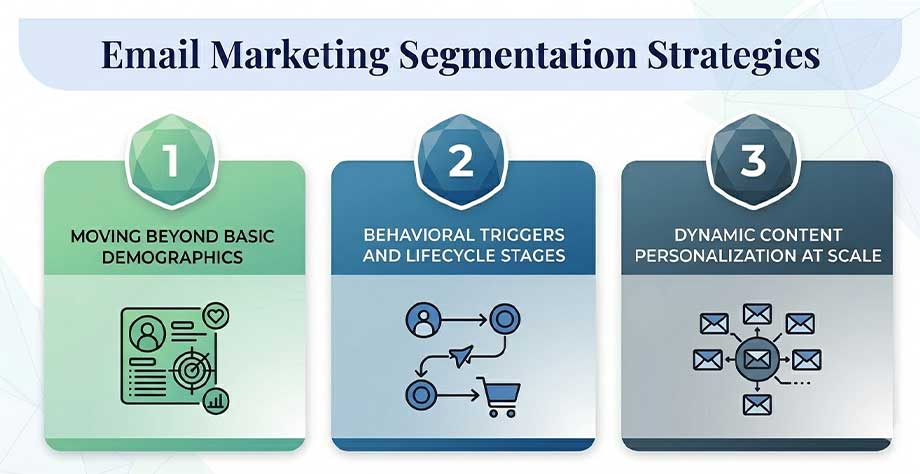
Moving Beyond Basic Demographics
While segmenting by age, gender, or geographic location is a start, it barely scratches the surface of what is possible. True personalization requires understanding user intent.
Behavioral Triggers and Lifecycle Stages
The most profitable segments are based on how users interact with your brand. By mapping emails to the customer lifecycle, you ensure relevance.
- The Window Shoppers: Subscribers who frequently open emails and browse categories but haven’t purchased. Send them educational content about product quality or social proof via user-generated content.
- The VIPs: Customers who have purchased multiple times and have a high lifetime value (LTV). Reward them with early access to new releases, exclusive loyalty tiers, or referral incentives.
- The Churn Risks: Customers who haven’t engaged or purchased in 90+ days. Target them with aggressive win-back campaigns or surveys asking how you can improve.
Dynamic Content Personalization at Scale
Modern email service providers (ESPs) allow you to use dynamic content blocks within a single campaign. This means you can build one email framework, but the images, copy, and product recommendations swap out automatically based on the individual recipient’s data. If you run a pet supply store, a subscriber who previously bought dog food sees a hero image of a dog, while a cat owner sees a cat—all from the exact same campaign send.
4. Building Automated Workflows for Continuous Revenue
If you are only sending manual broadcast emails, you are leaving massive amounts of revenue on the table. Automated email workflows operate in the background 24/7, triggering specific messages based on user behavior.
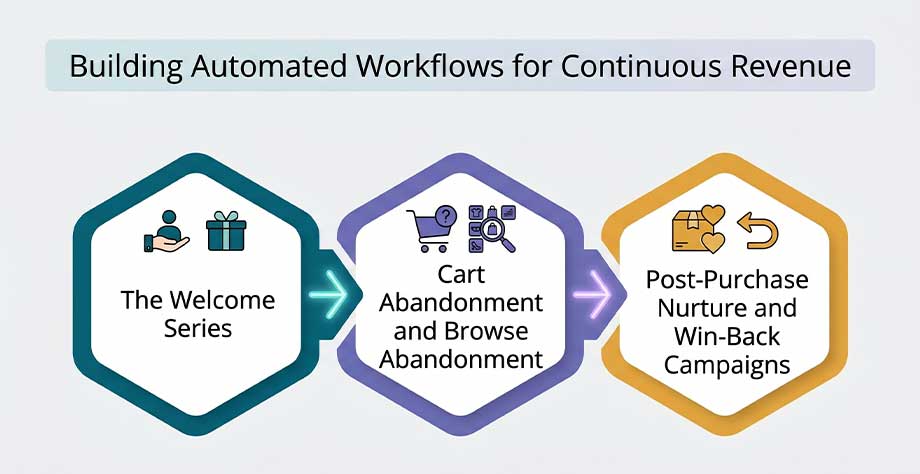
The Welcome Series
The moment a user subscribes, their intent and interest are at their absolute peak. Do not waste this opportunity with a single “Thanks for subscribing” message. Build a 3-to-4 part welcome sequence:
- Email 1 (Immediate): Deliver the promised incentive (discount code, ebook) and introduce your brand’s core mission.
- Email 2 (Day 2): Highlight your best-selling products or most popular content. Show them where to start.
- Email 3 (Day 4): Share your brand story, founder background, or core values to build an emotional connection and credibility.
Cart Abandonment and Browse Abandonment
Nearly 70% of online shopping carts are abandoned. An automated sequence is your best tool for recovering this lost revenue.
- The Scenario: A high-intent shopper adds a $150 item to their cart but gets distracted by a text message and closes their browser.
- The Action (Automation): * 4 Hours Post-Abandonment: Send a low-friction, helpful reminder: “Did you leave something behind? Your cart is saved.”
- 24 Hours Post-Abandonment: Inject social proof. “See why 5,000 others love this item,” featuring 5-star reviews of the specific product left in the cart.
- 48 Hours Post-Abandonment (Optional): Offer a small, time-sensitive incentive (e.g., free shipping or 5% off) to push them over the edge.
- The Result: A well-optimized cart abandonment flow can consistently recover 10% to 15% of abandoned revenue.
Post-Purchase Nurture and Win-Back Campaigns
The customer journey does not end at checkout; it begins. Post-purchase workflows turn one-time buyers into loyal advocates. Send an email a week after delivery asking for a review or offering a tutorial on how to get the most out of the product. For users who lapse, trigger a Win-Back sequence at the 90-day mark: “We miss you! Here is a special offer to come back.” If they remain unengaged after this sequence, it is time to sunset them from your active list to protect your deliverability.
5. Safeguarding Your Inbox Placement: Deliverability
Email deliverability is the technical foundation of your strategy. If your emails are consistently routed to the spam folder, your open rates will plummet, rendering your automation and copywriting useless.
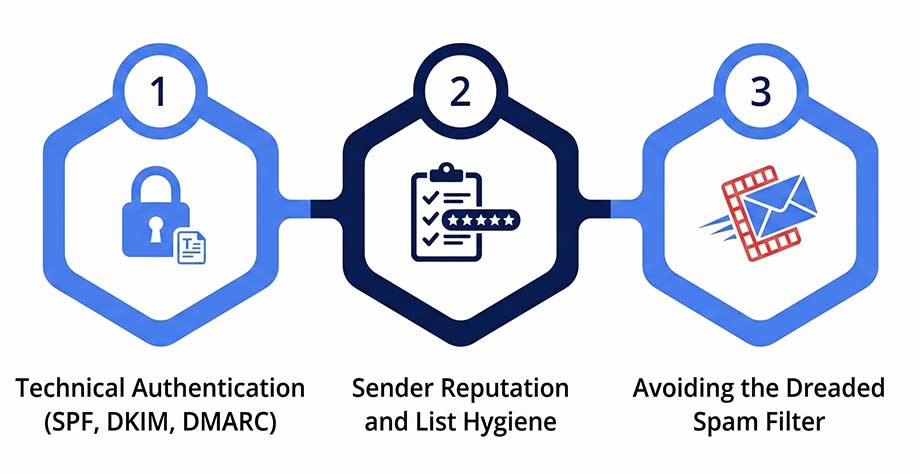
Technical Authentication (SPF, DKIM, DMARC)
Internet Service Providers (ISPs) like Gmail and Yahoo use authentication protocols to verify that you are who you say you are. Failing to set these up is the fastest route to the junk folder.
- SPF (Sender Policy Framework): A DNS record that specifies which IP addresses are authorized to send emails on behalf of your domain.
- DKIM (DomainKeys Identified Mail): Adds a cryptographic signature to your emails, proving to the receiving server that the email was not tampered with in transit.
- DMARC (Domain-based Message Authentication, Reporting, and Conformance): Tells the receiving server exactly what to do if an email fails SPF or DKIM checks (e.g., quarantine it or reject it).
Sender Reputation and List Hygiene
ISPs track how your audience interacts with your emails. If your emails frequently bounce, or if users consistently mark them as spam, your sender reputation will tank. Maintain aggressive list hygiene. Regularly scrub your list to remove hard bounces (invalid email addresses). More importantly, segment out “unengaged” subscribers—those who haven’t opened an email in 4 to 6 months. Continuing to email people who ignore you sends a negative signal to Gmail and Apple Mail, which will eventually penalize your deliverability for your engaged subscribers as well.
Avoiding the Dreaded Spam Filter
Beyond technical setup, the content of your email matters.
- Avoid using deceptive subject lines (e.g., starting an email with “Re:” or “Fwd:” to trick users into thinking it’s an ongoing conversation).
- Maintain a healthy text-to-image ratio. Emails composed entirely of one large image cannot be read by spam filters and are often flagged as suspicious.
- Never purchase email lists. Not only is it illegal in many jurisdictions, but these lists are also seeded with “spam traps”—hidden email addresses used by ISPs to catch and blacklist spammers.
6. Decoding Email Metrics for Continuous Optimization
To scale your email marketing efforts, you must transition from intuition-based decisions to data-driven optimization. Tracking the right metrics allows you to diagnose bottlenecks in your funnel.
Analyzing the Core Four Metrics
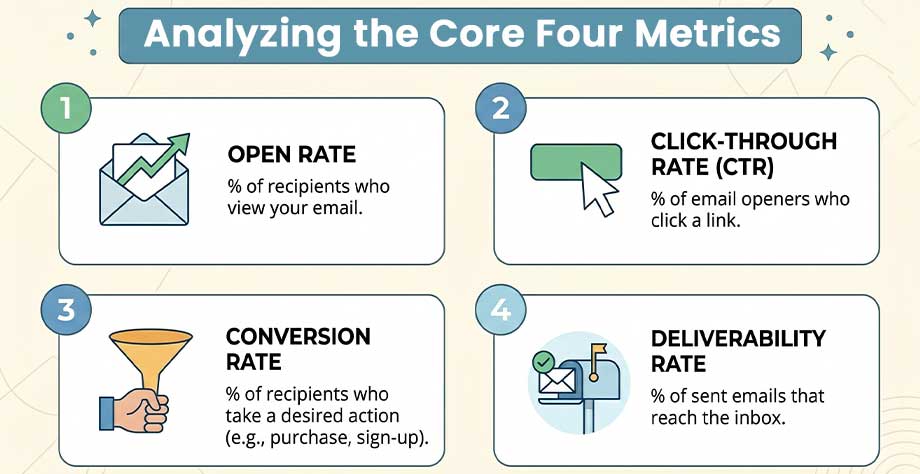
- Open Rate: While Apple’s Mail Privacy Protection (MPP) has inflated this metric slightly, it remains a directional indicator of subject line effectiveness and sender recognition. If open rates drop suddenly, you likely have a deliverability issue.
- Click-Through Rate (CTR): The percentage of people who clicked a link out of those who opened the email. This measures the relevance of your body copy and the strength of your CTA.
- Conversion Rate: The ultimate metric. It tracks the percentage of recipients who completed the desired action (e.g., making a purchase or booking a consultation) after clicking through.
- Unsubscribe Rate: A healthy unsubscribe rate is below 0.5%. If it spikes, you are either sending emails too frequently or your content is no longer aligning with user expectations.
Establishing a Rigorous A/B Testing Protocol
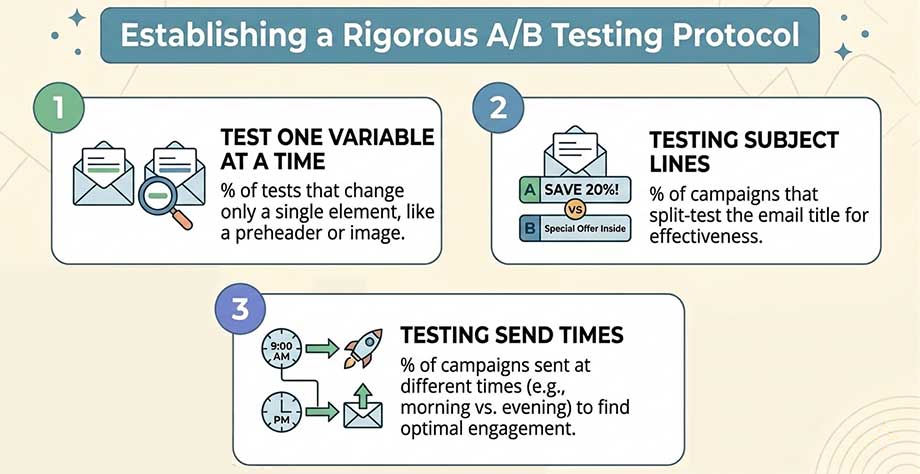
Never assume you know what your audience wants; let the data dictate your strategy. Implement continuous A/B testing (split testing) on your campaigns.
- Test One Variable at a Time: If you test a new subject line, a new hero image, and a new CTA all in the same email, you will not know which change drove the result.
- Testing Subject Lines: Test a question versus a definitive statement. Test including an emoji versus plain text.
- Testing Send Times: Does your B2B audience engage more on Tuesday mornings or Thursday afternoons? Does your e-commerce audience prefer Sunday evening browsing? Test, measure, and optimize.
7. Navigating Global Privacy and Compliance Laws
As digital privacy regulations become increasingly stringent, ethical email marketing is no longer just a best practice—it is a legal requirement. Non-compliance can result in catastrophic fines and permanent domain blacklisting.
CAN-SPAM and GDPR Essentials
If you operate in the US, the CAN-SPAM Act mandates that you must never use false or misleading header information, you must identify promotional messages as ads, you must include a valid physical postal address, and you must honor opt-out requests promptly (usually via an automated unsubscribe link).
If you have subscribers in the European Union, the GDPR (General Data Protection Regulation) applies to you. GDPR requires explicit, affirmative consent. Pre-ticked checkboxes on opt-in forms are strictly prohibited. You must clearly state what the user is opting into, and you must securely manage their data, providing them the right to be forgotten upon request.
Building a Culture of Transparent Permission
Ultimately, compliance builds trust. Only send emails to individuals who have explicitly requested them. Make your unsubscribe link highly visible; hiding it only frustrates users and leads them to click the “Mark as Spam” button, which severely damages your sender reputation. Transparent, value-first communication will always win in the long run.
Ready to Scale Your Revenue?
Your email list is your most valuable digital asset, but only if you have the strategy to unlock its potential. Stop leaving money on the table with generic newsletters and leaky funnels.
Ready to implement high-converting, automated email architectures that drive predictable revenue? Schedule a Free Strategic Consultation with XCEEDBD today and let our experts build your custom growth roadmap.
FAQ
Q: What is a good average open rate for email marketing? A: While it varies by industry, a healthy open rate typically ranges between 20% and 30%. However, due to recent privacy changes like Apple’s Mail Privacy Protection, click-through rates and conversion rates are far more reliable indicators of campaign success.
Q: How often should I send marketing emails to my list? A: Consistency is more important than frequency. For e-commerce, 2-3 times a week is standard during non-peak seasons. For B2B or service businesses, a high-value weekly or bi-weekly cadence works best. Always monitor your unsubscribe rates to gauge if you are sending too often.
Q: Why are my marketing emails going to the spam folder? A: Spam placement usually stems from poor sender reputation. This can be caused by missing authentication protocols (SPF, DKIM, DMARC), high bounce rates from an uncleaned list, recipients manually marking your emails as spam, or using deceptive subject lines.
Q: What is the difference between a broadcast email and an automated workflow? A: A broadcast email is a manual, one-time campaign sent to a specific segment at a specific time (like a seasonal sale announcement). An automated workflow is a pre-built sequence of emails triggered automatically by user behavior, such as abandoning a cart or signing up for a newsletter.
Q: Do I really need to use double opt-in for my email list? A: While not strictly legally required in the US, a double opt-in (where users must click a confirmation link in their email to join) ensures a much higher quality list, eliminates fake email addresses, and significantly improves long-term deliverability and engagement rates.
Q: How do I improve my email click-through rate (CTR)? A: To boost CTR, ensure your email uses the “4Cs” framework (Clear, Concise, Credible, Compelling). Keep your design scannable, isolate a single Call to Action (CTA) button with contrasting colors, and use action-oriented copy that focuses on the benefit to the reader.