
Machine learning (ML) has graduated from a futuristic concept to an indispensable engine driving the modern business landscape. It is no longer just a buzzword for tech giants; it is the fundamental force transforming raw data into actionable insights, precise predictions, and automated efficiency.
As Adnan Masood, Chief AI Architect at UST, rightly puts it, “Machine learning is beneficial for modern business.” But that statement, while true, only scratches the surface. This remarkable technology has permeated every facet of operations—from critical decision-making and predictive maintenance to hyper-personalized service delivery.
The widespread adoption of ML is a testament to its transformative power. Across sectors, forward-thinking developers and business leaders are seamlessly integrating ML into their workflows to reap rich benefits. But what does this look like in practice, and how can your organization leverage it?
In this comprehensive guide, we will explore the profound impact of machine learning, dissecting its market potential, its underlying mechanisms, and its top applications across diverse industries.
Machine Learning – A Market Overview
To understand the urgency of adopting machine learning, one only needs to look at the market trajectory. The numbers tell a story of explosive growth and inevitable integration.
According to Fortune Business Insights, the global machine learning market stood at $19.20 billion in 2022. However, the future holds even more staggering potential. The market is projected to surge from $26.03 billion in 2023 to an impressive $225.91 billion by 2030.
This growth trajectory reflects a robust Compound Annual Growth Rate (CAGR) of 36.2% during the forecast period. Such rapid expansion signals that ML is moving from an “experimental” phase to a “core infrastructure” phase for businesses worldwide.
The Catalyst: Crisis and Innovation
The resilience and utility of ML were tested and proven during the global disruptions of 2020. As COVID-19 forced countries into quarantine and social distancing, researchers and businesses needed swift, data-driven tools to navigate the unknown.
- Rapid Response: Researchers turned to innovative ML tools to assess policy effects in real-time.
- MIT’s Contribution: In April 2020, a team at the Massachusetts Institute of Technology (MIT) devised a model harnessing pandemic data. Relying on advanced machine learning algorithms, this model predicted the virus’s spread and assessed the effectiveness of quarantine measures with a speed manual analysis could never match.
The success of such models underscored a critical business truth: the demand for advanced ML capabilities to tackle critical, fast-moving challenges is only growing.
The Evolution: Business Life Before vs. After Machine Learning
To fully appreciate the value ML brings, we must look at the operational landscape that preceded it. Before the era of Machine Learning, businesses grappled with significant friction points that hindered growth, efficiency, and agility. These challenges stemmed largely from the limitations of traditional data analysis methods.
The “Before” State: Manual & Reactive
Life before ML was characterized by reaction rather than prediction.
- Manual Data Analysis: Businesses relied heavily on human analysts to pour over spreadsheets. This was a slow, labor-intensive process prone to fatigue and error, often leading to delayed decision-making.
- Limited Data Processing: Traditional tools could not handle “Big Data.” Companies often worked with small sample sizes, missing the valuable insights hidden in the vast majority of their unanalyzed data.
- Lack of Real-time Insights: By the time data was processed, market conditions had often changed. Businesses struggled to pivot quickly based on shifting customer behavior.
- Inefficiency in Predictive Analysis: Forecasting was often a guessing game based on simple historical averages. This led to sub-optimal inventory management (stockouts or overstocking) and poor resource allocation.
- Human Error & Bias: Manual analysis is inherently subjective. Personal biases and simple calculation errors frequently impacted the objectivity of strategic decisions.
The “After” State: Automated & Proactive
Machine Learning flipped this dynamic. Instead of looking backward at what happened, ML allows businesses to look forward at what will happen. It replaces manual drudgery with automated intelligence, allowing human talent to focus on strategy rather than calculation.
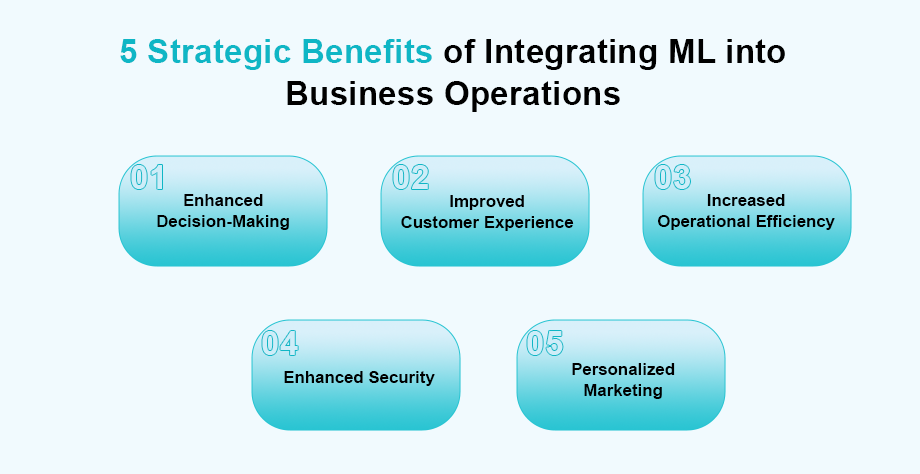
5 Strategic Benefits of Integrating ML into Business Operations
Why are companies racing to invest in this technology? Machine Learning offers advantages that directly impact the bottom line and competitive positioning. Here are five key benefits of incorporating ML into your business processes:
1. Enhanced Decision-Making
Machine Learning empowers businesses to move from “gut feeling” strategies to data-driven precision. ML algorithms can sift through vast datasets faster than any human team, identifying trends and correlations that are invisible to the naked eye.
- Real-world impact: Netflix uses ML to analyze viewing history and recommend personalized content. This isn’t just a convenience; it is a strategic retention tool that keeps users engaged and reduces churn.
2. Improved Customer Experience
In the digital age, generic service is a business risk. ML enables a tailored, responsive customer experience.
- 24/7 Availability: ML-powered chatbots and virtual assistants resolve customer queries instantly, regardless of the time zone.
- Seamless Navigation: Platforms like Shopify utilize chatbots to help customers navigate online stores efficiently, directly improving satisfaction scores and increasing conversion rates.
3. Increased Operational Efficiency
One of the most immediate ROI drivers for ML is the automation of repetitive, high-volume tasks.
- Predictive Maintenance: In manufacturing, algorithms monitor equipment conditions via sensors. They schedule maintenance only when necessary—preventing costly unexpected breakdowns while avoiding unnecessary routine maintenance.
4. Enhanced Security
As digital threats evolve, so must our defenses. ML is instrumental in bolstering cybersecurity by moving from static firewalls to dynamic threat detection.
- Anomaly Detection: Financial institutions employ ML to spot unusual transaction patterns in real-time (e.g., a card used in two countries within an hour), effectively identifying and blocking fraudulent activities before damage is done.
5. Personalized Marketing
Machine Learning allows businesses to create marketing campaigns with surgical precision.
- Targeted Recommendations: Retail giants like Amazon analyze customer behavior, purchase history, and even browsing time to recommend products. This increases the “share of wallet” by putting the right product in front of the right person at the right time.
Demystifying the Tech: How Machine Learning Actually Works
Have you ever wondered how machines can learn and make predictions seemingly independently? To the uninitiated, Machine Learning might appear to be magic. In reality, it is a blend of sophisticated algorithms, data-driven training, and neural networks working in sync.
Here is a simplified look at the “underlying mechanism” of this technology:
1. Algorithms: The Building Blocks
At the heart of any ML system lies a set of algorithms. Think of these as mathematical “recipes” or instruction sets designed to sift through data, identify patterns, and make decisions. These algorithms act as the brain, taking in data inputs (ingredients) and generating predictions as outputs (the meal).
2. Training the Brain: Data is Key
A machine learning model is like a new employee: it needs training.
- The Learning Process: ML models require extensive datasets comprising historical information. The model studies this data to understand relationships and trends.
- The Analogy: This process is like teaching a child. If you show a child thousands of pictures of cats and say “this is a cat,” they eventually learn to identify a cat they have never seen before. Similarly, the more data examples an ML model is exposed to, the better it learns.
3. The Neural Network Connection
For complex tasks—like recognizing a face in a photo or translating a spoken language—simple algorithms aren’t enough. This is where Neural Networks come in.
- Inspired by Biology: These networks are inspired by the human brain’s structure, consisting of layers of interconnected artificial neurons.
- Deep Learning: They excel at capturing intricate, non-linear patterns and nuances within data that traditional software would miss.
4. The Cycle: Learn, Adjust, Predict
Once trained, the ML model diligently studies new data, discovers patterns, and remembers them.
- Example – Spam Filters: In a spam email detection system, the model analyzes thousands of emails during training, learning to distinguish between “safe” language and “spam” language. When you receive a new email, the model applies this learned knowledge to predict whether it is spam. It is a continuous cycle of learning, adjusting, and predicting at lightning speed.
Top Machine Learning Applications Across 5 Key Industries
ML has emerged as a transformative force, reshaping how industries operate and excel. The following section showcases the top machine learning applications across various sectors, unraveling the innovation, efficiency, and profound impact it brings to each domain.
1. Healthcare
Machine Learning applications are making significant strides in the healthcare sector, transforming how diseases are diagnosed, treatments are developed, and patient care is administered. It is shifting medicine from reactive to predictive.
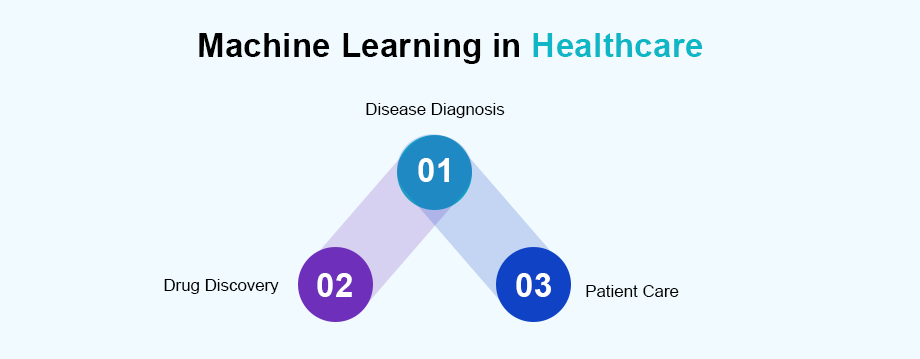
- Disease Diagnosis: ML algorithms analyze medical images (X-rays, CT scans, MRIs), pathology reports, and patient records to aid diagnosis. It acts as a “second pair of eyes” for radiologists, often detecting anomalies invisible to the human eye.
- Notable Example: IBM Watson aids in cancer diagnosis and treatment recommendations by analyzing vast medical literature and patient data to support oncologists.
- Drug Discovery: Developing a new drug traditionally takes a decade and billions of dollars. ML accelerates this by predicting the biological effectiveness of potential drug candidates before physical testing, significantly reducing time and cost for pharmaceutical companies.
- Patient Care: ML-powered Electronic Health Records (EHRs) utilize predictive analytics to alert healthcare providers about potential patient risks (like sepsis or readmission), enabling proactive intervention.
2. Finance
The finance industry is perhaps the most data-rich sector in the world, making it a perfect playground for ML. It has revolutionized the industry by automating tasks, enhancing security, and improving risk management.
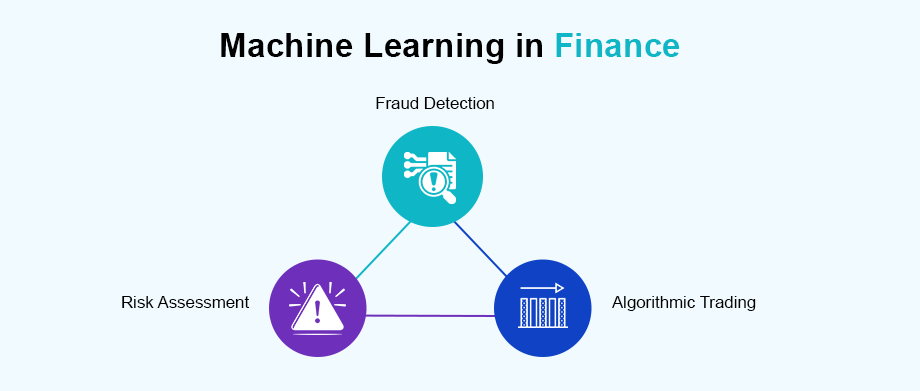
- Fraud Detection: This is the most critical application. ML algorithms analyze real-time transaction data to identify fraudulent activities.
- Notable Example: Companies like JPMorgan Chase and PayPal utilize ML to flag suspicious activities instantly, reducing financial losses and ensuring user trust.
- Risk Assessment: Traditional credit scoring is limited. ML assesses credit risk by evaluating a borrower’s complete financial history and behavioral patterns, improving loan approval accuracy and expanding access to credit.
- Algorithmic Trading: In the stock market, milliseconds matter. ML-driven algorithms predict market trends, optimize trading strategies, and execute trades at lightning speed, far surpassing human capability.
3. Retail
In retail, Machine Learning is a game-changer. It enables businesses to understand customer behavior and streamline the supply chain.
- Demand Forecasting: Predicting what customers will buy next week is crucial. ML predicts demand based on seasonality, trends, and even weather, helping retailers optimize inventory.
- Inventory Management: By optimizing stock levels, ML reduces holding costs (the cost of storing unsold goods) and ensures products are always available when customers want them.
- Customer Personalization:
- Notable Example: Amazon’s recommendation engine accounts for a massive portion of their revenue. By suggesting products based on detailed customer preferences, they create a highly curated shopping experience.
4. Manufacturing
The manufacturing sector benefits from Machine Learning by ensuring efficient production processes, product quality, and supply chain management. This is often referred to as “Industry 4.0.”
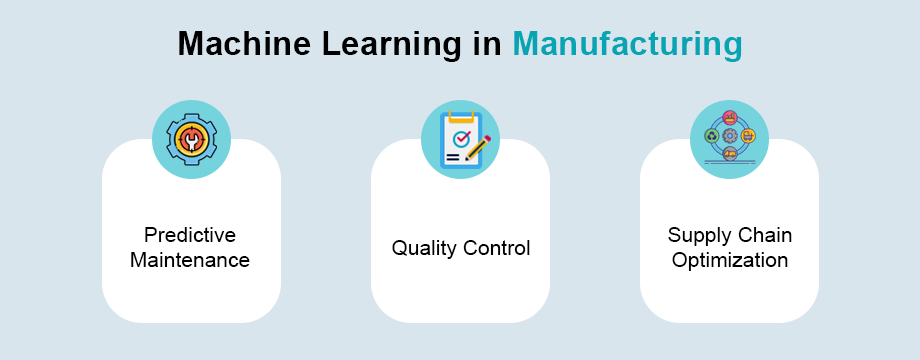
- Predictive Maintenance: Instead of fixing machines when they break, ML models analyze sensor data (vibration, heat, sound) to predict when equipment needs maintenance.
- Notable Example: General Electric (GE) implemented predictive maintenance with ML, resulting in a reported 10% reduction in maintenance costs and a 20% increase in efficiency.
- Quality Control: Computer vision systems powered by ML can identify defects and anomalies on the assembly line in real-time, ensuring only high-quality products reach the packaging phase.
- Supply Chain Optimization: ML optimizes logistics routes and warehouse operations, reducing delays and minimizing transportation costs.
5. Marketing
Marketing has moved from “spray and pray” to “target and convert.” ML is the engine behind this shift.
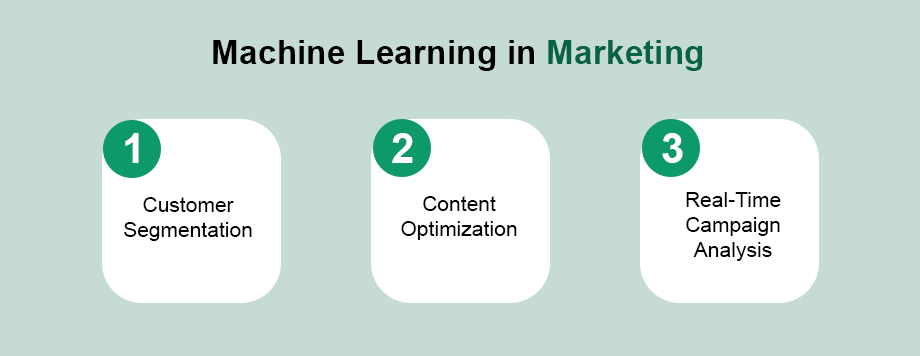
- Customer Segmentation: ML segments customers based on complex behaviors and preferences, allowing businesses to tailor marketing campaigns to specific micro-audiences.
- Content Optimization: ML tools analyze which headlines, images, and email subject lines perform best, suggesting improvements to ensure content resonates with the target audience.
- Real-Time Campaign Analysis: Marketers no longer have to wait until a campaign is over to see results. ML provides real-time insights, enabling adjustments on the fly.
- Notable Example: Netflix employs ML not just to recommend movies, but to determine which thumbnail image is most likely to make you click on a title based on your viewing history. This demonstrates the profound impact of ML on user engagement.
Navigating the Hurdles: Challenges and Ethical Considerations
As ML continues to transform industries, it brings unique challenges and ethical considerations that organizations must address. Navigating these hurdles is crucial for harnessing the full potential of ML while ensuring responsible and ethical practices.
1. The Implementation Challenges
- Data Privacy: ML relies heavily on data, which is often personal or sensitive. Protecting user privacy is paramount. Organizations face the challenge of striking a balance between accessing data for training and complying with regulations like GDPR or HIPAA.
- Bias & Fairness: ML algorithms are only as good as the data they are trained on. If historical data contains human bias (e.g., in hiring or lending), the algorithm can “inherit” and amplify that bias. Ensuring fairness is an ongoing challenge.
- Regulation & Compliance: The regulatory landscape around AI is evolving rapidly. Staying compliant with new AI-specific laws is a continuous operational challenge for global businesses.
2. The Importance of Ethical AI
- Responsible Machine Learning: This involves building systems that prioritize fairness, transparency, and accountability. It ensures that ML models do not inadvertently harm or discriminate against individuals.
- Trust & Reputation: Ethical AI practices build trust. Organizations that prioritize ethical considerations—and can explain how their AI makes decisions—are more likely to maintain a positive brand reputation.
- Long-term Sustainability: Embracing ethical AI is not just a moral choice; it is a business necessity. It reduces the risks associated with legal consequences and public backlash, ensuring the long-term sustainability of AI initiatives.
Accelerate Your Transformation with XCEEDBD
The gap between knowing you need Machine Learning and successfully implementing it can be wide. When it comes to harnessing the full potential of ML in your business, partnering with experts is crucial.
At XCEEDBD, one of the industry’s leading machine learning companies, we bridge that gap. We bring over 12,500+ successful projects’ worth of experience to your organization.
Our team of IT professionals understands the intricacies of ML languages such as Python and R, ensuring that your projects are executed flawlessly. Our services cover the full spectrum of advanced capabilities, including:
- Cognitive Insight & Engagement: Unlocking deep patterns in your data to drive strategy.
- Cognitive Automation: Streamlining complex workflows.
- Data Mining: Extracting value from large, raw datasets.
- Natural Language Processing (NLP): Enabling machines to understand and generate human language.
- Robotic Process Automation (RPA): Automating rule-based business processes.
We work closely with you to identify your unique needs and tailor machine learning solutions that drive tangible results. Whether you are looking to enhance customer engagement, automate business processes, or extract valuable insights from data, we have you covered.
With our track record of delivering cutting-edge ML solutions—such as Shop With Us, Expense Management App, Health Tracking App, Invoicera, EATIGO, and Klyke—we are here to help you stay ahead in the ever-evolving technological landscape.
Conclusion
The pervasive influence of Machine Learning across industries is undeniable. From the warehouse floor of a manufacturing plant to the trading desks of Wall Street, we are witnessing the potential of this technology to solve complex challenges and drive exponential growth.
To stay ahead in this evolving landscape, businesses must harness the capabilities of machine learning development services. The journey has only begun, promising endless possibilities for those willing to explore its potential.
Frequently Asked Questions (FAQ)
1. What is the difference between AI and Machine Learning? Artificial Intelligence (AI) is the broader concept of machines being able to carry out tasks in a way that we would consider “smart.” Machine Learning (ML) is a specific subset of AI where machines are given access to data and let them learn for themselves, rather than being explicitly programmed for every single rule.
2. How expensive is it to implement Machine Learning for a small business? The cost varies significantly based on the complexity of the project. However, with the rise of cloud-based ML services and scalable solutions from providers like XCEEDBD, ML is becoming increasingly accessible to small and medium-sized enterprises (SMEs), not just large corporations.
3. Will Machine Learning replace human employees? While ML automates repetitive and data-heavy tasks, it is generally viewed as a tool for augmentation rather than replacement. It frees up human employees to focus on creative, strategic, and interpersonal tasks that machines cannot perform.
4. What industries are growing the fastest in ML adoption? According to recent market data, Healthcare, Finance, and Retail are currently the leaders in adoption. However, Manufacturing and Logistics are rapidly catching up due to the high ROI of predictive maintenance and supply chain optimization.
5. Do I need a team of data scientists to use Machine Learning? Not necessarily. While having in-house expertise helps, many businesses partner with specialized development agencies (like XCEEDBD) to build and maintain their ML infrastructure, allowing them to focus on their core business goals.
6. Is customer data safe when using Machine Learning? Data safety depends on implementation. Ethical ML providers prioritize data encryption, anonymization, and compliance with privacy laws (like GDPR) to ensure that customer data is used securely and responsibly.
Ready to Transform Your Business with AI?
Don’t let your data go to waste. Contact XCEEDBD today to discuss how our machine learning experts can build a custom solution for your industry.
[Book a Call with an Expert]