The digital landscape has shifted dramatically over the last few years. As of 2023, global mobile app revenue had already surpassed the $935 billion mark. Fast forward to 2026, and that trend hasn’t just continued—it has accelerated.
However, for many businesses, the barrier to entry remains high. Custom development requires significant capital, time, and technical oversight. But what if you could bypass the heavy lifting? What if you could capitalize on this mobile boom without the hefty development costs associated with building software from scratch?
Enter the white-label solution.
White-label apps are revolutionizing the development landscape by offering a “middle ground” between off-the-shelf software and fully bespoke engineering. They allow businesses to swiftly launch branded applications with customized features, skipping the hassle of starting from square one.
But is a white-label app right for your specific business model? What does the architecture actually look like under the hood? In this comprehensive guide, we will uncover the advantages, dissect the challenges, and provide a technical overview of building white-label applications in 2026.
What Exactly is a White-Label App?
To understand white-label software, it helps to look at a tangible example from the retail world.
Consider a retail giant like Walmart. When you walk down their aisles, you see products sold under their private brand, “Great Value.” Walmart doesn’t necessarily own the factories producing those specific potato chips or cleaning sprays. Instead, they purchase products from third-party manufacturers and sell them under their own brand.
White-label mobile app development works the same way.
It is a product created by one company (the provider or “Company A”) that is re-branded and sold to customers by another company (“Company B”).
A Real-World Scenario
Let’s break this down with a practical example in the tech space:
- The Provider (Company A): You create a robust, fully functional Android app designed specifically for food delivery. It has GPS tracking, menu management, and payment gateways built-in.
- The Client (Company B): A local Italian restaurant wants to offer customers an easy way to order from their smartphones, but they cannot afford a $50,000 custom development project.
- The Solution: The restaurant buys a license to your app.
- The Transformation: They customize the app with the restaurant’s logo, brand colors, and specific menu items. To the end-user (the hungry customer), it looks exactly like the restaurant built the app themselves.
Meanwhile, you (Company A) handle the backend support and maintenance, allowing the restaurant staff to focus on cooking rather than coding. This partnership allows businesses to acquire a fully supported solution with minimal investment.
White Label Mobile Apps Vs. Custom Mobile Apps
Before diving into the architecture, it is crucial to understand the strategic differences between going white-label and building a custom mobile app. In 2026, the choice often comes down to a trade-off between speed and absolute uniqueness.
Here is how they compare:
| Feature | White-Label App | Custom Mobile App |
| Development Cost | Significantly lower (subscription or one-time license). | High initial capital investment (often $50k+). |
| Time to Market | Rapid launch (weeks or even days). | Slow deployment (months to over a year). |
| Maintenance | Handled by the provider/vendor. | Requires an in-house team or retainer agency. |
| Customization | Limited to branding and pre-set features. | Infinite—you build exactly what you want. |
| Scalability | Dependent on the vendor’s roadmap. | Fully controlled by your architecture. |
The Core Benefits of White Label App Development
Why are so many industries shifting toward this model? Building a white-label app offers several strategic advantages that make it an attractive business option in the current economy.
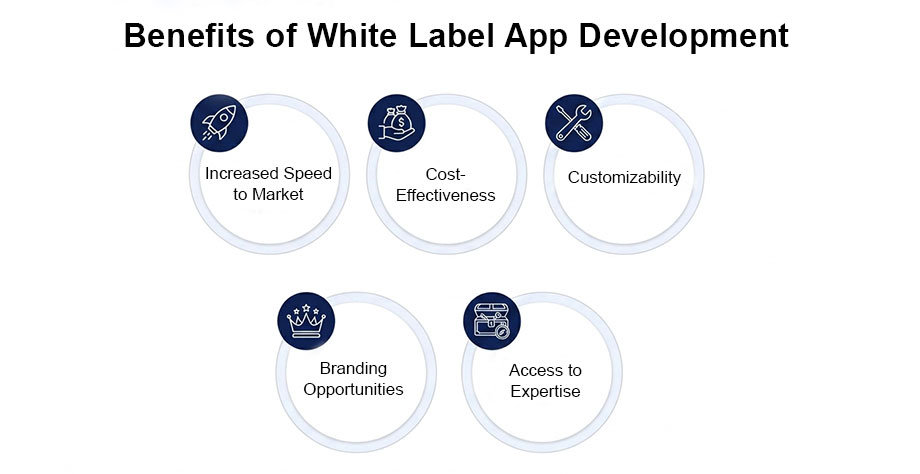
1. Increased Speed to Market
In the digital age, speed is currency. Developing an application from scratch involves wireframing, prototyping, coding, testing, and debugging—a process that can take six to twelve months. White-label apps allow businesses to skip this time-consuming cycle. By utilizing a pre-built framework, you can launch quickly, giving you a competitive edge before your rivals can even hire a CTO.
2. Cost-Effectiveness
Budget constraints are the primary killer of innovation projects. Custom development requires hiring UI/UX designers, frontend developers, backend engineers, and QA testers. With white label mobile app development, these costs are amortized across many users. Businesses save massively on development costs by using pre-built solutions, making enterprise-grade technology accessible to SMBs.
3. Branding Opportunities
White-label apps allow businesses to strengthen their brand identity. Even though the core code is shared, the user interface is “skinned” to reflect the company’s image. This reinforces brand recognition and loyalty among users, who interact with your logo on their home screen every day.
4. Access to Expertise
When you leverage a white label mobile app builder, you aren’t just buying code; you are buying the expertise of the team that built it. You gain access to experienced developers, security experts, and support teams that you may not have the resources to hire in-house. This ensures your app meets 2026 industry standards for security and performance.
5. Customizability (Within Reason)
While not “fully custom,” modern white-label apps offer surprising flexibility. You can tailor the app to specific needs, ensuring it aligns with the business’s unique requirements and branding guidelines.
Scenario: A local gym wants to offer workout tracking. Using a white-label fitness solution, they can launch a “City Gym App” tailored to their class schedule and color scheme, allowing them to compete with national chains without a national chain budget.
Overview of a White-Label App Architecture
Understanding the architecture is essential for both clients and developers. How do you structure an app that can be resold to hundreds of different clients while keeping their data separate?
A robust white-label architecture typically consists of four main pillars:
1. Front-End Design ( The User Experience)
The front-end is what the end-users interact with. In a white-label context, this layer must be highly dynamic to allow for “theming.”
- UI Elements: Buttons, menus, and screens that are coded to accept variable style parameters.
- Dynamic Branding: The code checks a configuration file to determine which logo, color palette, and fonts to load.
- Integration: Seamless connection to backend functionalities to ensure a smooth user experience.
2. Back-End Functionality (The Engine)
The backend handles data processing and business logic. This is usually a multi-tenant architecture, meaning one software instance serves multiple customers (tenants).
- Database Management: Securely storing user data, orders, and sensitive information, often partitioned so Client A never sees Client B’s data.
- Server-Side Scripting: Executing business logic, processing user requests, and generating responses.
- API Integrations: Connecting with third-party services like Stripe (payments), Google Maps (location), or Twilio (SMS).
3. The Admin Panel (The Control Room)
This is the dashboard where your client (the business owner) manages their app.
- Analytics Dashboard: Monitoring app performance, user activity, downloads, and revenue metrics.
- CMS (Content Management System): A simple interface for updating menu items, pricing, push notifications, and promotional offers without writing code.
- Access Control: Defining user roles (e.g., “Manager” vs. “Staff”) and permissions.
4. Customization & Integration Layers
White-label app builders offer extensive options to meet client requirements:
- Feature Toggling: The ability to turn specific features on or off depending on the subscription tier of the client.
- Scalability Options: Infrastructure that automatically scales server resources as the app’s user base grows.
- Third-Party Connections: Enhanced functionality through integrations with existing CRM systems, analytics platforms, and marketing tools.
Which Industries Use White Label Apps?
The versatility of this model means it permeates almost every sector. Here are five key industries where white-label solutions are making a significant impact in 2026:
Retail and eCommerce
White label mobile apps empower retail businesses to offer seamless shopping experiences, rivaling giants like Amazon. Retail chains use these apps for mobile storefronts, loyalty programs, and personalized push notifications.
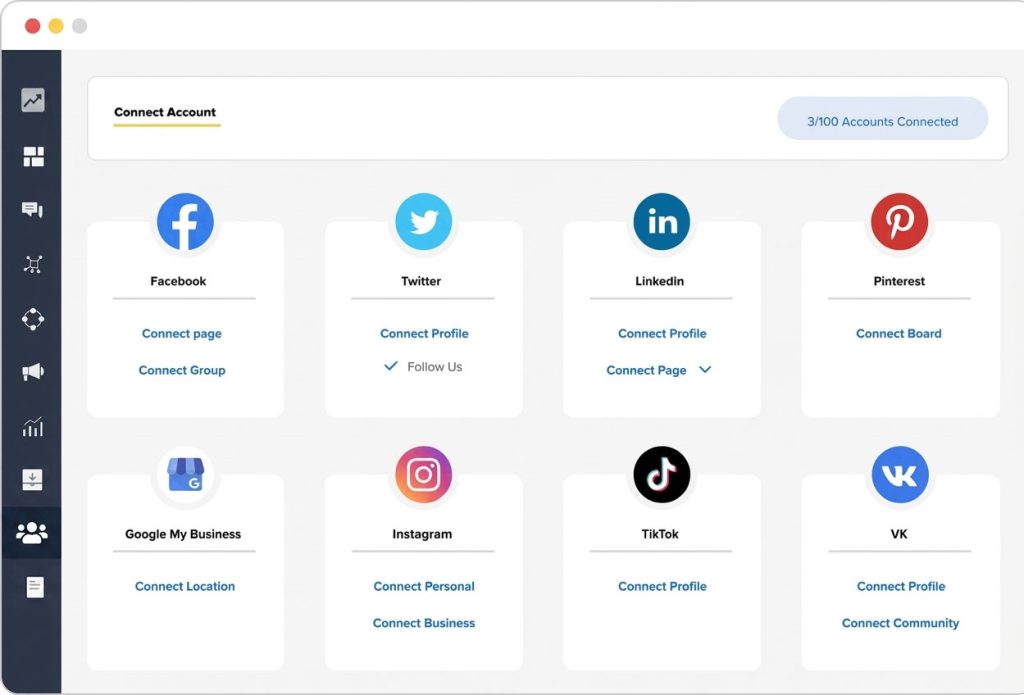
- Example: SocialPilot (while primarily a SaaS tool) demonstrates the power of white-labeling in the B2B marketing space, allowing agencies to present software as their own.
Hospitality and Travel
Hotels, resorts, and travel agencies utilize these apps to streamline the guest experience.
- Use Case: A boutique hotel chain deploys a white-label app allowing guests to perform mobile check-ins, order room service, and book spa appointments—all under the hotel’s brand.
Food and Beverage
This is perhaps the largest market. Restaurants, cafes, and delivery services leverage white-label apps to bypass high-commission platforms like UberEats.
- Use Case: Local eateries partner with app builders to create branded apps for direct online ordering and delivery tracking, keeping the profit margins in-house.
Healthcare and Wellness
Healthcare providers adopt white-label apps for telemedicine, appointment scheduling, and HIPAA-compliant health tracking.
- Use Case: Telehealth platforms utilize these frameworks to connect patients with doctors for virtual consultations, branded specifically for the clinic.
Finance and Banking (FinTech)
Neobanks and startups deploy white-label apps for mobile banking, payment processing, and wallet services.
- Example: SalesPype is a prime example of a finance/CRM-based application that can be white-labeled, enabling professionals to manage sales pipelines under their own banner.
Challenges of White-Label Apps
In the fast-paced world of mobile app development, businesses are increasingly turning to these solutions for convenience. However, despite the benefits, challenges abound. It is vital to be transparent about these hurdles.
Lack of Uniqueness
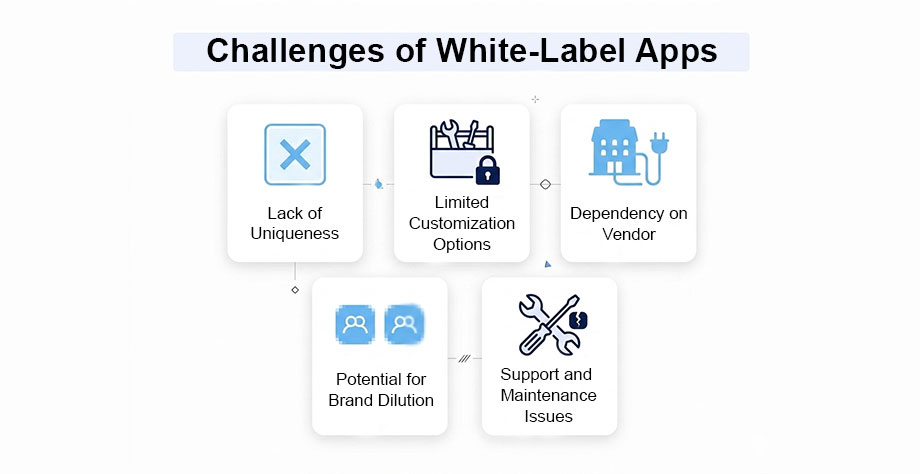
White label app development often utilizes a shared codebase. Since multiple businesses may use the same underlying template, it can be challenging to differentiate yourself from competitors who might be using the exact same platform. If your competitor has the same “Look and Feel,” your brand equity could suffer.
Limited Customization Options
While flexible, you are still playing within the vendor’s sandbox. Many solutions offer limited customization options, restricting businesses from tailoring complex workflows. If you need a hyper-specific feature that isn’t in the roadmap, you might be stuck.
Dependency on Vendor
When you buy white-label, you are renting the technology. You depend on the vendor for ongoing support, updates, and maintenance. If the vendor goes out of business or their servers crash, your app goes down too. This dependency poses a business continuity risk.
Potential for Brand Dilution
If the user experience is “generic” or clunky, it reflects poorly on your brand, not the vendor’s. Users don’t know you bought a white-label solution; they just know your app is glitchy.
Support and Maintenance Issues
Issues such as bugs, security vulnerabilities, or OS compatibility updates (like a new iOS release) must be handled by the vendor. If they are slow to react, your users will leave negative reviews on the App Store.
However, businesses can mitigate these risks by selecting a reliable mobile app builder with a proven track record.
Two Main Approaches to Selling a White Label App
If you are looking to enter the market as a provider of these apps, there are two primary business models to consider.
1. Direct Sales Approach
This involves selling the white-label app directly to the end-user businesses (e.g., selling a booking app directly to a hair salon).
- Pros: You have direct control over the sales process, personalized demos, and typically higher profit margins per sale.
- Cons: It requires a significant sales force and effort to identify and close each individual customer. The sales cycles can be long.
- Examples: Companies like Shopify and Wix effectively use this model, selling directly to merchants.
2. Reseller or Partner Program Approach
Here, you collaborate with other agencies or individuals who sell your app on your behalf.
- Pros: This leverages the network of your partners for broader reach and faster market penetration. It’s a “force multiplier.”
- Cons: You have less control over how your product is pitched. You also have to share revenue, resulting in lower margins per unit.
- Examples: Companies like Appscrip often provide solutions that resellers can market to their own clients.
Which Approach Is Right for You?
- Resources: Can you build a sales team (Direct), or do you prefer managing partnerships (Reseller)?
- Target Audience: Are you targeting SMBs directly, or marketing agencies who serve SMBs?
- Goals: Fast cash flow (Direct) vs. Market dominance (Reseller).
Tips to Choose the Best White Label App Development Company in 2026
Choosing the right partner is not just a technical decision; it is a business marriage. Here is a checklist to help you make an informed decision.
1. Define Your Requirements Clearly
Before you Google “best white label app builder,” know what you need. What specific features are non-negotiable? Do you need a loyalty program? GPS tracking? Geofencing? Knowing this narrows your search immediately.
2. Evaluate Expertise and Experience
How long has the company been in the industry? A company that has survived the tech shifts of the last 5 years is likely stable. Look for a track record of delivering successful projects in your specific vertical.
3. Check Portfolio and Client Reviews
Don’t just look at screenshots; download their live apps. Read client reviews to gauge satisfaction levels regarding uptime and support. A strong portfolio is your best indicator of future success.
4. Assess Customization Options
Ask the hard questions: “Can I change the position of the ‘Buy’ button?” “Can I integrate my own payment gateway?” Ensure the company offers flexible customization options to tailor the app to your brand identity.
5. Consider Support and Maintenance
Post-launch support is more important than pre-launch development. Do they provide timely updates for new Android and iOS versions? Choose a company that offers reliable SLAs (Service Level Agreements).
6. Verify Licensing and Compliance
Ensure the company complies with data privacy laws (GDPR, CCPA) and provides clear legal agreements regarding who owns the user data. Working with a compliant company mitigates legal risks.
7. Schedule a Consultation
Arrange a meeting. Use this opportunity to assess their communication skills. Are they trying to sell you, or are they trying to solve your problem? Trust your instincts.
To Conclude
As we navigate the digital ecosystem of 2026, it is evident that while challenges exist, the advantages of white-label apps far outweigh them for the vast majority of businesses.
White-label apps offer a cost-effective, time-efficient solution to enter the market swiftly. With the demand for mobile app development services skyrocketing, these solutions provide the necessary competitive edge to survive and thrive.
XCEEDBD stands ready to assist businesses in navigating these challenges and reaping the benefits. As the digital landscape continues to evolve, embracing white-label app development opens doors to endless possibilities. Whether you’re a startup looking to make your mark or an established enterprise seeking innovation, let XCEEDBD guide you toward success in 2026 and beyond.
Frequently Asked Questions (FAQ)
Q: Is a white-label app legal?
A: Yes, absolutely. It is a legitimate software licensing model where one company grants another the right to rebrand and sell their technology. It is standard practice in industries from retail to SaaS.
Q: Can I customize the code of a white-label app?
A: Generally, no. You can usually customize the branding (logos, colors) and configuration (features, menus), but you rarely get access to the source code unless you pay a significant fee for a “source code license.”
Q: How much does a white-label app cost in 2026?
A: Costs vary widely. A subscription-based model might cost $100–$500 per month, while a one-time license fee could range from $5,000 to $20,000, which is still significantly cheaper than the $50,000+ required for custom development.
Q: Will the app work on both iPhone and Android?
A: Most modern white-label solutions are built on cross-platform frameworks (like Flutter or React Native), allowing them to function seamlessly on both iOS and Android devices from a single codebase.
Q: Who owns the user data in a white-label app?
A: typically, you (the client) own your user data, but the vendor hosts it. Always clarify data ownership and portability in your contract before signing.
Ready to Launch Your Branded App?
Ready to dominate your market with a custom-branded mobile app? Stop waiting for “someday.” Contact XCEEDBD today for a free consultation and let’s get your app live in weeks, not months.