


According to industry data from Haystack, nearly 70% of software projects fail to be delivered on time. For businesses striving to stay competitive, this statistic is more than just a number—it represents lost revenue, frustrated stakeholders, and missed market opportunities.
For startups and enterprises alike, the challenges are often identical: long wait times for updates, critical bugs appearing post-launch, and the sheer headache of manual deployments. When your team spends more time fighting fires than building features, innovation stalls.
The solution to breaking this cycle lies in the heart of modern DevOps: CI/CD (Continuous Integration and Continuous Deployment).
CI/CD is more than just a set of tools; it is the operational backbone that turns the collaborative spirit of DevOps into a fast, efficient engine for software delivery. This guide explores how CI/CD transforms the Software Development Lifecycle (SDLC), the tools required to build a robust pipeline, and how XCEEDBD can help you automate your way to success.
Understanding CI/CD: The Engine of DevOps
To appreciate the role of CI/CD, we must first break down its two distinct but connected phases. Together, they replace manual, error-prone handoffs with automated precision.
Continuous Integration (CI): The Collaborative Foundation
Continuous Integration is a development practice where developers regularly merge their code changes into a central repository—often multiple times a day.
- Code Merging: Instead of working in isolation for weeks (leading to “merge hell”), developers commit small changes frequently to a shared repository like Git.
- Automated Testing: Each merge triggers an automated build and test sequence.
- Faster Feedback: If a test fails, the developer is notified immediately. This allows teams to fix bugs when they are small and manageable, rather than days later.
Continuous Deployment/Delivery (CD): The Delivery Mechanism
While CI focuses on the code, CD focuses on the release. It ensures that software can be reliably released at any time.
- Automated Deployment: Once code passes all CI tests, it is automatically built, packaged (containerized), and deployed to target environments (staging or production).
- Streamlined Releases: This removes the “deployment day” anxiety. Releases become routine, low-risk events that happen automatically without manual intervention.
Note: Top-tier software development services utilize CD to push updates to users instantly, ensuring that value is delivered the moment it is ready.
Why CI/CD is Essential for Modern DevOps Success
You may understand the what, but the why is what drives ROI. Transforming from traditional development to a CI/CD-driven workflow impacts every level of your organization.
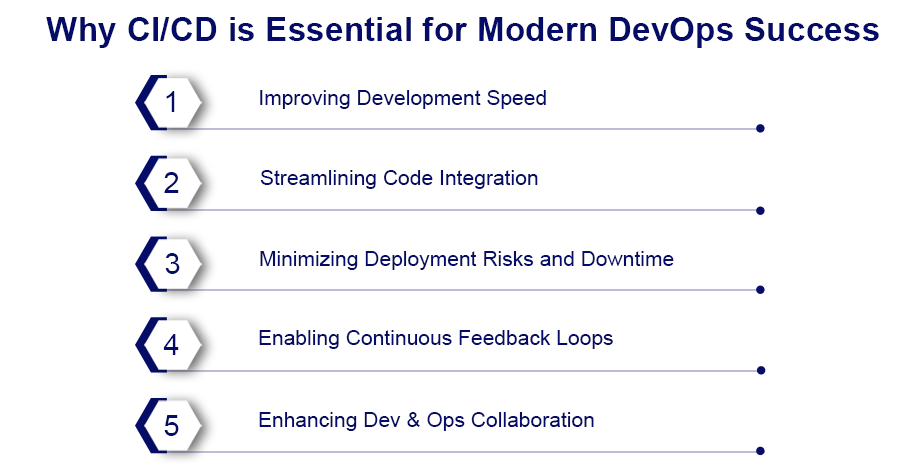
1. Improving Development Speed
CI/CD pipelines act as high-efficiency software assembly lines. By automating repetitive tasks—such as environment provisioning and regression testing—developers are freed from manual grunt work.
- Eliminate Manual Bottlenecks: No more waiting for an ops engineer to manually upload files or configure a server.
- Focus on Innovation: Developers spend their time coding new features, not troubleshooting deployment scripts.
2. Streamlining Code Integration
In traditional setups, integration happens at the end of a sprint, often resulting in massive conflicts. CI/CD smooths this process.
- Conflict Resolution: Frequent merges mean conflicts are resolved daily, not monthly.
- Consistent Quality: Every change is vetted against the main codebase immediately, ensuring the “main” branch is always in a deployable state.
3. Minimizing Deployment Risks and Downtime
The biggest fear in software development is breaking production. CI/CD mitigates this risk through rigorous standardization.
- Automated Safety Nets: Pipelines run comprehensive test suites before any code touches production. If a test fails, the deployment halts automatically.
- Reduced Human Error: Manual deployments are prone to typos and configuration drift. Automation executes the same script, the same way, every single time.
4. Enabling Continuous Feedback Loops
Speed isn’t just about coding fast; it’s about learning fast.
- Instant Visibility: Dashboards provide real-time insights into build health.
- Faster Issue Resolution: When a build breaks, the team knows exactly which commit caused it, drastically reducing Mean Time to Recovery (MTTR).
5. Enhancing Dev & Ops Collaboration
CI/CD is the technological bridge that unites Development and Operations.
- Shared Responsibility: Developers take ownership of how their code runs; Ops teams focus on platform stability rather than manual ticket fulfillment.
- Unified Truth: Both teams look at the same pipeline status, eliminating the “it works on my machine” argument.
Core Components of a Robust CI/CD Pipeline
A CI/CD pipeline is only as strong as its components. Building a seamless workflow requires the right mix of testing frameworks and orchestration tools.
1. Automated Testing Frameworks
Testing is the gatekeeper of quality. Without it, CI/CD is just a fast way to ship broken code.
- Unit Testing: Verifies that individual functions or components work in isolation.
- Integration Testing: Ensures that different modules (e.g., the database and the API) interact correctly.
- Performance Testing: Validates that the software can handle high traffic loads without crashing.
2. Continuous Integration Tools
These tools manage the “Build” and “Test” phases.
- Jenkins: The industry veteran. Highly customizable with a massive plugin ecosystem, suitable for complex, bespoke pipelines.
- GitLab CI: An all-in-one DevOps platform where the CI tool is tightly integrated with the source code repository.
- CircleCI: A cloud-native option known for its speed and ease of integration with modern stacks.
3. Continuous Deployment & Containerization Tools
These tools handle the “Release” and “Deploy” phases.
- Docker: Packages applications and their dependencies into lightweight containers, ensuring consistency across development, testing, and production.
- Kubernetes: The standard for container orchestration. It manages the deployment, scaling, and health of containerized applications.
- Ansible: An automation tool for configuration management, allowing you to provision infrastructure and configure servers via code.
Real-World CI/CD Pipeline Examples
How does this look in practice? Here are specific strategies top teams use to optimize their workflows.
Static Code Analysis
Before code is even run, static analysis tools scan the codebase for security vulnerabilities, coding standard violations, and performance bottlenecks. This enforces best practices and prevents “technical debt” from accumulating.
Code Review Gates
Even with automation, peer review is vital. Modern pipelines block merges until code has been reviewed and approved by a peer. This facilitates knowledge sharing and maintains high coding standards.
Infrastructure as Code (IaC)
Managing servers manually is obsolete. With IaC, infrastructure is defined in code files. This allows you to version control your server configurations just like your application code, ensuring that your staging environment is an exact replica of production.
Canary Releases
Instead of releasing an update to 100% of users at once, a “Canary Release” rolls out the change to a small subset (e.g., 5%). If monitoring tools detect increased error rates, the system automatically rolls back. If the release is stable, it gradually expands to the rest of the user base.
Monitoring & Alerting
The pipeline doesn’t end at deployment. Real-time monitoring tools track application performance post-release. If a bottleneck or error spikes, alerts are triggered immediately, allowing for rapid response.
Accelerate Your Development Cycle with XCEEDBD
As we have explored, CI/CD is not just a trend—it is a vital component of a high-performing technology strategy. It bridges the gap between development speed and software stability.
However, implementing a secure, scalable CI/CD pipeline requires expertise. At XCEEDBD, we specialize in transforming chaotic workflows into streamlined automation engines. We understand that every business has unique infrastructure needs, which is why we offer customized DevOps services.
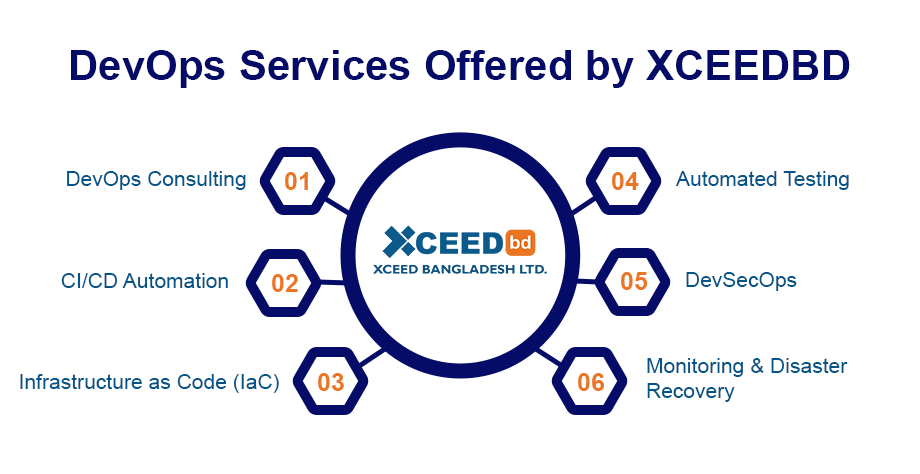
How XCEEDBD Can Help You:
- DevOps Consulting: Strategic planning to align technology with business goals.
- CI/CD Automation: Building pipelines that eliminate manual handoffs.
- Infrastructure as Code (IaC): ensuring reproducible, scalable environments.
- Automated Testing: Implementing rigorous quality gates.
- DevSecOps: Integrating security into the pipeline from day one.
- Monitoring & Disaster Recovery: Ensuring uptime and business continuity.
Don’t let manual processes slow you down. Enhance your development cycle with our top-tier workflow automation services and stay competitive in your market.
Ready to Automate?
[Contact XCEEDBD Today for a Free DevOps Consultation]
Frequently Asked Questions (FAQ)
1. What is the main difference between CI and CD? Continuous Integration (CI) focuses on frequently merging code and automated testing to catch bugs early. Continuous Deployment (CD) focuses on the automated release of that code to production environments.
2. Is CI/CD only for large enterprises? No. Startups benefit significantly from CI/CD. It allows small teams to move fast, release features quickly, and compete with larger companies without needing a massive operations staff.
3. What happens if a test fails in the pipeline? If a test fails, the pipeline halts immediately. The code is not deployed, and the developer receives an instant notification to fix the issue, preventing bugs from reaching users.
4. Can legacy applications use CI/CD? Yes, though it may require some refactoring. We often start by containerizing legacy applications (using Docker) to make them compatible with modern CI/CD pipelines.
5. How does CI/CD improve security? By integrating security scans (DevSecOps) directly into the pipeline, vulnerabilities are detected during the development phase rather than after deployment, making the software inherently more secure.
6. Do I need to use the Cloud for CI/CD? While cloud platforms (AWS, Azure, Google Cloud) make CI/CD easier to scale, pipelines can also be built on-premise using tools like Jenkins and local servers, depending on your data privacy requirements.