


Following the widespread popularity of digital wallet applications, numerous startups and established enterprises are actively trying to leverage e-wallet mobile app development. This strategic move is in direct response to a massive and continuously growing consumer demand for digital payment solutions. The highly publicized success stories of industry giants like Google Pay, Paytm, and PayPal serve as a profound inspiration for many mobile app development companies and ambitious entrepreneurs worldwide.
This specific type of mobile wallet application has fundamentally changed the traditional mode of payment. Instead of relying on physical cash, e-wallets make getting rid of the waiting time to pay bills or transfer money significantly easier and faster than traditional methods. E-wallets are quickly becoming the absolute go-to solution for many individuals looking to transfer money securely from one place to another, and with very good reason. These platforms allow users to utilize money that is stored in an online bank account completely hassle-free. Furthermore, these digital transactions are remarkably quick, incredibly easy, and often completely free of charge.
To understand the sheer scale of this industry, a Global Forecast Report presented by Market Research Future estimated that the E-wallet market would grow at a robust Compound Annual Growth Rate (CAGR) of 15%. That same report projected the market to reach an astounding $2100 billion by the year 2023. As we move further into a cashless society, understanding the architecture of these apps is crucial. In this comprehensive guide, you will find the unique features and the meticulous development process required for successful E-wallet mobile application development.
When developing an E-wallet app, the number one priority of developers should always be to provide a highly secure environment for all e-transactions. Before we thoroughly explore the specific features of E-wallet app development, let us first explore the various foundational methods and technologies used to conduct e-transactions through mobile phones.
What are the Standard E-Wallet Payment Methods?
If you have firmly decided to develop an E-wallet, it is absolutely essential to determine which type of mobile wallet functionality you actually need. Apart from the primary payment method itself, the specific features with which your mobile application is integrated will directly affect the overall mobile app development process.
iBeacon and Bluetooth
This particular method utilizes proximity to help you identify all your nearby friends or contacts for the purpose of making payments. The integration of iBeacon and Bluetooth technologies allows developers to make all e-transactions faster and highly secure. While these specific technologies are still evolving in the fintech space, they are very much indulged and appreciated by a current community of tech-savvy users.
Near Field Communication (NFC)
Near field communication (NFC) is widely considered to be probably one of the best technologies currently being used to transfer funds and successfully share information with a highly convenient approach. These days, the vast majority of modern E-wallets are using NFC technology to allow users to make all of their daily payments in a fully contactless manner.
QR Codes
Quick Response (QR) Codes are undoubtedly one of the most widely used technologies in the digital payment landscape these days. As a user, you can simply use the QR code to transact effortlessly with people you often meet, or with individuals who are part of your immediate social community or office environment. The only technical requirement of this user-friendly method is to simply scan the QR code displayed on another person’s smartphone. This intuitive action thus makes the entire process of peer-to-peer transactions incredibly quick and straightforward.
Payment Via Fund Transfer
This is generally considered the best payment method if your specific E-wallet app is only being built to fulfill dedicated business needs. Through this method, your business can smoothly collaborate with local merchants and various other businesses to transfer funds quickly and reliably. With a properly customized mobile app, moving massive amounts of transfer becomes entirely safe, exceptionally quick, and strictly ensures that no unwanted third party is ever involved in the transaction.
Blockchain
Today, the most highly developed and anticipated trend for online payments is conducting them through an E-wallet that is completely powered by a blockchain network. The massive appeal of this technology is primarily due to its strict immutability and its exceptionally high security standards. Due to the undeniable advantages of utilizing blockchain architecture, blockchain development companies have found themselves in incredibly great demand. Currently, these highly secure mobile applications are mainly used by government entities and large financial institutions, primarily because they have to reliably spend and manage massive amounts of capital every now and then.
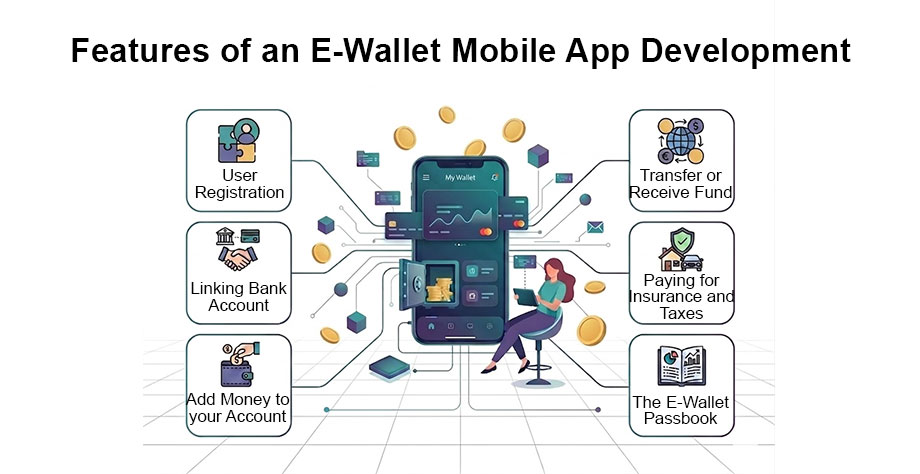
Features of an E-Wallet Mobile App Development
To ensure high user adoption and market competitiveness, here are some essential features you should carefully incorporate while developing a mobile wallet app for your business:
1. User Registration and KYC
As this standard process happens with most commercial apps, the user has to securely register their account on a strictly mandatory note. To begin, users have to use their primary email ID and their active phone number. The user will then receive a secure verification code, and upon correctly entering the code, the application will successfully register his account. Furthermore, some advanced e-wallet apps also proactively use KYC (Know Your Customer) protocols to strictly secure all funds transfer activities.
2. Linking Bank Account
In the crucial next step of onboarding, you have to securely link your personal bank account details directly to the e-wallet, which is where you will eventually make transactions and handle other payments. Further into this process, you must accurately add your physical or virtual card details, including sensitive data like the CVV number and the specific expiry date.
3. Add Money to your Account
For the wallet to be functional, you have to provide a clear option for the user to add more money to the digital wallet. Users can conveniently add money directly to the wallet from their respective linked bank. After successfully adding that specified amount, the newly updated balance will be immediately reflected inside the wallet interface.
4. Transfer or Receive Fund
A core feature of any E-wallet is that it offers you the flexible option of sending money to someone by either manually typing in the designated recipient’s phone number or by simply scanning their unique QR code. Additionally, you can also seamlessly use NFC or specialized beacon technology to send money locally. Naturally, payment can be received by users similarly through these exact same methods.
5. The E-Wallet Passbook
For financial tracking, it becomes absolutely essential to add a dedicated E-wallet passbook so that users should be able to consistently monitor their entire transaction history. Additionally, you can enhance this feature so the user can use the advanced filter option to efficiently go for a much-leading, specific search regarding their past spending.
6. Send Money Back to Bank
These days, the modern E-wallet app also frequently offers an additional, highly requested option, where the user can securely send money back to his original bank account whenever they simply don’t want to keep extra cash sitting idly in the digital wallet. Furthermore, for security and compliance, each app has usually set a strict monthly limit for utilizing the wallet’s features. If a user’s transaction amount unexpectedly exceeds that set limit, you simply cannot do more transactions until the next cycle. For a real-world example, the specific monthly limitation for Paytm (which is a massively popular e-wallet app in India) is set at Rs 10k.
7. Making Bill Payments or Recharges
To increase daily usage, the E-wallet app actively facilitates you to promptly pay your regular essential bills—such as electricity, municipal water tax, and monthly phone bills—in the absolute most convenient way possible. Besides these standard utilities, you can also easily recharge your mobile phones or maintain your home internet broadband connectivity using the exact same application interface.
8. Paying for Insurance and Taxes
Expanding on financial utility, the application provides you with the direct facility to pay your vital insurance premium in a highly timely manner. Moreover, depending on the region, you can also efficiently pay your state income and local sales tax directly with the Help of an integrated app.
9. Flight and Train Reservations
To capture the travel market, recently updated e-wallet apps like PayTm have aggressively introduced the comprehensive facility to easily book flight, train, and even bus reservations directly using the app itself. For the end user, all you have to actually do is to accurately input your desired travel details and seamlessly follow the very easy steps to complete the pay process.
10. Shopping for Grocery & Various Products
Modern E-wallet apps are consistently expanding their impressive suite of user-oriented features. In this growing context, they now frequently offer integrated online grocery shopping right along with numerous other diverse categories of retail items. This massive digital catalog often includes fashion accessories, clothing apparel, daily household items, complex electronic appliances, new mobile phones, and incredibly, even large purchases like cars and bikes.
11. Promotional and Discount Offers
As the global competition level within the fintech space has sharply risen, you urgently need to offer attractive promotions and exclusive discounts to successfully lure more dedicated customers to your platform. Within the app UI, these lucrative deals can be prominently displayed as totally separate categories strategically placed under sections like cashback offer, or categorized as items under 50% discount, etc..
12. Ratings and Reviews
For ongoing quality assurance, now, this is an incredibly important feature where you directly ask the active user to honestly rate your app’s overall service and write a detailed review detailing exactly whether the user is fully satisfied with the current offers and daily deals. Based entirely on the careful analysis of this direct feedback, you can continuously improve your app’s services for the much better.
13. Order History Tracking
The dedicated order history interface clearly displays the comprehensive details of absolutely all orders a specific customer has ever made using the E-wallet app. This extensive log applies whether they are paying monthly bills, booking weekend movie tickets, or digitally shopping for a retail item. In this specific case, if the user has recently purchased a physical item, the app definitely also needs to accurately show his current order’s shipping status and exactly when it will be physically delivered. Functionally, it is something highly similar to what dedicated e-commerce apps successfully perform every day.
14. Selecting the Favored Language
To ensure global or national reach, you have to intentionally provide a wide range of different languages so that the individual user can comfortably choose their native mother tongue or preferred regional language. By doing so, they can easily and fully enjoy using the various app services and promotional offers. Professional developers should always add specific language choices based heavily on the exact geographic region where their intended primary target audience is actually residing. For a practical example, if you are building an app specifically for Indian customers, you absolutely need to add all the major regional languages present in the country, strictly other than just English and Hindi.
15. 24×7 Help and Chatbot Integration
Providing reliable customer support is an absolutely essential feature, specifically keeping the varied user’s urgent needs constantly in mind. If your active customers suddenly face any unexpected problem directly related to a failed payment or concerning any other integrated service, then you urgently need to offer immediate, accessible help to your struggling customers. From a technological standpoint, it would be highly commendable and efficient if you strategically included a smart, automated virtual chatbot service to significantly better interact with your vast user base.
16. Refer a Friend Programs
This built-in referral system is a powerful promotional feature or marketing tool where you actively ask or strongly urge the satisfied user to effectively spread the positive word for your mobile application. In direct exchange for this organic marketing, they will be generously offered highly lucrative offers and very attractive financial discounts on every subsequent transaction they make.
17. Comprehensive App Settings
Finally, deep application settings also inherently become completely vital, as they directly allow the specific user to fully customize the app experience strictly according to his or her personal needs. A robust settings menu will typically include essential areas like personal profile settings, preferred payment settings, strict security settings, etc..
The 5-Step e-Wallet App Development Process
Fundamentally, E-wallet apps are incredibly convenient for modern users who desperately want to securely store all their various payment information strictly in one unified place. When embarking on the journey of creating an e-wallet, it’s absolutely essential to deeply consider the five critical stages of the standard e-wallet app development process: careful planning, intuitive designing, robust building, rigorous testing, and strategic launching.
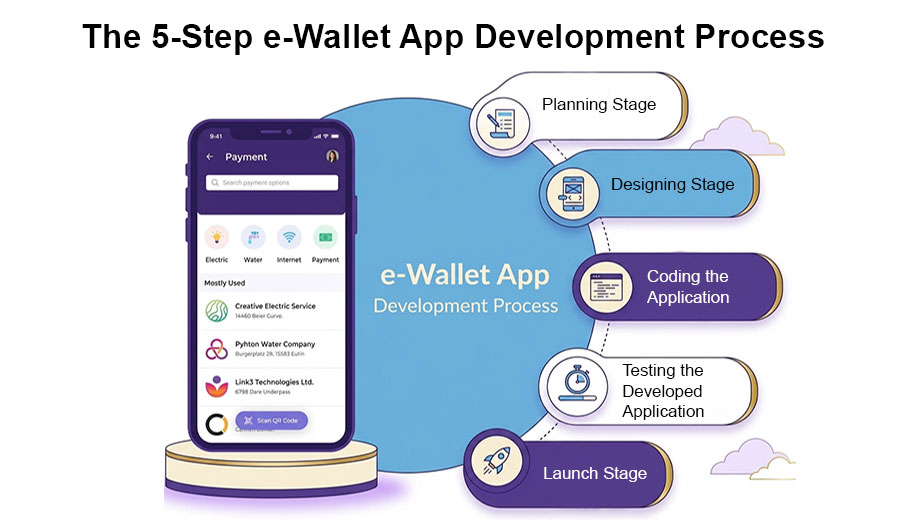
Let’s explore these foundational stages in much greater detail:
Step 1: Discovery or Planning Stage
The absolute first step in any software project is to accurately find the specific target audience and carefully choose an operating platform they’re highly likely to actively use. For a practical example, if you clearly know your specific customers will predominantly be using Apple iOS devices coupled with fast 4G internet connections, deciding to build an iPhone-specific e-wallet app would be entirely appropriate.
Next, you must meticulously develop a comprehensive strategy that clearly outlines exactly how the individual user will smoothly move through the different, varied levels of the complex e-wallet process. This strategy must provide clear guidance on exactly where they should intuitively tap next and outline precisely what happens functionally when they tap on specific interactive screens. For an interface example, when you simply tap a button to add a new card, you’ll immediately see three distinct options presented (such as Apple Pay/Google Pay/Walmart MoneyCard). Selecting any of these will naturally take them to completely different internal screens equipped with specific instructions focused on securely adding each respective card type. Developing such a robust strategy early on will also greatly help ensure visual and functional consistency throughout the entire holistic app experience as well as seamlessly between individual pages.
In this critical early stage, you absolutely must have highly definite, concrete answers to the following vital questions:
- Exactly who are you fundamentally developing this specific app for?
- Will this application ultimately be deployed purely on Android, strictly on iOS, or simultaneously on both of the major platforms?
- Precisely what specific performance metrics do you actually plan to rigorously track immediately after the official launch?
- What are your ultimate top goals and core business objectives for this entire development project?
- Realistically, exactly how long do you accurately anticipate the entire development phase taking from the very start all the way to finish?
Based entirely on these comprehensive answers, your team will finally have a highly concrete, actionable draft of the official e-design brief required for the subsequent design phase of your e-wallet app development.
Step 2: Designing Stage
The visual designing phase heavily includes strategically selecting brand-appropriate colors, readable fonts, intuitive navigation elements, and various other critical layout choices. Once the brand identity is clear, then you can actively begin wireframing the actual UI design. This is done by meticulously creating basic rough sketches of absolutely every single screen and carefully sketching the complex user interactions occurring between screens. Doing this crucial step will effectively map out any potential logical problems long before the team begins writing actual building code later in the expensive development process.
Project managers must strictly ensure that the dedicated designing team of the application fully knows and understands all the required functionalities tied to the e-wallet app development cost. To succeed, they will absolutely have to work incredibly closely with the dedicated mobile developers, engaging content developers, creative graphic designers, highly technical UX specialists, and meticulous QA analysts to properly ensure that absolutely everything works exactly as initially planned.
Step 3: Building or Coding the Application
This is considered a highly crucial, resource-intensive stage in which the various technical functionalities laid out carefully in the earlier phases are finally and concretely implemented. The core developer’s team will officially provide you with a polished final prototype and a highly detailed specifications document sourced directly from your creative design team. That specific moment is exactly when you’ll officially begin actively building out each individual screen associated with your overall e-wallet app development cost.
The chosen app development companies must professionally provide you with a highly detailed timeline carefully detailing exactly how long each specific part of the intricate coding process will actually take. These projected timelines can easily vary depending quite heavily on several distinct factors. These factors include the total number of human resources readily available, the overall technical complexity of the specific e-wallet app development cost, and various external time constraints.
For clarity, the proposed time frame should explicitly detail whether each individual developmental stage is formally estimated to last exactly one week, perhaps two weeks, or even stretch to one full month. Absolutely all project deadlines should be clearly specified and rigorously discussed at immense length before officially agreeing to absolutely anything. This is mainly because frequently missing established deadlines very often directly leads to significantly increased financial costs and causes very significant, damaging delays regarding the final public release date.
Step 4: Testing the Developed Application
During this phase, the dedicated quality assurance team actively works in extremely close coordination with the core developers and the creative designers. Their primary goal is to strictly ensure that absolutely each and every step involved in the overall e-wallet app development cost is thoroughly reviewed at every conceivable stage. It is an undeniably crucial part of the entire e-wallet app development process mainly because it safely ensures that absolutely all coded functionalities perfectly work exactly as per the initial business requirement.
The highly standardized testing process heavily involved in this specific stage usually includes:
- Unit Testing: This specific phase is a highly detailed, granular review of the compiled app to formally verify that each distinct, isolated unit of functionality properly performs exactly as originally expected. Dedicated unit tests strictly check the underlying functionality of very individual, microscopic coding units such as specific data classes, programmed methods, and standalone functions.
- Functional Testing: This broader testing process specifically aims to rigorously verify that the assembled app successfully functions entirely as originally intended by the designers. Comprehensive system-level tests will thoroughly determine exactly how the finished app reliably responds to standard regular use scenarios as well as highly unusual edge cases. Furthermore, QA engineers will actively run a massive battery of complex system-level tests. These mandatory tests usually look like checking for cross-browser compatibility, applying heavy artificial stress, and conducting massive concurrent user load tests.
- User Acceptance Testing (UAT): The primary, ultimate goal of UAT is to officially and formally validate that the final e-wallet app development cost is completely aligned according to your specific business needs and high user expectations. Typically, this is done directly with external beta testers. UAT heavily consists of assigning specific tasks that are specially designed to completely validate the finished app based strictly on its original business requirements, industry standards, or strict corporate security policies.
Step 5: Launch Stage
The final launching stage officially entails actively deploying the finalized E-wallet app development cost directly onto app stores for real-world users to finally gain live access. Once the finished application is successfully put to live status, you, as the app owner, will officially have a dedicated analytics dashboard to accurately track the newly launched app’s ongoing success.
This powerful dashboard will visually show you incredibly detailed, real-time information. This data includes metrics about exactly how many distinct people successfully downloaded and actually installed the specific app, exactly what specific actions they frequently performed while inside, and ultimately, exactly how much financial revenue was successfully generated.
How Much Does E-Wallet App Development Cost?
If you are planning your fintech budget, you might be wondering about the financial investment required. The overall cost of successfully developing an E-wallet mobile app heavily depends on many different, highly variable factors. Specifically, the chosen agency’s pricing model and various other technical aspects strictly control the ultimate, final pricing of the delivered app. However, as a general industry baseline, developing a fully functional E-wallet Mobile app would typically range anywhere from around an estimated $25,000 to approximately $50,000. Furthermore, many distinct technical factors directly determine exactly how long it actually takes to fully develop a mobile E-wallet app. These variables include the chosen application platform, the complexity of app features, the intricacy of the design, the depth of testing, and frankly many more.
Wrapping Up Your E-Wallet Journey
With a highly visible, drastic global shift moving aggressively towards digital payment adoption, the traditional term of using cash-in-hand is very rapidly becoming entirely obsolete. Robust E-wallet apps have completely revolutionized the modern global financial and complex economic sectors. In very recent years, we all have clearly seen exactly how E-wallets app development has surprisingly become incredibly significant in this fast-moving information age and era of advanced technology.
To succeed in this space, you can wisely opt to hire app developers. Professional agency teams will expertly help you systematically build a highly reliable E-wallet mobile app uniquely designed to consistently give your end users a highly captivating, seamless digital experience and ultimately help your business get the absolute maximum financial benefits.
Ready to Build Your Digital Wallet?
Want to learn more about the technical requirements of building a secure payment app? Contact our team of fintech experts today to discuss your vision and get a personalized project roadmap.
Frequently Asked Questions
Q: What is the estimated cost of developing an E-wallet Mobile App?
A: The total cost of thoroughly developing an E-wallet mobile app heavily depends on many distinct variable factors. The agency’s specific pricing model and various other technical aspects dictate the final pricing of the finished app. Generally speaking, developing a standard E-wallet Mobile app would safely range from around $25,000 to upwards of $50,000.
Q: I really want to create an E-wallet mobile app; exactly how long will it practically take?
A: Many complex, interrelated factors actually determine exactly how long it officially takes to fully develop a functional mobile E-wallet app. These major dependencies include the chosen application platform, the sheer volume of app features, the visual design, rigorous testing phases, and many more. For an accurate timeline, you can easily contact an app development company and thoroughly discuss your specific app ideas in great detail.
Q: Exactly where can I reliably hire a skilled developer to professionally make an E-wallet mobile app?
A: You can confidently hire top-tier mobile app developers directly at XCEEDBD. To highlight their massive expertise, the company has successfully done almost 13800+ complex technical projects. This staggering portfolio firmly reflects exactly how incredibly experienced and highly skilled the dedicated developers at XCEEDBD truly are.
Q: What are the absolute primary advantages of using a dedicated E-wallet app?
A: There are truly many distinct, powerful advantages that a well-built E-wallet app seamlessly offers to its users. These include massive daily accessibility , highly timely automated payments , an incredibly wide range of practical uses , and a significantly faster, frictionless transfer of personal funds.
Q: What exactly will be the projected future of modern E-wallet mobile apps?
A: It is widely projected that mobile wallets will consistently and gradually become much more inherently familiar and accepted with both everyday consumers and massive corporate organizations. However, the digital payment market will highly likely continue to rapidly change and evolve in several unpredictable technical ways in the quickly coming years.