Building a modern, high-performance website or web application requires elite technical talent. But what happens when your local talent pool is dry, your budget is stretched thin, or your internal team is overwhelmed with other priorities? For many growing companies in the USA, outsourcing web development has evolved from a simple cost-cutting measure into a highly strategic growth engine.
The IT outsourcing market is expanding rapidly, with global revenue projected to surpass $800 billion by the end of the decade. Businesses of all sizes—from agile startups to established enterprise brands—are recognizing that geography no longer dictates access to top-tier engineering talent. Whether you need a simple corporate website, a complex Software-as-a-Service (SaaS) platform, or a dedicated team to augment your existing staff, partnering with the right external experts can dramatically accelerate your time to market.
However, outsourcing is not a magic wand. Simply hiring the cheapest offshore team often leads to miscommunications, delayed timelines, and subpar code quality. To truly harness the power of global talent, you need a precise strategy. You must know exactly what to look for, which outsourcing model fits your business structure, and how to manage remote collaboration effectively.
If you want to maximize your return on investment and build digital products that drive revenue, this comprehensive guide covers everything you need to know about outsourcing web development today.
When Should You Consider Outsourcing Web Development?
Outsourcing web development can save you thousands of hours and dollars, but timing is everything. Understanding the exact moment your business should transition from an in-house-only model to a hybrid or fully outsourced approach is critical. Here are the most common scenarios that signal it is time to look outward for technical support.
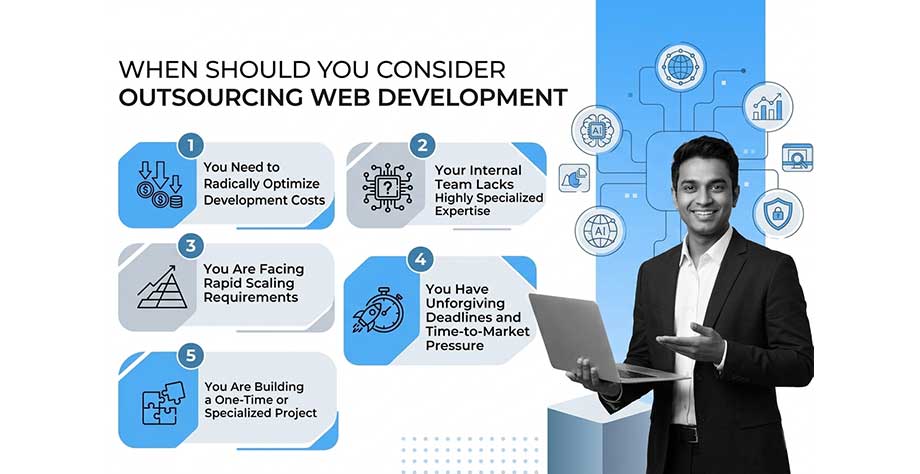
1. You Need to Radically Optimize Development Costs
Building an in-house development team is an expensive endeavor. Beyond baseline salaries, you are responsible for recruitment fees, employee benefits, healthcare, software licenses, office space, and ongoing training. By outsourcing web development, you instantly convert these heavy fixed costs into flexible, variable costs. You gain access to a global talent pool where the cost of living and labor rates are lower, allowing you to secure elite developers for a fraction of the cost you would pay locally, without sacrificing the quality of the final product.
2. Your Internal Team Lacks Highly Specialized Expertise
Technology moves at an incredible speed. One day your team is perfectly equipped, and the next, your project requires an expert in a niche framework like Next.js, specialized cloud infrastructure, or advanced React architecture. Not every business can afford to keep a full stack of specialized engineers on the payroll year-round. When your project demands specialized skills—whether it is frontend wizardry, complex backend API integrations, or rigorous cybersecurity testing—outsourcing gives you on-demand access to professionals who have built similar architectures dozens of times.
3. You Are Facing Rapid Scaling Requirements
Business growth is rarely linear. You might land a massive new client account or receive a sudden influx of funding that demands immediate execution. When the product roadmap expands rapidly, traditional hiring simply cannot keep pace. Recruiting, interviewing, hiring, and onboarding a new in-house developer can easily take three to four months. Conversely, outsourcing allows you to scale your development workforce up or down in a matter of weeks, keeping your business agile, competitive, and responsive to market demands.
4. You Have Unforgiving Deadlines and Time-to-Market Pressure
Do you have a product launch, a major marketing campaign, or a vital investor presentation on the horizon? When deadlines are incredibly tight, pushing your existing internal team to work endless overtime leads to burnout, high turnover, and sloppy code. An outsourced web development agency acts as a rapid-deployment force. Because they are accustomed to aggressive timelines and have robust project management frameworks already in place, they can expedite development and ensure you cross the finish line on schedule.
5. You Are Building a One-Time or Specialized Project
It rarely makes financial sense to hire full-time, permanent employees for temporary needs. If your company is building a specialized internal workflow tool, a short-term promotional microsite, or an event-specific application, outsourcing is the most logical path. Once the project is successfully completed and deployed, you are not burdened with the challenge of finding new work to justify a permanent developer’s salary.
Exploring the Primary Outsourcing Models
Not all outsourcing is created equal. The strategy you choose should align perfectly with your budget, your preferred communication style, and the level of management control you wish to maintain. There are three primary geographic models for outsourcing web development projects.
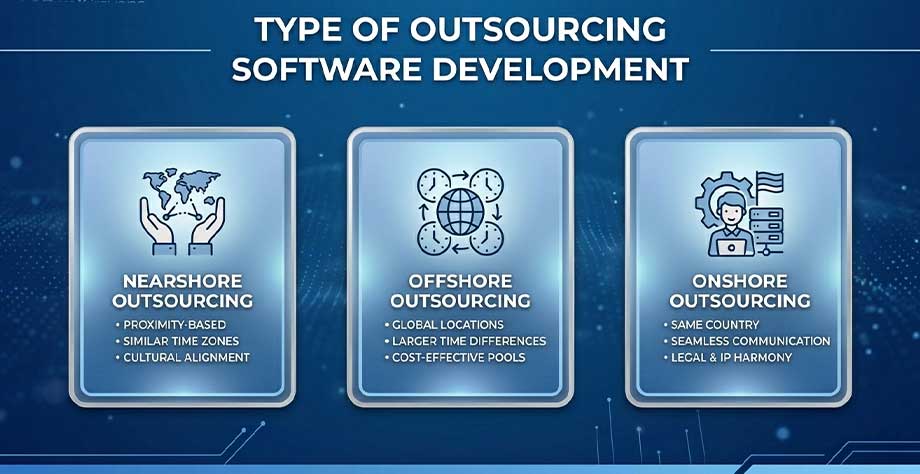
1. Nearshore Outsourcing
Nearshore outsourcing involves partnering with a development team located in a neighboring country or a region with a very similar time zone. For a company based in the USA, nearshore outsourcing typically means working with teams in Latin America (such as Mexico, Colombia, or Argentina). The Advantage: The primary benefit here is real-time collaboration. Because your working hours overlap significantly, you can conduct daily stand-up meetings, resolve immediate technical roadblocks, and maintain a highly integrated workflow. It offers a solid balance: lower costs than hiring locally, with far fewer communication friction points than offshoring.
2. Offshore Outsourcing
Offshore outsourcing is the most popular model for dramatic cost reduction. It involves collaborating with developers located in distant countries, often across different continents—such as India, the Philippines, or Eastern Europe. The Advantage: This model provides the most substantial cost savings and access to massive pools of technical talent. While the significant time zone differences (often 8 to 12 hours) require meticulous asynchronous communication and strong project management, it also enables a “follow-the-sun” workflow. Your internal team can pass work off at the end of the US business day, and the offshore team will develop overnight, presenting completed code by the next morning.
3. Onshore Outsourcing
Onshore outsourcing means partnering with an agency, consultancy, or specialized freelancer located within your own country. The Advantage: This is the most frictionless model available. There are virtually no cultural barriers, no language differences, and zero time zone issues. Communication is incredibly straightforward, and legal contracts are easier to enforce. However, because you are pulling from the same expensive domestic talent pool, onshore outsourcing is by far the most expensive option and does not provide the financial leverage associated with nearshore or offshore models.
A Step-by-Step Blueprint for Outsourcing Website Development Services
Diving into an outsourcing partnership without a structured plan is a recipe for scope creep and blown budgets. To ensure a smooth, profitable, and stress-free engagement, follow this rigorous step-by-step process.
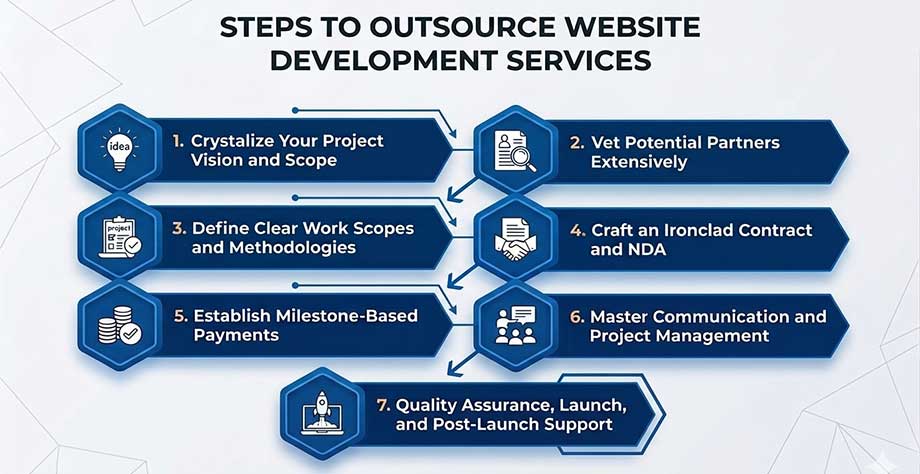
Step 1: Crystalize Your Project Vision and Scope
Before you even begin searching for an external partner, you must clearly define what you are trying to build. Are you looking to design and build a complex e-commerce platform from the ground up? Do you need to modernize a legacy application? Or are you simply seeking ongoing maintenance for an existing WordPress site? Document your core objectives, required features, preferred technology stack, and business goals. A vague project description will yield wildly inaccurate estimates and misaligned expectations.
Step 2: Vet Potential Partners Extensively
Once your internal requirements are locked in, begin the search for the right provider. Do not rush this phase. You should look for development agencies that possess deep, proven experience in your specific industry. Scrutinize their public portfolios, read verified client testimonials on third-party B2B review platforms, and request detailed case studies. Most importantly, conduct technical interviews with the actual developers who will be assigned to your project, not just the sales representatives.
Step 3: Define Clear Work Scopes and Methodologies
When you select a partner, collaborate with them to build an airtight Statement of Work (SOW). This document must specify every single deliverable, the precise technologies to be used, testing protocols, and the criteria for project success. Furthermore, establish the project management methodology from day one. Agile and Scrum frameworks are highly recommended for outsourced web development because they break the project down into manageable, two-week sprints, allowing for continuous feedback and course correction.
Step 4: Craft an Ironclad Contract and NDA
Protecting your intellectual property is paramount. Ensure that an enforceable Non-Disclosure Agreement (NDA) is signed before sharing any proprietary business logic or source code. Your master services agreement must explicitly state that your company retains 100% ownership of all custom code, design assets, and data produced during the engagement. The contract should also outline dispute resolution protocols and exit strategies if the partnership needs to be terminated early.
Step 5: Establish Milestone-Based Payments
Never pay for a massive web development project entirely upfront. Instead, structure your financial agreement around concrete, verifiable milestones. For example, you might release a percentage of funds upon completion of the UI/UX wireframes, another tranche after the backend database architecture is finalized, and a final payment only after rigorous quality assurance testing and the successful public launch of the website. This keeps the outsourced team financially motivated to deliver high-quality work on time.
Step 6: Master Communication and Project Management
The number one reason outsourcing relationships fail is poor communication. To prevent this, establish a clear hierarchy of communication tools immediately. Use Slack or Microsoft Teams for rapid, day-to-day chat. Rely on Jira, Asana, or Trello for meticulous task tracking and sprint planning. Use Zoom or Google Meet for weekly progress reviews. Appoint a dedicated internal product owner whose sole responsibility is to answer the outsourced team’s questions promptly, ensuring developers are never blocked waiting for client feedback.
Step 7: Quality Assurance, Launch, and Post-Launch Support
A website is never truly “finished.” As your outsourced team approaches the end of the build, mandate rigorous Quality Assurance (QA) testing. This must include automated code testing, manual user acceptance testing across various devices and browsers, and rigorous security audits. Once the project launches, transition into a predefined maintenance agreement. You will need ongoing support to handle routine software updates, patch security vulnerabilities, and implement user-requested feature enhancements.
Cost Analysis: How Much Does Outsourcing Web Development Really Cost?
The cost of outsourcing website development varies drastically based on the geographic location of the team, the complexity of the project, and the seniority of the developers required. Here is a realistic look at average hourly rates in 2026:
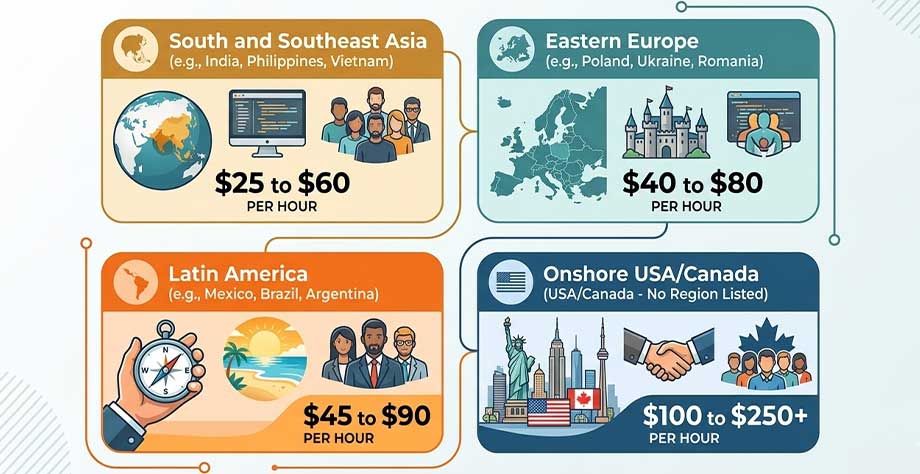
- South and Southeast Asia (e.g., India, Philippines, Vietnam): $25 to $60 per hour. This region remains the global powerhouse for volume and affordability, offering massive talent pools heavily focused on modern JavaScript frameworks and mobile development.
- Eastern Europe (e.g., Poland, Ukraine, Romania): $40 to $80 per hour. Renowned for their rigorous technical education, developers here often excel in complex backend architecture, cybersecurity, and advanced data engineering.
- Latin America (e.g., Mexico, Brazil, Argentina): $45 to $90 per hour. LATAM rates have risen slightly due to the massive demand from US companies seeking nearshore, same-time-zone collaboration, but they still represent a major saving over local US talent.
- Onshore USA/Canada: $100 to $250+ per hour. Premium pricing for premium proximity.
Beware of Hidden Costs: When calculating your total project budget, do not just multiply the hourly rate by estimated hours. You must factor in project management overhead, software licensing fees, cloud hosting infrastructure (AWS, Google Cloud), and third-party API costs. A prudent strategy is to add a 15% to 20% contingency buffer to your budget to handle unforeseen technical challenges or vital scope additions.
Costly Mistakes to Avoid When Outsourcing
Even with a perfect plan, pitfalls exist. Be incredibly cautious to avoid these common outsourcing traps:
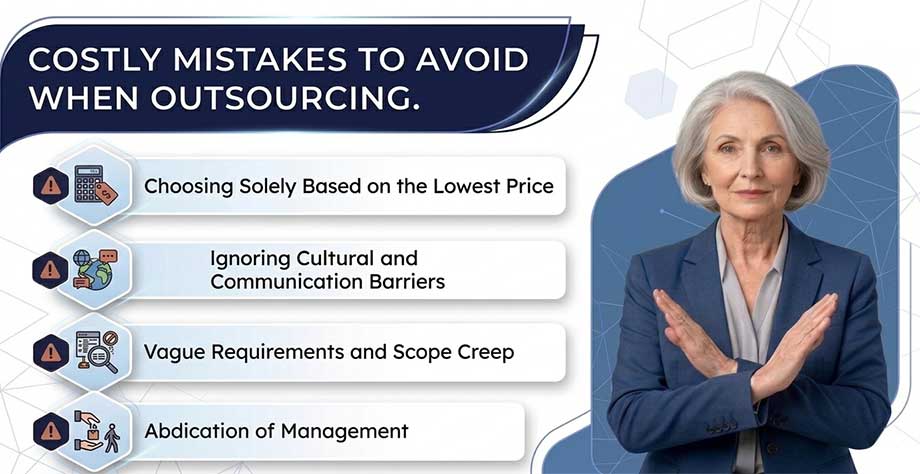
Choosing Solely Based on the Lowest Price: The cheapest hourly rate usually ends up being the most expensive option in the long run. Bargain-basement developers often produce fragile, undocumented “spaghetti code” that is incredibly difficult to maintain. You will eventually have to hire a more expensive agency to completely rebuild the product. Always optimize for value, proven experience, and code quality, not just the lowest bid.
Ignoring Cultural and Communication Barriers: Technical skills are only half the equation. If an outsourced team struggles with spoken English or comes from a business culture that avoids asking clarifying questions, minor misunderstandings will quickly snowball into major structural errors. During your vetting process, evaluate their communication clarity just as harshly as their coding tests.
Vague Requirements and Scope Creep: If you tell an agency, “Build me a platform like Airbnb,” without providing granular feature documentation, the project will fail. Without a rigid, highly detailed scope of work, project features will continuously inflate (scope creep), destroying your budget and delaying your launch indefinitely.
Abdication of Management: Outsourcing is delegation, not abdication. You cannot simply hand over a requirements document and expect a perfect product three months later. Successful outsourcing requires active, daily involvement from your internal stakeholders to review progress, provide feedback on early iterations, and keep the team deeply aligned with your core business objectives.
Conclusion & Next Steps
Outsourcing web development in 2026 is one of the most powerful strategies available to scale your digital presence, reduce operational overhead, and access the exact technical expertise your business requires. By carefully selecting the right engagement model, meticulously defining your project scope, and fostering a culture of transparent communication, you can turn a remote group of developers into an indispensable extension of your own company.
Do not let limited internal resources stall your digital growth. With the right partner, you can execute your product roadmap flawlessly and focus your internal energy on what matters most: growing your business, securing new clients, and driving revenue.
Ready to Build Something Extraordinary?
Stop delaying your product launch due to talent shortages. Hire our pre-vetted web development team at XCEEDBD and start scaling your digital infrastructure today with zero recruitment delays. Let’s build your future.
Frequently Asked Questions (FAQs)
1. How do I protect my intellectual property when outsourcing web development? Always require the agency or freelancers to sign a comprehensive Non-Disclosure Agreement (NDA) before sharing sensitive information. Additionally, ensure your master services contract explicitly states that your company legally retains full ownership of all custom source code, designs, and database assets upon payment.
2. Is staff augmentation better than a dedicated project team? It depends entirely on your needs. Staff augmentation is ideal if you already have an internal tech lead and just need extra hands (like an extra frontend developer) to speed up a sprint. A dedicated project team is better if you want to hand off the entire project—from design to deployment—to an external agency managed by their own project manager.
3. What happens if I am not satisfied with the outsourced team’s work? This is why milestone-based payments and Agile methodologies are crucial. By reviewing work in two-week sprints, you can identify quality issues immediately. If the work does not meet the standards outlined in your contract, you can pause development, demand revisions, or, in worst-case scenarios, terminate the contract before spending your entire budget.
4. Can an outsourced team maintain my website after it launches? Absolutely. Most reputable web development agencies offer ongoing support and maintenance retainers. This ensures your site remains secure, software dependencies are updated regularly, and you have developers on call to handle urgent bug fixes or build out new features as your user base grows.
5. How much time will my internal team need to dedicate to managing the outsourced project? Even with a fully autonomous external team, your company needs to assign an internal Product Owner. This person should expect to spend 3 to 5 hours per week reviewing milestone deliverables, answering technical or business logic questions, and ensuring the final product aligns perfectly with the initial company vision.