
Choosing a software development partner can speed up your roadmap—or quietly drain months of time and budget.
You’re not just buying code. You’re bringing in a team that will influence product quality, security, customer experience, and your ability to ship on schedule.
If you’re struggling with missed deadlines, limited in-house capacity, or hard technical problems, partnering with a software development company can be the solution. The hard part is picking a vendor that fits your goals, works transparently, and keeps quality high.
This guide walks through the key considerations for hiring a software development company, with practical questions, templates, and a simple scorecard you can use to shortlist candidates.
“Great things in business are never done by one person. They’re done by a team of people.” — Steve Jobs
Quick prep: define what “success” means (before you talk to vendors)
Most vendor selection problems start with unclear goals. Spend 30 minutes aligning internally on these basics:
1) Outcome and success metrics
Write one sentence that completes: “This project will be successful if…”
Examples:
- “Customers can place orders end-to-end without support tickets.”
- “Internal teams can reduce manual data entry.”
- “We can launch in a new region with fewer operational steps.”
2) Scope for the first release
Be explicit about what’s in/out for version 1:
- Must-have features
- Nice-to-have features
- Integrations (payments, CRM, ERP, analytics)
- Platforms (web, iOS, Android)
- Non-functional requirements (performance, uptime targets, accessibility)
3) Constraints and risk
List anything that will shape delivery:
- Budget and timeline
- Compliance obligations (e.g., HIPAA, GDPR)
- Security expectations
- Legacy systems or data migrations
- Stakeholders who must approve releases
Having this written down helps you compare vendors on the same playing field—and it makes overpromises easier to spot.
Company background and experience
When considering a software development company, start with their background and delivery history. Years in business matter, but relevance and consistency matter more.
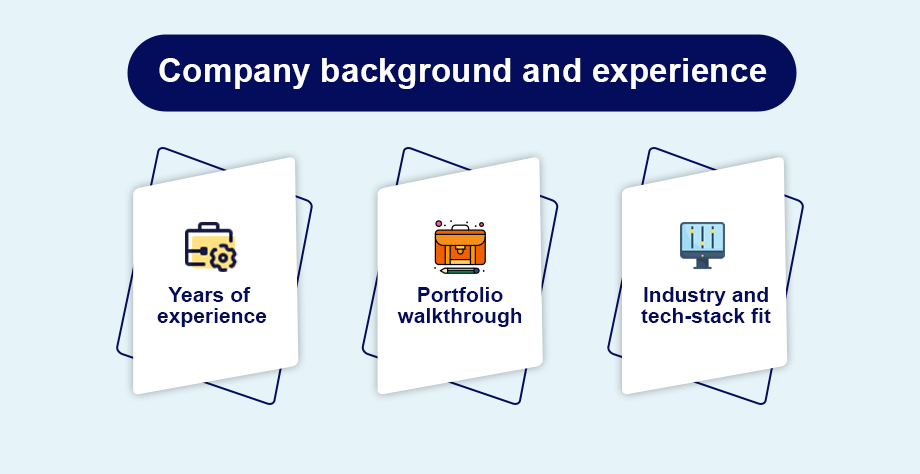
Years of experience (and how to judge it)
Ask:
- How long have you been delivering client software projects?
- What’s your typical team size per project?
- What’s the longest client relationship you’ve maintained?
Then look for evidence:
- Repeat clients (a signal of trust)
- Stable delivery teams (less turnover)
- Clear explanations of lessons learned
A company with fewer years but deep experience in your product type can be a better fit than a generalist with a long timeline.
Portfolio walkthrough: what to look for
A portfolio should show more than screenshots. Request a walkthrough of 1–2 relevant projects and evaluate:
Product polish
- Does the UI feel coherent and usable?
- Are flows clear, or are there obvious UX gaps?
Engineering fundamentals
- How did they handle performance or scaling?
- What did they do for observability (logging/monitoring)?
- What testing and release process was used?
Breadth vs. depth
- A diverse portfolio can signal adaptability.
- Deep experience in a niche can signal faster delivery and fewer mistakes.
If the vendor can’t explain why certain decisions were made, that’s a warning sign.
Industry and tech-stack fit
You don’t need a vendor who “does everything.” You need one that can deliver in your environment:
- Relevant programming languages and frameworks
- Cloud and infrastructure preferences
- Experience with similar business workflows
- Understanding of compliance or audit requirements (when applicable)
Strong partners explain tradeoffs and recommend a stack that fits your business goals—not a one-size-fits-all template.
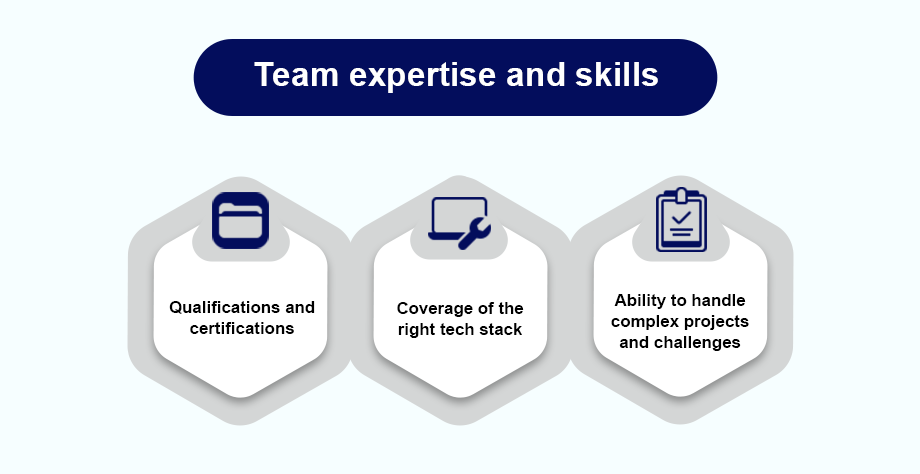
Team expertise and skills
Your real risk isn’t the vendor’s brand. It’s whether the actual team assigned to your project can build and maintain what you need.
Who will be on your team?
Ask for a proposed team plan that includes:
- Roles (PM, BA, designer, QA, DevOps, backend, frontend, mobile)
- Seniority levels (who leads architecture decisions?)
- Estimated allocation (full-time vs. part-time)
- Backup coverage (what happens if someone leaves?)
If the vendor won’t confirm a team structure until “later,” push back. You’re hiring people, not a promise.
Qualifications and certifications (signals, not guarantees)
Certifications aren’t everything, but they can indicate structured learning. Depending on your stack and delivery model, you may see:
- Microsoft Certified Professional (MCP)
- Certified Scrum Master (CSM)
- AWS Certified Solutions Architect
Also ask:
- What ongoing training do developers complete?
- Do senior engineers review critical code paths?
- How are standards documented and enforced?
Coverage of the right tech stack
Confirm the team can cover what you need now and support what you’ll need next.
Common areas to validate:
- Core languages (e.g., Java, Python, JavaScript, C#)
- Frameworks (e.g., React, Angular, Django, Spring Boot)
- Databases and data modeling
- Cloud and DevOps practices
- Security practices and testing depth
Tip: Ask each vendor to map your requirements to their skills. A clear mapping shows preparedness; vague answers signal risk.
Ability to handle complex projects and challenges
Complexity usually shows up as scale, integrations, performance, or ambiguous requirements. Explore:
- Examples of large or technically challenging projects
- How the team debugs production issues
- How they communicate risk early
- How they handle shifting priorities without chaos
A great team doesn’t hide uncertainty—they surface it, quantify it, and propose options.
Development process and methodologies
A process isn’t a document. It’s how work is planned, executed, tested, and released—with you kept in the loop.
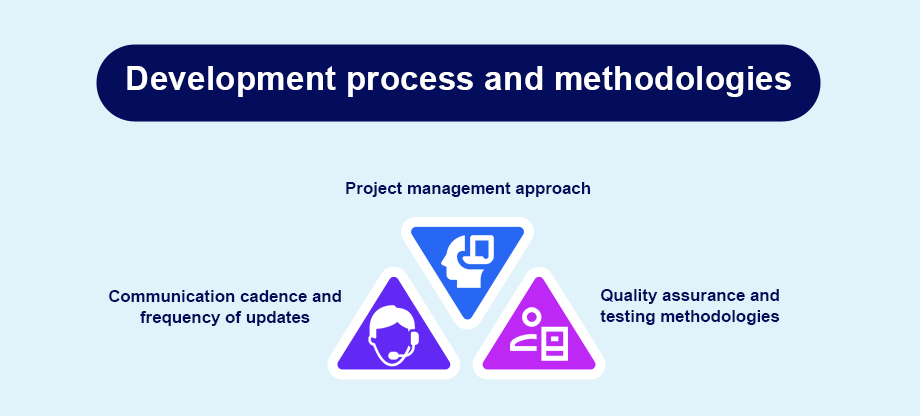
Project management approach (Agile, Scrum, Kanban)
Many teams use Agile methods like Scrum (sprints) or Kanban (continuous flow). Instead of asking “Are you Agile?”, ask:
- How do you plan a sprint or delivery cycle?
- How do you prioritize the backlog with the client?
- How do you handle scope change requests?
- How do you define “done”?
Healthy signals
- The vendor can describe their rituals (planning, demos, retrospectives)
- You get visibility into the backlog and priorities
- The team tracks progress against clear acceptance criteria
Communication cadence and frequency of updates
Strong communication prevents surprises. Clarify:
- Who is your day-to-day contact?
- How often are updates provided (daily async, weekly call)?
- What does a status update include (progress, blockers, next steps)?
- How are decisions documented?
Mini template: weekly status update
- What shipped this week
- What’s in progress
- Risks/blockers (and what’s needed from you)
- Next week’s plan
- Budget/time burn vs. plan (if relevant)
Quality assurance and testing methodologies
Quality is a habit throughout the project, not a phase at the end. Look for:
- Unit, integration, and acceptance testing
- Regression testing for critical flows
- Automation where it meaningfully reduces risk
- A clear definition of “release-ready”
Also ask:
- What test coverage is expected for core modules?
- Who writes tests—developers, QA, or both?
- How are defects triaged and prioritized?
CI/CD and release discipline
Continuous Integration / Continuous Deployment (CI/CD) can speed up delivery and reduce defects when implemented well. Ask about:
- Automated builds and test runs on pull requests
- Deployment environments (dev, staging, production)
- Release approvals and rollback plans
- Feature flags for safer releases
Even if you don’t need frequent production deployments, the practices behind CI/CD improve reliability.
Client references, testimonials, and proof
Case studies and testimonials are useful—if they include details. But the strongest validation comes from speaking with real past clients.
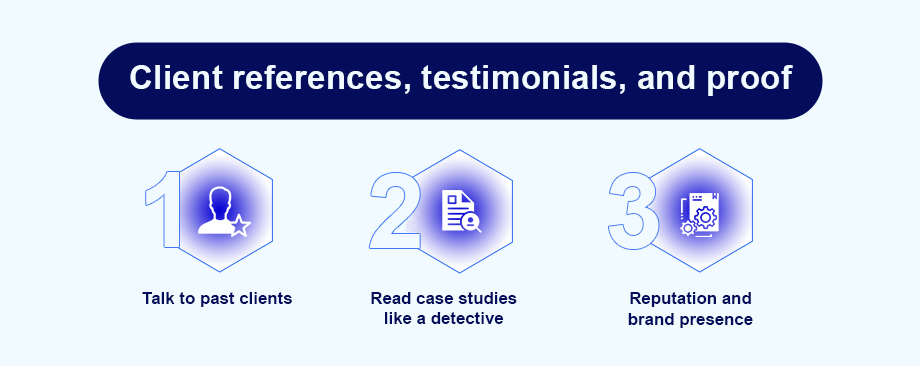
Talk to past clients (what to ask)
Ask the vendor for references and then ask clients:
- Did the team meet milestones and communicate well?
- How did they handle change requests or shifting priorities?
- What went wrong, and how did they respond?
- Would you hire them again?
If references feel overly curated, request one client from a similar industry or project scope.
Read case studies like a detective
In testimonials/case studies, look for:
- The problem and constraints
- The solution and technical approach
- The delivery model and timeline
- What was delivered (and what wasn’t)
- How post-launch support worked
If everything reads like a generic marketing story, ask for specifics.
Reputation and brand presence
Use third-party review sites (e.g., Clutch, GoodFirms) and community presence to validate credibility. Look for patterns:
- Consistent praise for communication and delivery
- Clear examples of problem-solving
- Mature responses to critical feedback
One bad review isn’t always a dealbreaker. A pattern is.
Cost, budget, and ROI
Price matters—but “cheap” becomes expensive if it creates rework, delays, or quality problems.
Demand transparent pricing
Ask for a pricing structure with a clear breakdown:
- Discovery / planning
- UX/UI design
- Development
- QA and test automation
- DevOps / deployment setup
- Support and maintenance
A transparent breakdown helps you compare proposals fairly and prevents surprise “add-ons.”
Common engagement and pricing models
Most software development outsourcing companies offer some version of these:
Fixed price
- Best when scope is very clear
- Predictable budget
- Risk: change requests can create friction
Time and materials (T&M)
- Flexible scope, pay for actual effort
- Best for evolving products and iterative delivery
- Requires clear governance and reporting
Dedicated team
- You “rent” a stable team that works as an extension of your staff
- Great for ongoing roadmaps
- Requires strong leadership and backlog ownership on your side
Ask each vendor which model they recommend for your project and why.
Evaluate value, not just rates
A vendor that ships faster with fewer defects can reduce long-term costs through:
- Better architecture decisions
- Stronger testing discipline
- More predictable releases
- Less post-launch firefighting
A practical question: “If we double the user base, what breaks first?” The answer reveals whether the team thinks ahead.
Contracts, ownership, and change control
A proposal can look great and still lead to pain if the contract is unclear. You don’t need legal jargon—you need clear expectations.
Scope of work (SOW) essentials
A strong SOW usually defines:
- Deliverables (features, platforms, integrations)
- Timeline and milestones
- Acceptance criteria (how work is approved)
- What’s included vs. out of scope
- Assumptions (data availability, third-party access, stakeholders)
Mini template: acceptance criteria
For each feature, define:
- User story (“As a…, I want…, so that…”)
- Happy-path behavior
- Edge cases and error states
- Performance expectations (if relevant)
- Analytics or logging needs (if required)
IP ownership and access
Confirm in writing:
- Who owns the source code and related assets
- Where the code lives (your repo vs. vendor repo)
- Access to build pipelines and environments
- What happens if you end the engagement
Change requests (how scope changes without drama)
Scope changes happen. The question is whether your process handles them cleanly:
- How are changes requested and estimated?
- Who approves them?
- How do changes affect timeline and budget?
- How do you track decisions so nothing is disputed later?
Clear change control protects both sides and keeps the relationship healthy.
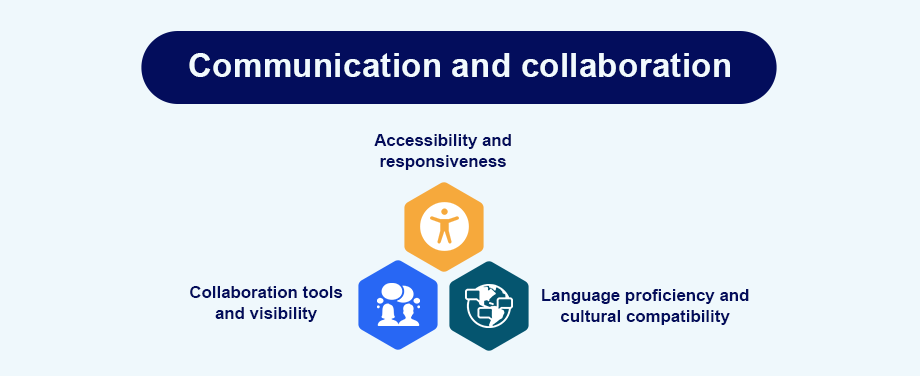
Communication and collaboration
Great communication turns outsourcing into a partnership. Poor communication turns it into constant rework.
Define ownership (so nothing falls through the cracks)
Many projects stall because nobody knows who decides what. Before kickoff, agree on:
- Product owner: prioritizes the backlog and approves tradeoffs
- Project manager / delivery lead: runs ceremonies, removes blockers, keeps scope realistic
- Tech lead / architect: owns technical decisions and reviews critical changes
- QA lead: owns test strategy and release readiness
If a vendor can’t name these roles (even if one person wears multiple hats), you’ll feel it later.
Accessibility and responsiveness
Clarify expectations up front:
- Expected response time (same day, 24 hours, etc.)
- Escalation path for blockers
- Support during critical release windows
- Who covers vacations and outages
If time zones differ, confirm overlap hours for real-time decision-making.
Collaboration tools and visibility
Collaboration platforms keep work transparent. Ask:
- What tools do you use for tickets and roadmaps?
- Can we access the project board?
- How do you manage documentation?
- Do tools integrate with our existing workflow?
You should be able to see progress, priorities, and risks without chasing updates.
Language proficiency and cultural compatibility
Language and working norms reduce friction. Explore:
- How meetings are facilitated
- The quality of written updates and technical documentation
- How feedback is received and actioned
- How disagreements are resolved
Cultural compatibility isn’t about “being the same.” It’s about being able to work smoothly under pressure.
Security and confidentiality
If you’re sharing customer data, proprietary IP, or regulated information, security must be non-negotiable.
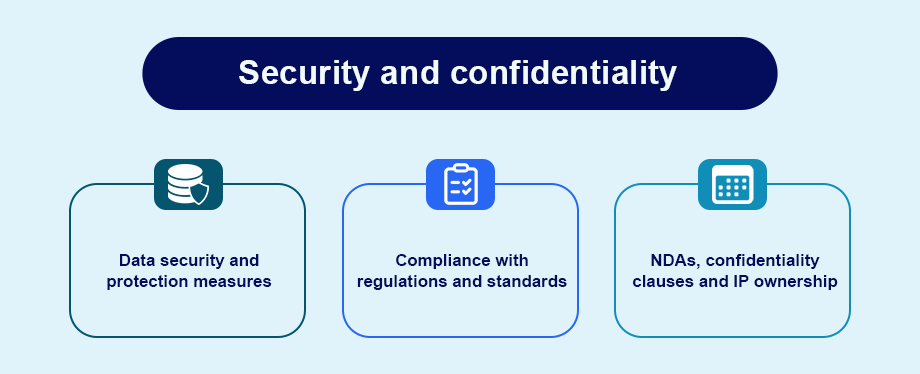
Data security and protection measures
Look for basic controls done consistently:
- Encryption in transit and at rest
- Role-based access control
- Secure credential management
- Regular security reviews/audits
- Backup and recovery procedures
Also ask:
- Who has access to production data (if anyone)?
- How are secrets stored and rotated?
- What happens during incident response?
Compliance with regulations and standards
Depending on your business, ask about readiness for:
- GDPR (for EU data subjects)
- HIPAA (U.S. healthcare)
- ISO 27001 or similar security standards
Good partners clarify shared responsibility: what they handle, what you must handle, and what must be documented. For regulated work, involve your legal/compliance team early so requirements are captured before build.
NDAs, confidentiality clauses, and IP ownership
Contracts protect your business. Ensure clarity on:
- Non-disclosure agreements (NDAs)
- Confidentiality obligations
- IP ownership and licensing
- Subcontractor usage
- Data handling and retention policies
- Handover and exit terms (so you’re not locked in)
If a vendor is vague or defensive about these, treat it as a serious red flag.
Post-launch support and long-term maintenance
A reliable launch is great. Sustainable software is better. Many teams forget to evaluate what happens after the first release.
Maintenance options to clarify
Ask what support looks like in each scenario:
- Bug fixes: How quickly are issues triaged and patched?
- Minor enhancements: Can you ship iterative improvements without renegotiating the contract?
- Security updates: How are dependencies monitored and updated?
- Performance tuning: Who investigates slowdowns or scaling limits?
SLAs and response expectations
If your software supports revenue or operations, discuss service levels in plain language:
- What counts as a “critical” issue?
- Target response time vs. target resolution time
- Support coverage (business hours vs. 24/7 for emergencies)
- Escalation path and who is on-call
Even a simple SLA outline reduces confusion during high-pressure incidents.
Documentation and handover (avoid vendor lock-in)
Good partners document as they build. Confirm expectations for:
- Architecture overview and key decisions
- Setup instructions for local/dev environments
- API documentation and integration notes
- Runbooks for deployments and incident response
- Ownership of repos, cloud accounts, and third-party tools
Mini template: handover checklist
- Source code access (repos + permissions)
- CI/CD pipelines (credentials rotated, ownership transferred)
- Environments (dev/staging/prod) documented
- Secrets management documented
- Monitoring dashboards shared
- Open issues and roadmap backlog handed over
If a vendor resists this level of transparency, treat it as a risk—especially if you may switch partners later.
Location and time zone considerations
Location affects collaboration more than most teams expect.
Proximity and on-site options
Even in remote-first projects, occasional workshops can help:
- Align on requirements
- Run discovery sessions
- Review key milestones and demos
If you expect on-site visits, confirm availability and costs up front.
Time zone compatibility
Some teams prefer nearshore for daily overlap. Others use time zone differences for “follow-the-sun” progress. Either can work if you define:
- Overlap hours for real-time decisions
- Handoff rules (what must be documented)
- Who owns decisions when you’re offline
A practical baseline: 2–4 hours of overlap often keeps projects moving.
Feedback, reviews, and red flags
Reviews matter, but context matters more.
How to interpret reviews responsibly
Look for consistency in:
- Communication quality
- On-time delivery
- Post-launch support
- Technical competence
Be cautious with reviews that are extremely vague or unrealistically glowing. Detailed feedback is more trustworthy.
Common red flags when outsourcing development
- Proposals that skip discovery and jump straight to building
- No clear testing plan (“we’ll test at the end”)
- Unclear ownership of IP or code repositories
- Limited visibility into progress (no shared backlog)
- Inconsistent communication during the sales process
- Refusal to share references or explain past work
How to run a smart selection process (without wasting weeks)
A structured process protects your time and reduces the chance of choosing the wrong partner.
Step 1: Shortlist 3–5 vendors
Use initial filters:
- Relevant portfolio
- Clear service offering (web, mobile, custom software, etc.)
- Comfortable with your time zone/cadence
Step 2: Send a lightweight requirements brief
You don’t need a 40-page document. A 1–2 page brief is enough:
- What you’re building and why
- Key users and key workflows
- Must-have features
- Integrations
- Constraints (timeline, budget range, compliance)
Mini template: the email you send vendors
Subject: Request for proposal — [Project name] (timeline + budget range)
Hi [Name],
We’re evaluating development partners for [one-sentence description of product]. We’d like a proposal covering:
- Your recommended delivery model (fixed price / T&M / dedicated team) and why
- Proposed team roles and estimated allocation
- High-level timeline with milestones
- Assumptions and risks you see
- A cost breakdown (discovery, build, QA, release, post-launch support)
Context:
- Target users: [who uses it]
- Must-have workflows: [3–5 bullets]
- Integrations: [list]
- Constraints: [timeline, compliance, hosting, etc.]
If helpful, we can schedule a 30–45 minute call to answer questions.
Thanks,
[Your name]
Vendor interview questions that reveal maturity
Use these to move past surface-level promises:
Product and delivery
- What would you push back on in our scope—and why?
- What would you cut first if the timeline gets tight?
- What does your “definition of done” include?
Engineering
- How do you handle code reviews (who reviews, what’s required)?
- How do you manage branching and releases?
- How do you prevent regressions in critical user flows?
Risk and transparency
- Tell us about a project that went off-track. What happened, and what did you change?
- What metrics do you track during delivery (velocity, defect trends, release frequency)?
Security
- How do you manage secrets and access to environments?
- What’s your process for dependency updates and vulnerability response?
A strong vendor answers clearly, without getting defensive, and can describe specific practices—not just principles.
Step 3: Run a discovery call with structured questions
Use the same questions with each vendor. For example:
- What assumptions are you making based on the brief?
- What risks do you see?
- What would you do first in the first two weeks?
- What deliverables do we get during discovery?
Step 4: Ask for a sample plan
Request a simple plan that includes:
- Milestones and timeline
- Proposed team and roles
- Communication cadence
- QA approach
- Pricing model and cost assumptions
Step 5: Validate with references and reviews
Before signing, speak to at least one reference and cross-check patterns in public reviews.
Step 6: Start with a pilot (when appropriate)
If the project is high-stakes, a short pilot can reduce risk:
- Discovery workshop
- UX prototype
- A small feature slice through to release
Step 7: Confirm governance before kickoff
Agree on:
- Decision-making and approvals
- Definition of done
- Release process
- Reporting and billing
- How scope changes are handled
A simple vendor scorecard you can use
To compare vendors fairly, score each area from 1–5:
- Relevant experience (industry + similar products)
- Team capability (roles, seniority, certifications)
- Process (planning, QA, release discipline)
- Communication (cadence, tools, responsiveness)
- Security & compliance (controls, NDAs, standards)
- Cost transparency (breakdown, assumptions, model fit)
- Cultural/time-zone fit (overlap, collaboration style)
- Post-launch support (bug fix flow, maintenance options)
Total the scores and use your notes to break ties.
Final takeaways
The “best” software development company is the one that fits your product, your constraints, and your way of working—while being transparent about risks and tradeoffs.
If you’re evaluating offshore software development services and want a partner that focuses on communication, timely delivery, and cost-effective solutions tailored to your needs, XCEEDBD is one option to consider.
If you’re still deciding, start by scoring 2–3 vendors using the scorecard above, then run a short discovery/pilot with your top pick. You’ll learn more from a two-week collaboration than from any slide deck—and you’ll reduce the risk of committing to the wrong team.
Have a project in mind?
Contact XCEEDBD to discuss scope, timelines, and a realistic delivery plan.
FAQ
1) What should I ask a software development company before hiring?
Ask about relevant experience, team composition, process (Agile/Scrum/Kanban), testing, security practices, communication cadence, and references.
2) Is it better to hire an in-house team or outsource development?
It depends on your timeline, budget, and the skills you already have. Outsourcing can accelerate delivery when you need specialized expertise or added capacity.
3) How do I compare proposals from different vendors?
Compare scope assumptions, deliverables, timelines, QA approach, pricing breakdown, and what’s included after launch (support/maintenance).
4) What pricing models are common in software development outsourcing?
Common models include fixed-price, time-and-materials, and dedicated team engagement. Each has tradeoffs in predictability and flexibility.
5) How do I make sure code quality stays high?
Require a testing strategy, code reviews, CI/CD, and clear acceptance criteria. Ask how defects are tracked and prevented from recurring.
6) What security measures should a development partner have?
At minimum: encryption, access controls, regular audits, backups, and clear policies for data handling. For regulated projects, confirm compliance requirements early.
7) What time-zone overlap do I need?
Enough overlap to resolve blockers and make decisions quickly—often 2–4 hours per workday keeps projects moving.
8) What are the biggest red flags when outsourcing development?
Vague proposals, lack of references, weak testing practices, unclear IP ownership, and poor communication before you even sign.