The landscape of technology is shifting rapidly, and staying ahead in the digital game has never been more critical for modern enterprises. Industry analysts from Quixy report that the global digital transformation market is predicted to grow to a staggering $1,009.8 billion by the year 2025. As entire industries evolve at a breakneck pace, so does the demand for innovative software solutions that possess the capability to adapt and evolve post-deployment.
This continuous demand for adaptability has given rise to the exciting intersection of software deployment and AI, ultimately shaping the highly specialized field of Post-Deployment Software Evolution in Artificial Intelligence. Understanding this evolving landscape is crucial for businesses that want to thrive in an age characterized by ever-changing customer expectations, volatile market dynamics, and rapidly emerging technologies. This comprehensive guide explores the mechanics of continual learning—detailing exactly how software can evolve dynamically with AI even after it is officially launched into production. Let us examine how AI-driven solutions completely revolutionize post-deployment software evolution and why adopting this methodology is absolutely pivotal for success in the modern digital era.
The Hidden Gaps in Traditional Post-Deployment Processes
When discussing the lifecycle of software development, the journey definitively does not end once an application is deployed to production. Traditional post-deployment processes, while historically crucial, have consistently shown significant gaps that actively hinder software evolution and prevent rapid adaptation to dynamic, shifting user needs. These specific gaps stem directly from the inherent limitations of conventional methods when it comes to addressing emerging challenges. Here is a closer look at why traditional post-deployment processes frequently fall short in today’s environment:

- Limited Data Utilization: Traditional post-deployment processes rely heavily on historical data for scheduling routine maintenance and pushing updates. However, they struggle immensely to harness the full potential of real-time data insights, immediate user feedback, and constantly changing market trends.
- Reactive Issue Resolution: Conventional development methods tend to adopt a highly reactive approach, generally addressing bugs and system issues only as they visibly arise. This methodology leaves incredibly little room for proactively identifying and mitigating potential problems before they negatively impact the end-user experience.
- Time-Intensive Manual Efforts: The inherently manual nature of traditional update processes can be extremely time-consuming, making it exceptionally challenging for engineering teams to keep pace with rapidly changing user expectations and stringent industry standards.
- User-Centric Challenges: Truly understanding complex user behavior, shifting preferences, and overarching sentiment is absolutely essential for meaningful software evolution. Traditional processes may not effectively capture and thoroughly analyze qualitative user feedback and quantitative data to drive continuous improvements.
- Scalability Constraints: In an era where successful software scales rapidly across global markets, traditional processes may struggle significantly to accommodate rapid growth, ultimately leading to severe bottlenecks and operational inefficiencies.
How Artificial Intelligence Bridges the Post-Deployment Divide
There has almost always been a noticeable gap between the theoretical ideal of software and its actual real-world performance. Even the most meticulously designed and rigorously tested applications can face unexpected issues once deployed and once they start actively interacting with unpredictable users. This specific friction point is exactly where Artificial Intelligence steps in to transform the paradigm.

1. Adaptive Problem-Solving Advanced AI algorithms excel at complex, adaptive problem-solving. They continuously analyze live software performance, actively identifying hidden issues, architectural bottlenecks, and emerging user concerns. When a complex problem arises in production, AI can swiftly adapt, dynamically devise technical solutions, and even automatically implement minor fixes completely without human intervention.
2. Real-time Data Insights Modern AI architecture harnesses the immense power of real-time data. It constantly monitors user behavior patterns, feature preferences, and overarching system performance to provide invaluable, actionable insights. This continuous stream of information enables software applications to evolve with surgical precision, accurately addressing critical user needs exactly as they evolve in real-time.
3. User-Centric Enhancements An AI model’s unique ability to deeply understand complex user behavior and interpret nuanced feedback actively fosters user-centric enhancements. It dynamically tailors specific software features, intelligently recommends UX improvements, and optimizes user interfaces. The ultimate result is software that feels uniquely customized and highly personal to each individual user.
4. Agile Issue Resolution AI-driven post-deployment evolution is fundamentally agile, making the complex intersection of software deployment and AI both seamless and highly efficient. It detects underlying issues immediately as they arise, enabling a rapid, automated response. Critical bugs, security vulnerabilities, or infrastructure performance hiccups are proactively identified and resolved swiftly, directly ensuring uninterrupted service for the end-user.
5. Seamless Integration Sophisticated AI seamlessly integrates directly into your existing software environments and infrastructure. It actively learns from your specific software’s underlying architecture and complex data flows, ensuring its presence is continuously felt through optimizations without causing operational disruption.
6. Future-proofing Your Architecture Intelligent AI actually anticipates the future by identifying macro trends and emerging technologies, directly allowing your software to evolve in a strategic, forward-looking manner. This vital future-proofing mechanism definitively ensures the long-term relevance and competitive viability of your application.
Core Concepts: Understanding Continual Learning in AI
Continual learning, specifically within the complex realm of AI and modern software development, directly refers to the sophisticated capability of a system to continually learn and actively adapt to new, incoming data and novel experiences. Unlike traditional, legacy software that remains entirely static once officially deployed, continually learning software autonomously evolves and actively refines its own operations over time.
The Paradigm of Self-Improving Software
Imagine a dynamic software architecture that not only executes its explicitly designated tasks perfectly but also actively learns from absolutely each and every interaction, each distinct user’s input, and every single piece of new data it encounters. This revolutionary concept of self-improving software specifically aims to continuously enhance its core functionality, operational accuracy, and overall user-friendliness completely without requiring manual human intervention. It operates much like having a highly intelligent digital assistant who strictly follows your initial instructions but also continuously better understands and proactively fulfills your nuanced needs with each subsequent interaction.
Real-World Examples You Use Daily
To properly grasp the tangible real-world impact of continual learning frameworks, one should closely consider highly popular AI-driven services such as virtual assistants, complex recommendation systems, and advanced language translation applications. These ubiquitous applications are constantly, continually learning and dynamically adapting based entirely on ongoing user behavior and direct feedback:
- Virtual Assistants: Platforms like Siri, Alexa, and Google Assistant continually improve their baseline understanding of complex natural language, diverse regional accents, and specific user preferences, directly resulting in significantly more accurate responses and highly personalized daily interactions.
- Recommendation Systems: Massive streaming platforms like Netflix and Amazon utilize extensive continual learning models to accurately suggest movies, retail products, or relevant content that aligns perfectly with your historical preferences, actively making your user experience substantially more enjoyable and highly tailored.
- Language Translation Apps: Tools like Google Translate continually refine and update their underlying translation accuracy by actively analyzing crowdsourced user-provided corrections and contextual feedback.
Strategic Advantages for Post-Development Software Evolution
Continual Learning is definitely not a simplistic, one-size-fits-all concept; rather, it is a highly tailored, sophisticated strategy that businesses can actively employ to directly address specific operational challenges and unique market opportunities, particularly within the specialized realm of software deployment and AI. Here is exactly how implementing continual learning architecture can significantly benefit businesses throughout their ongoing journey of post-development software evolution:
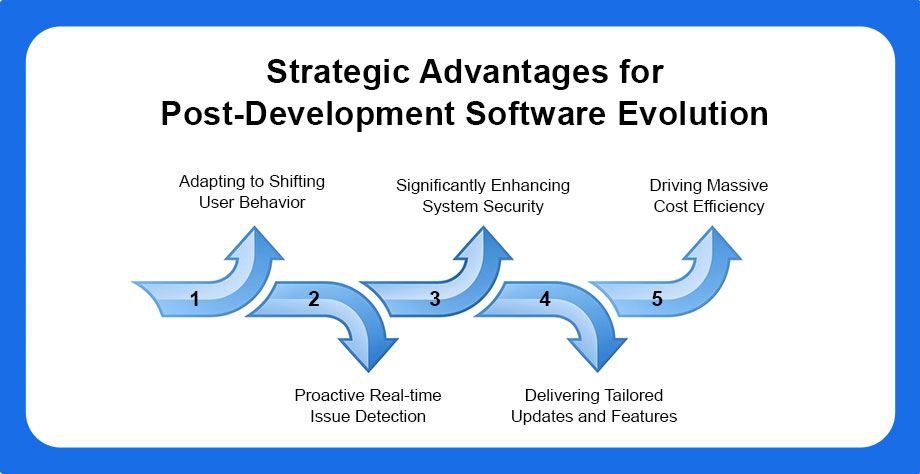
1. Adapting to Shifting User Behavior Advanced continual learning algorithms systematically analyze granular user behavior, changing preferences, and nuanced interactions with the software interface. By deeply understanding exactly how diverse users engage with the application, businesses can actively make highly informed, data-backed decisions to significantly enhance user experiences, intelligently streamline operational workflows, and accurately predict future user needs.
2. Proactive Real-time Issue Detection These sophisticated algorithms continuously and tirelessly monitor the entire software ecosystem for statistical anomalies, hidden bugs, and degrading performance issues. This highly proactive monitoring approach directly allows businesses to rapidly identify and immediately rectify critical issues swiftly, effectively minimizing costly downtime and preventing widespread user frustration.
3. Significantly Enhancing System Security Modern cyber threats are perpetually ever-present, and undiscovered software vulnerabilities can easily have severe, catastrophic financial and reputational consequences. Continual Learning frameworks can proactively bolster system security by preemptively identifying potential data breaches and actively learning from previous, historical cyber attacks. It directly helps engineering teams in dynamically reinforcing network defenses and remaining consistently one step ahead of sophisticated malicious actors.
4. Delivering Tailored Updates and Features Instead of pushing disruptive, blanket software updates to the entire user base, Continual Learning architecture actually enables businesses to deliver highly personalized updates and specific new features to distinct user segments. It directly ensures that all software enhancements align perfectly with specific user preferences and operational needs, ultimately leading to significantly higher feature adoption rates.
5. Driving Massive Cost Efficiency By proactively addressing underlying architectural issues and continuously optimizing overarching software performance, businesses can significantly and measurably reduce massive operational costs directly related to ongoing software maintenance and manual customer support.
Real-World Applications Across Key Industries
Continual learning and dynamic AI-driven post-deployment evolution are not merely theoretical academic concepts; they are highly transformative, practical methodologies currently applied across incredibly diverse enterprise domains. Below are several compelling, practical real-world applications where continuous software evolution powered by AI has already made a highly substantial, measurable impact:
1. Healthcare Innovation
- Disease Prediction and Prevention: Advanced AI-enhanced healthcare software systems continually learn from massive datasets of patient data, actively enabling the highly accurate, early prediction of severe diseases. For instance, sophisticated software can rapidly analyze historical medical records and proactively flag specific individuals who are currently at a significantly higher risk of developing diabetes, directly allowing for crucial, timely medical interventions.
- Accelerated Drug Discovery: Global pharmaceutical companies actively employ AI-driven software platforms to continuously evolve and optimize their complex drug discovery processes. Specialized machine learning models rigorously analyze millions of chemical compounds, accurately predict highly potential drug candidates, and continuously optimize molecular structures for vastly enhanced clinical effectiveness.
2. The eCommerce Sector
- Personalized Shopping Recommendations: Leading, global eCommerce platforms heavily employ sophisticated AI-powered recommendation engines that dynamically evolve with absolutely every single user click and completed purchase. These advanced systems deeply analyze real-time user behavior, historical preferences, and critical external factors such as seasonal trends to accurately suggest relevant products perfectly tailored to each individual shopper.
- Dynamic Pricing Models: Massive eCommerce giants utilize AI to dynamically and continuously adjust specific product prices based entirely on highly fluid, real-time market conditions, fluctuating consumer demand, and aggressive competitor pricing strategies. This highly continual learning approach directly ensures optimal competitive pricing and actively maximizes overarching corporate revenue.
3. Financial Services
- Advanced Fraud Detection: Major banks and global financial institutions actively employ sophisticated AI models to continuously evolve their critical fraud detection mechanisms. Highly advanced machine learning algorithms continuously learn directly from massive volumes of transaction data to rapidly identify highly anomalous behavioral patterns that are strongly indicative of organized fraudulent activities.
- High-Frequency Algorithmic Trading: Within the highly volatile stock market, sophisticated AI-powered trading algorithms continually adapt to rapidly shifting, real-time market conditions. These complex algorithms instantaneously analyze vast troves of historical data, real-time news sentiment, and macro market trends to make incredibly rapid, real-time trading decisions.
4. The Automotive Industry
- Autonomous Vehicles: Modern self-driving cars rely entirely on complex AI software architectures that actively evolve and improve with absolutely every single mile driven on the road. Deep continual learning definitively enables these advanced vehicles to continuously improve their real-time decision-making capabilities, vastly enhancing passenger safety and overall navigation accuracy.
- Predictive Maintenance Systems: Major automotive manufacturers extensively use sophisticated AI to accurately predict future maintenance needs for commercial and consumer vehicles. The underlying software continuously analyzes live sensor data to proactively identify hidden potential issues, directly allowing for highly proactive maintenance scheduling and significantly reducing unexpected, costly breakdowns.
5. Next-Generation Customer Service
- Intelligent Chatbots and Virtual Assistants: Highly AI-driven customer service chatbots and corporate virtual assistants continually learn and adapt from millions of ongoing customer interactions. They rapidly become significantly better at deeply understanding complex natural language nuances and actively resolving user queries far more efficiently over time.
- Real-Time Sentiment Analysis: Forward-thinking companies utilize advanced AI to continuously analyze qualitative customer feedback and real-time social media sentiment continually. By deeply understanding true customer sentiments, agile businesses can promptly and effectively adapt their overarching marketing strategies and directly address growing consumer concerns.
A Comprehensive Blueprint for Implementing Continual Learning
Continual learning, robustly powered by sophisticated AI, is decidedly not just a minor technological advancement; it is a fundamental, massive paradigm shift in exactly how modern software evolves post-deployment. To effectively harness the myriad benefits of continual learning, forward-thinking businesses absolutely need a highly strategic, well-planned approach that deeply integrates these core principles directly into their foundational software development processes. Here is exactly how your engineering team can systematically make it happen:
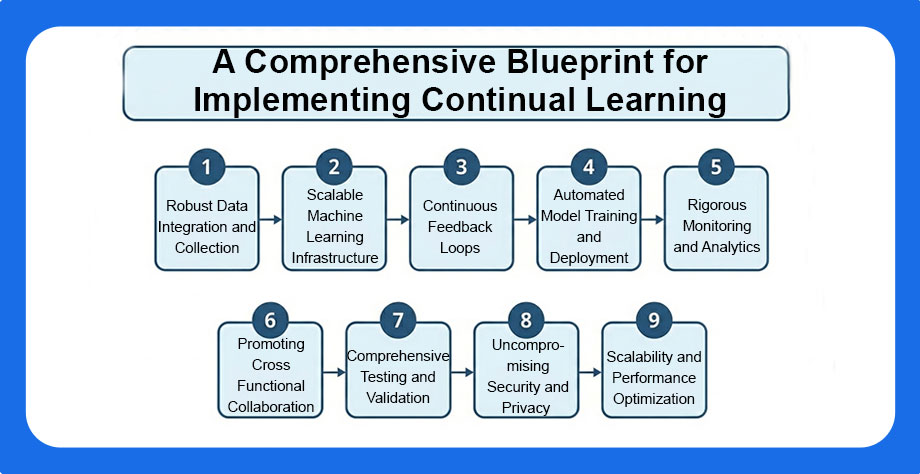
Step 1: Robust Data Integration and Collection You must first establish a highly robust, secure data collection framework deep within your software architecture. Ensure that this framework accurately and securely captures all relevant user interactions and nuanced behaviors. Furthermore, implement strict data cleaning and advanced preprocessing pipelines to consistently maintain high data quality.
Step 2: Scalable Machine Learning Infrastructure Expertly set up the absolutely necessary technical infrastructure required for efficiently training and seamlessly deploying complex machine learning models. Carefully choose the exactly right advanced tools and robust frameworks for optimal model development. Crucially, invest heavily in highly scalable cloud resources to effectively handle the massive computational demands inherently required by AI.
Step 3: Continuous Feedback Loops Systematically develop highly efficient mechanisms for continuously collecting qualitative user feedback and actionable data insights. Create closed feedback loops that directly and automatically connect raw user input straight to the internal software improvement process. Always prioritize implementing user feedback based entirely on its measurable impact on the overall user experience and core business goals.
Step 4: Automated Model Training and Deployment Your architecture must be designed to continually retrain core machine learning models utilizing fresh, incoming data streams. Implement a highly rigorous version control system specifically designed for tracking models and updating algorithms. Utilize advanced, fully automated deployment pipelines to safely push critical model updates seamlessly into production.
Step 5: Rigorous Monitoring and Analytics Actively employ sophisticated monitoring tools to strictly track overarching software performance and granular user interactions. Set up highly sensitive, automated alerts for detecting statistical anomalies and critical system issues that demand immediate engineering attention. Extensively leverage advanced data analytics platforms to derive highly actionable, strategic insights directly from raw user data.
Step 6: Promoting Cross-Functional Collaboration Actively foster deep, ongoing collaboration between distinct departments, specifically linking development, data science, and user experience teams. Strongly encourage highly open communication channels and continuous organizational knowledge sharing. Purposefully create an internal corporate culture focused heavily on continuous experimentation and rapid innovation.
Step 7: Comprehensive Testing and Validation Always implement highly rigorous, automated testing procedures required for evaluating new AI model deployments before they reach end-users. Utilize advanced A/B testing frameworks to accurately assess the statistical impact of all AI-driven architectural changes. Meticulously ensure that these new AI-driven updates absolutely do not inadvertently introduce novel bugs or system issues.
Step 8: Uncompromising Security and Privacy Absolutely prioritize strict data security and comprehensive user privacy protocols across all internal AI initiatives. Strictly comply with all relevant global data protection regulations and rigorous industry security standards. Regularly and thoroughly audit all deployed AI systems to proactively uncover and patch hidden vulnerabilities.
Step 9: Scalability and Performance Optimization Continuously and aggressively optimize your core AI algorithms for maximum computational efficiency. Strategically plan for massive system scalability specifically as your active user base continuously grows. Extensively use diagnostic AI to rapidly identify network bottlenecks and highlight specific architectural areas requiring immediate improvement.
Partnering with XCEEDBD for AI Integration
As you officially embark on the complex journey of successfully harnessing the vast potential of AI for dynamic post-deployment software evolution, carefully selecting the exactly right strategic partner for secure software deployment and deep AI integration becomes absolutely paramount to your success. XCEEDBD stands as a highly trusted, deeply experienced technology ally fully committed to actively driving your software’s ongoing evolution both efficiently and highly effectively. Here is exactly why you should strategically choose our top-tier software development services:
- Deep AI Expertise: Boasting a highly dedicated, specialized team of AI experts, we actively bring profound, in-depth technical knowledge and extensive hands-on experience in complex machine learning, advanced natural language processing, and various other cutting-edge AI-powered technologies directly to the table. Our sophisticated tech stack prominently includes Python, TensorFlow, PyTorch, and scikit-learn, directly ensuring we consistently employ the absolute best tools available for your specific project.
- Highly Customized Solutions: We deeply understand that absolutely no two distinct software applications are completely alike. Our highly tailored, bespoke AI solutions precisely cater to your specific organizational needs, thoroughly ensuring optimal, continuous post-deployment evolution. We expertly utilize a highly diverse, wide range of advanced tools and technical libraries depending entirely on your distinct requirements, guaranteeing complete customization at its absolute best.
- Actionable Data-Driven Insights: Extensively leveraging the raw power of big data, we consistently provide highly actionable, strategic insights meticulously derived from granular user behavior, core performance metrics, and deep feedback analysis to accurately guide ongoing software enhancements. Our robust, enterprise-grade data analytics tech stack comprehensively comprises BigQuery, Power BI, and Tableau, definitively ensuring comprehensive, highly data-driven corporate decisions.
- Seamless Architectural Integration: Our sophisticated AI-driven solutions are designed to seamlessly and securely integrate directly with your pre-existing software architecture, expertly minimizing operational disruption while aggressively maximizing technological benefits. We extensively use powerful enterprise integration tools such as MuleSoft, Apache Camel, and secure REST APIs to absolutely ensure remarkably smooth technical incorporation.
- Vigilant Continuous Monitoring: We expertly implement highly robust, automated monitoring systems that tirelessly monitor your overarching software’s system health, absolutely ensuring incredibly rapid issue detection and immediate technical resolution. Our comprehensive monitoring tech stack specifically includes Grafana, Prometheus, and the powerful ELK Stack, definitively ensuring real-time, granular insights directly into your software’s live performance.
- Massively Enhanced User Experiences: By continuously optimizing front-end user interfaces, deeply personalizing digital experiences, and significantly improving overarching back-end software performance, we constantly aim to consistently deliver truly unmatched, superior user satisfaction. Our modern, responsive user interface tech stack comprehensively encompasses React, Angular, and Vue.js, strictly guaranteeing an incredibly engaging and highly user-friendly interface.
In a nutshell, the vast, transformative potential of AI within the specific realm of post-deployment software evolution is truly limitless. With powerful AI technology and the deep expertise of XCEEDBD steadfastly by your side, your critical software can effortlessly keep up with market demands and actively thrive in competitive environments. By expertly harnessing the true power of AI, we effectively enable your core software to dynamically adapt, continuously learn, and continually enhance the fundamental user experience. The technological future definitively belongs to those forward-thinking organizations who actively embrace this continuous evolution.
Frequently Asked Questions (FAQs)
Q: What exactly is continual learning in the context of post-deployment software?
Continual learning is a specialized subset of artificial intelligence where a deployed software system continuously ingests new data, actively analyzes real-time user interactions, and autonomously updates its own underlying models. Instead of remaining static after launch, the software dynamically self-improves, optimizing its performance and features without requiring engineering teams to write and deploy new manual code updates.
Q: How does continual learning actually differ from standard machine learning?
Standard machine learning models are typically trained on a static, historical dataset in an isolated environment, deployed to production, and then remain completely unchanged until they are manually taken offline, retrained with new data, and redeployed. Continual learning, however, happens dynamically in a live production environment. The system processes incoming data streams and refines its algorithms in real-time, preventing the model degradation often seen in standard deployments.
Q: What are the primary security benefits of using AI for software evolution?
Because continual learning systems monitor network traffic and user behavior in real-time, they excel at anomaly detection. They can instantly recognize subtle deviations from normal operational patterns that might indicate a zero-day exploit or a coordinated cyber attack. By learning from these emerging threat vectors, the AI actively hardens the system’s defenses autonomously, significantly reducing the standard response time required to mitigate security breaches.
Q: Does implementing continual learning require a complete rebuild of my current software?
Not necessarily. Experienced implementation partners utilize robust APIs and integration frameworks (such as REST APIs, MuleSoft, or Apache Camel) to securely attach AI microservices to your existing legacy architecture. This modular approach allows you to inject continual learning capabilities into specific high-impact areas of your application—like recommendation engines or security monitoring—without disrupting the foundational codebase.
Q: How do we prevent AI models from learning bad habits or acting on corrupted user data?
This is precisely why Step 1 (Robust Data Integration) and Step 7 (Comprehensive Testing and Validation) of the implementation blueprint are absolutely critical. Engineering teams must implement strict data preprocessing pipelines to automatically filter out corrupted, biased, or malicious data before it ever reaches the training model. Additionally, utilizing rigorous A/B testing and setting strict algorithmic guardrails ensures the AI only evolves in ways that align with your core business objectives.
Q: Why is XCEEDBD’s specific technology stack ideal for continual learning?
XCEEDBD utilizes a highly scalable, enterprise-grade stack perfectly suited for AI. Tools like TensorFlow and PyTorch offer the deep learning frameworks required for complex pattern recognition. BigQuery and Tableau handle the massive data storage and visualization needs. Finally, the ELK Stack and Prometheus provide the necessary real-time observability to monitor exactly how the continually learning models are performing in live production environments.
Ready to Future-Proof Your Architecture?
So, why wait any longer to transform your technical infrastructure? Hire experienced software developers, completely unlock the full, untapped potential of your core software, and immediately set it on a definitive path of perpetual, automated improvement.
Are you ready to integrate continual learning AI into your deployment pipeline? Reach out to the AI architecture experts at XCEEDBD today to schedule a comprehensive technical consultation and discover exactly how our customized machine learning solutions can transform your software’s lifecycle.